South Korea's AI memory trade is unwinding as leveraged ETFs tracking Samsung and SK Hynix plunge up to 18%.
South Korea's AI memory trade is unwinding as leveraged ETFs tracking Samsung and SK Hynix plunge up to 18%.
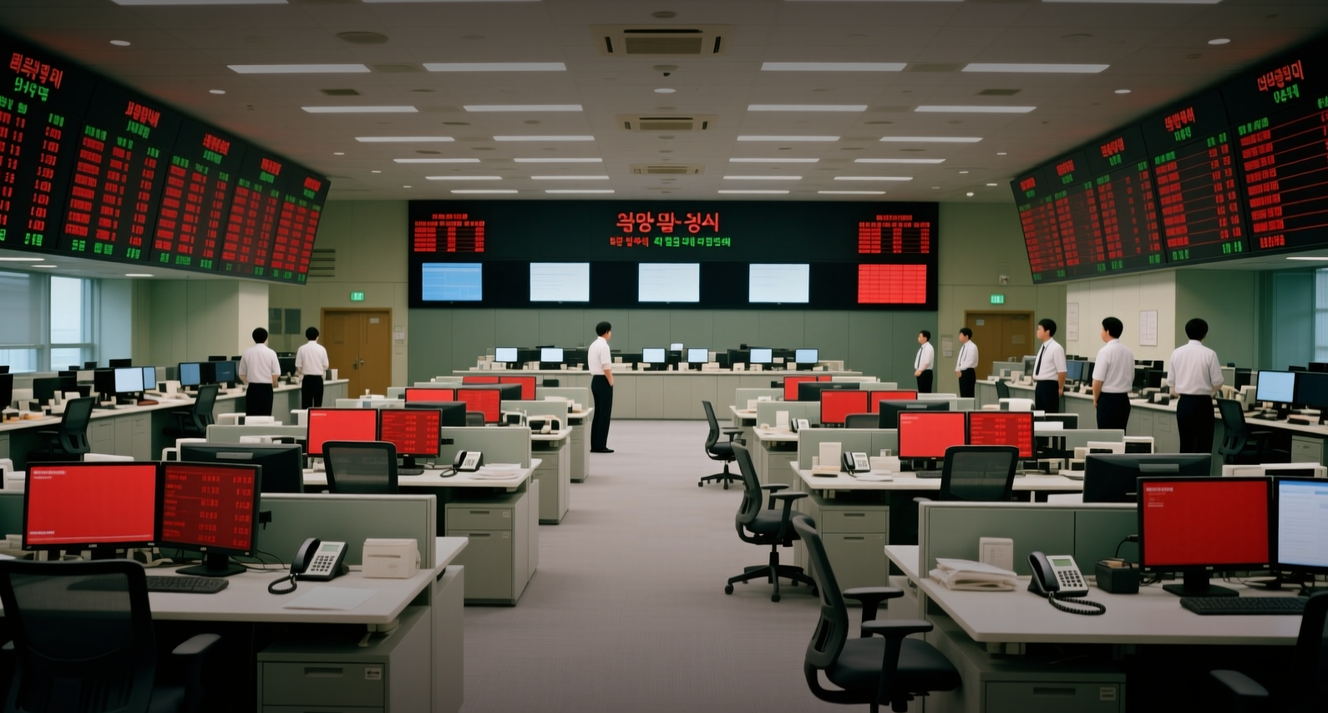
Leveraged ETFs tracking Samsung Electronics and SK Hynix plunged as much as 18% and 5% on Aug 24, extending a selloff that has pushed the Kospi 43% below its June peak.
"Heavy concentration in chip stocks is increasing market volatility," Koo Yun-cheol, South Korea's finance minister, said, as the government reviews market stabilization measures. Samsung Electronics and SK Hynix together account for roughly a third of the Kospi's market capitalization, making the index unusually sensitive to semiconductor sentiment.
The declines follow SK Hynix's second-quarter earnings that missed lofty AI-fueled estimates, triggering a cascade of selling across the memory chip complex. The company, which holds a 58% share of the global high-bandwidth memory (HBM) market per Counterpoint Research, reported a record 72% operating margin in the first quarter on revenue of 52.58 trillion won, up 198% year over year. Its stock surged more than 300% in 2026 and over 800% in the past year before the correction began.
The selloff arrives as SK Hynix completes its US listing on Nasdaq under the ticker SKHY, a move designed to re-rate the company against global AI semiconductor peers. The company's forward price-to-earnings ratio of roughly 8x remains well below US semiconductor peers, which is why CLSA reiterated its "High Conviction Outperform" rating and Daiwa Securities raised its target price to 3.6 million won with a "Buy" rating.
HBM4 qualification reshapes the memory race
Samsung Electronics took the lead in mass-producing HBM4 in February to supply Nvidia, and Nvidia CEO Jensen Huang confirmed in June that all three memory makers — SK Hynix, Samsung, and Micron — have passed qualification for the next-generation memory standard, eroding SK Hynix's first-mover advantage built on deep co-optimization with Nvidia's AI accelerators. As AI chip power consumption approaches 1,000 watts and stacked memory layers continue to rise, thermal management has become the new focus of competition, with the three manufacturers differentiating on cooling solutions — SK Hynix with iHBM, Samsung with HPB, and Micron with TSV liquid cooling.
For investors, the question is whether the correction represents a buying opportunity or the start of a deeper repricing. SK Hynix supplies over 60% of Nvidia's HBM and has secured more than two-thirds of HBM supply orders for Nvidia's Vera Rubin platform, making its revenue largely inelastic to short-term economic fluctuations. But HBM contract prices face downward pressure in 2026, and any cooling of AI capital expenditure would hit demand directly.
The leveraged ETF declines on Aug 24 suggest retail investors are still trying to catch the falling knife. The Southern 2x Long Samsung Electronics product has lost more than half its value from recent highs, while the SK Hynix leveraged product has given back a significant portion of its 2026 gains. For a market where two stocks drive the index, the risk of continued volatility remains elevated as investors weigh AI memory fundamentals against stretched valuations.
This article is for informational purposes only and does not constitute investment advice.
