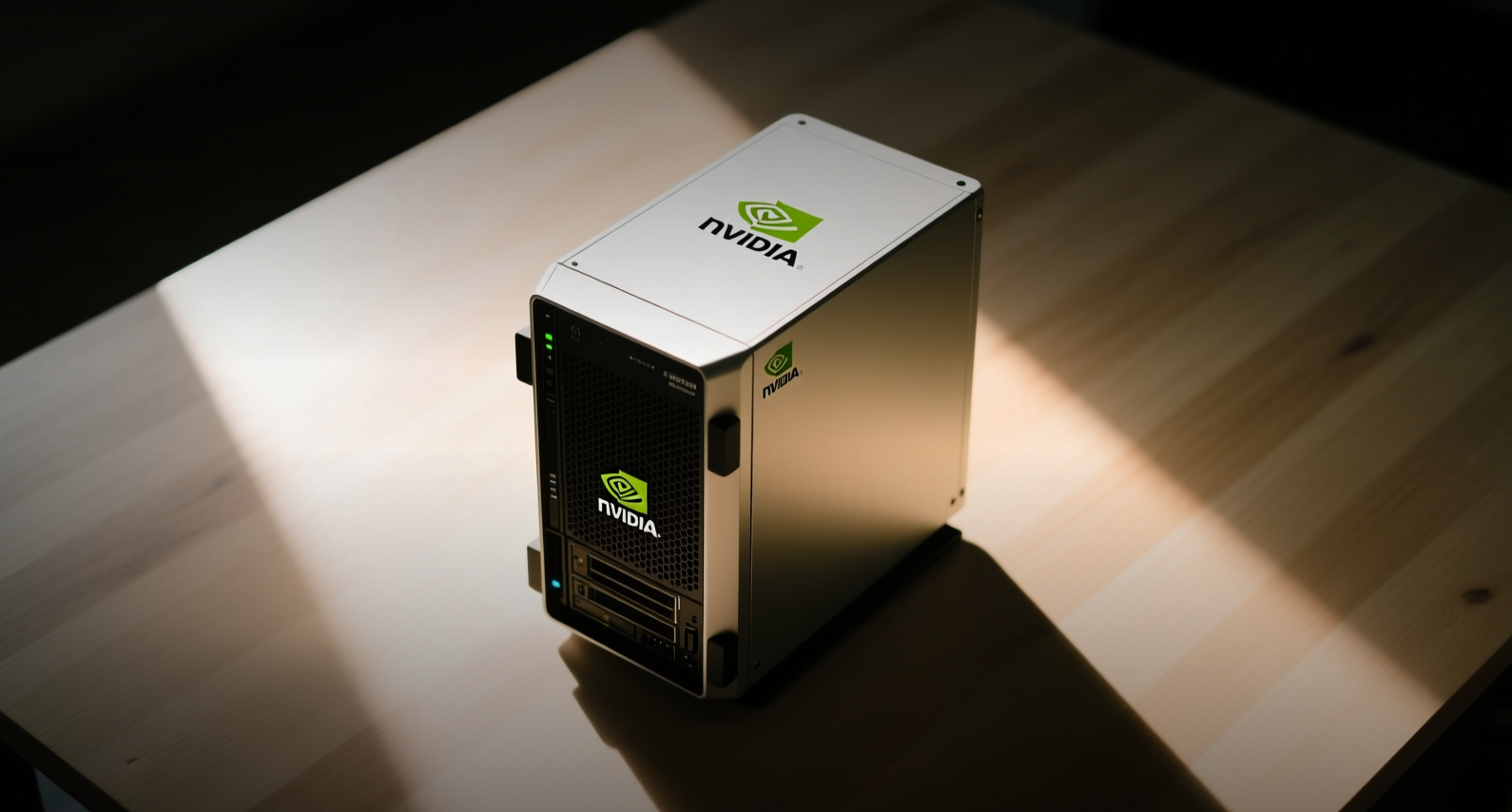
Nvidia is bringing agentic AI to the desktop, bundling its Agent Toolkit with Omniverse libraries on the GB300-powered DGX Station.
Nvidia's Agent Toolkit, now bundled with Omniverse libraries, lets developers deploy AI agents on the DGX Station workstation in about 30 minutes — shrinking what once required cloud GPU clusters to a single desktop machine.
"The physical AI era will be built in simulation first," Jensen Huang, founder and CEO of Nvidia, said. "Nvidia Agent Toolkit with Omniverse libraries brings AI agents into the 3D tools developers already use."
The toolkit runs on Nvidia's DGX Station, powered by the GB300 Blackwell Ultra GPU, and requires just three steps to deploy. It includes three Omnibus libraries now available on GitHub: ovrtx for RTX sensor simulation covering camera, lidar and radar outputs; ovphysx for GPU-accelerated physics handling collisions, mass, friction and motion; and CAD-to-SimReady skills for converting computer-aided design data into simulation-ready assets on OpenUSD.
The integration extends Nvidia's moat beyond hardware into software, creating a full-stack ecosystem that locks developers into Nvidia's workflow from model training to simulation testing. Nvidia shares trade at roughly 35x forward earnings, and the software layer could help justify premium hardware margins as enterprises seek local AI deployment alternatives to cloud GPU rental.
Software Makers Adopt the Platform
SideFX, the developer of Houdini, is exploring how agents can integrate Omniverse libraries into its procedural 3D content creation workflows using OpenUSD, ovrtx and ovphysx. "Procedural 3D creation is essential to building the complex, controllable worlds needed for simulation, robotics and industrial AI," Kim Davidson, president and CEO of SideFX, said. "With Nvidia Omniverse libraries and OpenUSD, SideFX is exploring how agent-ready tools can support Houdini workflows."
PTC's Onshape CAD and product data management platform is using OpenUSD and ovrtx to connect cloud-native design workflows with physical simulation. "Engineering teams are seeking more connected ways to design, collaborate and simulate throughout the development process," Neil Barua, president and CEO of PTC, said.
A new "SimReady" Blender blueprint, built with Omniverse libraries and Nvidia NemoClaw, is now openly available on GitHub. It shows how software makers can add agent-ready simulation capabilities — including RTX sensor simulation, physics and validation — into existing 3D applications while keeping creators in control.
Local Deployment as a Strategic Shift
The demo at SIGGRAPH previewed these workflows running locally across Nvidia's hardware stack, from compact RTX-powered systems with Nvidia RTX Spark to GB300-powered DGX Station systems. RTX Spark systems will be available this fall from ASUS, Dell Technologies, HP, Lenovo, Microsoft Surface and MSI, with models from Acer and GIGABYTE to follow. DGX Station systems are available to order from ASUS, Dell, Gigabyte, HP, MSI, Supermicro and Exxact.
Startups in Nvidia's Inception program are also building on the platform. Palatial is using CAD-to-SimReady skills to automate SimReady asset creation from CAD inputs at scale. Lightwheel is using Omniverse Content Agents in its SimReadyGen technology to generate physically accurate assets from text prompts. ForgeCAD and Moonlake AI are exploring agent-driven 3D content workflows for physical AI simulation.
What This Means for Investors
Nvidia's push to bundle software with its workstation hardware comes as the market grows more cautious about AI investment returns. The company's latest earnings beat expectations, but shares have faced pressure as enthusiasm for pure hardware growth fades. By adding a differentiated software layer — the Agent Toolkit with Omniverse — Nvidia strengthens its competitive position against AMD and Intel in the enterprise AI workstation market, where software ecosystem lock-in can be more durable than hardware specs alone.
The strategy also addresses a practical pain point: enterprises that want to keep sensitive data on-premises while running complex AI agents. Local deployment on DGX Station eliminates cloud GPU costs and data transfer latency, potentially saving enterprises thousands of dollars per month per workstation in cloud compute fees.
This article is for informational purposes only and does not constitute investment advice.