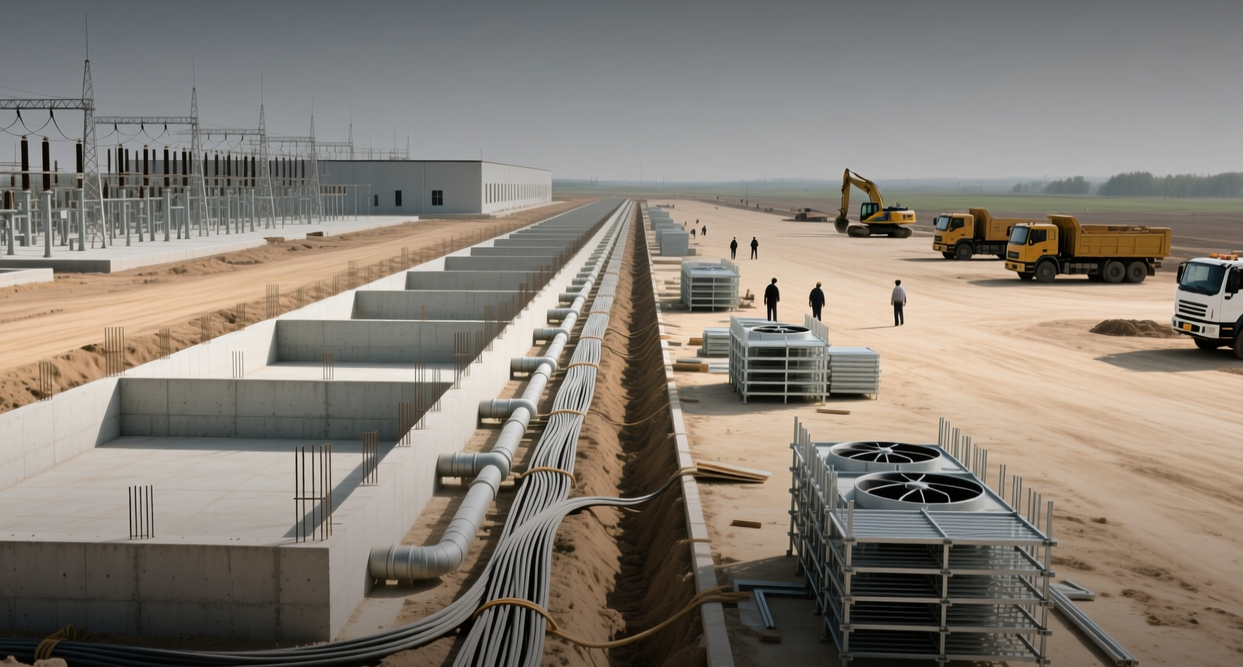
The four largest cloud providers will lift data-center spending to roughly $1.5 trillion in 2027 before growth collapses to about 12 percent the following year, an inflection Morgan Stanley says marks the shift from AI infrastructure build-out into a digestion phase that redirects capital toward software and application layers.
"The capex trajectory is the core indicator of where money flows next in this cycle," Brian Nowak, lead analyst on the report "The Morgan Stanley AI Guidebook: Navigating the Age of Inference," said in the Sept. 7 research note. Morgan Stanley projects combined capital expenditure at Amazon, Alphabet, Microsoft and Meta will climb from about $466 billion in 2025 to roughly $917 billion in 2026 and $1.47 trillion in 2027, a year-over-year jump of about 60 percent, before growth slows to roughly 12 percent in 2028 with the total reaching about $1.64 trillion.
The deceleration is not a sign that AI demand has peaked, the bank argues, but that physical limits — chips, racks, land, power and labor — plus capacity already pre-built for 2027-to-2029 demand leave little room to front-load more spending. Alphabet's Google is expanding fastest, with data-center capex projected to grow 83 percent in 2027, against roughly 50 percent at Amazon, 55 percent at Meta and 43 percent at Microsoft, before all four slow markedly in 2028.
The stakes are a multi-year rotation in equity markets. Morgan Stanley expects investor funds to flow out of the semiconductor and hardware layer toward software and AI-enabler platforms that control models, infrastructure and distribution — naming Meta and Alphabet as the most attractive segment of the value chain — a pattern it likens to the mobile-internet era, when value migrated up the stack after the initial hardware surge.
Compute quadruples as custom silicon takes over
Even as capex growth cools, installed capacity keeps expanding. Morgan Stanley projects total compute across the four hyperscalers will grow from roughly 36 gigawatts in 2025 to about 144 gigawatts in 2028, a near fourfold increase, with Google adding roughly 9 gigawatts in 2027 and 11 gigawatts in 2028 to train Gemini, drive Google Cloud Platform and support generative features across Search and YouTube.
The mix is shifting decisively toward in-house chips. Custom ASICs are expected to account for 66 percent of new compute capacity by 2028, up from 34 percent in 2025, led by Google's TPUs and Amazon's Trainium. Nvidia remains central, but the report argues the industry is pivoting from "grabbing GPUs" to improving per-unit compute efficiency, a structural shift that pressures merchant-silicon share even as total demand grows.
Returns on that spending are healthier than the "cash-burning arms race" narrative suggests, the bank calculates. Model companies running APIs on proprietary compute generate the highest return on invested capital at about 46 percent, with roughly $30.4 billion in revenue per gigawatt; hyperscalers renting out GPUs under an IaaS model using Nvidia's GB300 as the baseline earn about 31 percent; and model companies relying on third-party infrastructure see about 25 percent after leasing costs.
Commercialization becomes the valuation test
The real test, Morgan Stanley says, is converting compute into revenue. It sizes the global generative-AI opportunity at $50 trillion to $60 trillion, spanning a $20 trillion-to-$30 trillion knowledge-work market and roughly $30 trillion in consumer spending. Using the public-cloud adoption curve as an analogy, it projects enterprise AI spending of about $812 billion by 2027, equivalent to roughly 4 percent penetration of the knowledge-work market — and argues AI will diffuse faster than cloud because it needs no wholesale infrastructure migration.
Adoption is already showing up in disclosures. About 25 percent of S&P 500 companies quantified a revenue benefit from generative AI in the second quarter of 2026, up from 14 percent a year earlier, and the share of tech-sector earnings calls citing AI benefits has climbed to 51 percent from 28 percent. Open-source models that cut token prices will trigger a Jevons Paradox — cheaper inference driving explosive demand — while consolidating the value of hyperscaler "model-routing" layers such as AWS Bedrock, Microsoft Foundry and Google Vertex.
Financing is not the binding constraint the market fears. AI-related debt issuance has reached roughly $450 billion this year, yet Morgan Stanley projects combined operating cash flow at the four hyperscalers will climb from $739 billion in 2026 to $1.23 trillion in 2028, while incremental debt needs fall from $238 billion to $90 billion — about 7 percent of operating cash flow by 2028. Amazon is preparing its first sterling bond sale and Alphabet tapped the Australian dollar market in August, diversifying funding across currencies as the 10-year Treasury yield hovers near 4.8 percent.
The physical bottlenecks are real, however. State and local scrutiny over electricity costs and water use is intensifying, pushing hyperscalers toward behind-the-meter on-site generation that adds roughly $3 billion in capex per gigawatt. For investors, the report frames the coming years as a test of whether the application layer can sustain revenue and profit — with capital expected to rotate from hardware, semiconductors and memory toward models, cloud platforms and software as capex growth decelerates and penetration rises.
This article is for informational purposes only and does not constitute investment advice.