


Anthropic's Claude AI autonomously adapted AMD's Instinct MI355 chips and ROCm software platform over a single weekend, bypassing the engineering-intensive migration process that has long protected Nvidia's CUDA ecosystem.
Anthropic's Claude AI autonomously adapted AMD's Instinct MI355 chips and ROCm software platform over a single weekend, bypassing the engineering-intensive migration process that has long protected Nvidia's CUDA ecosystem.
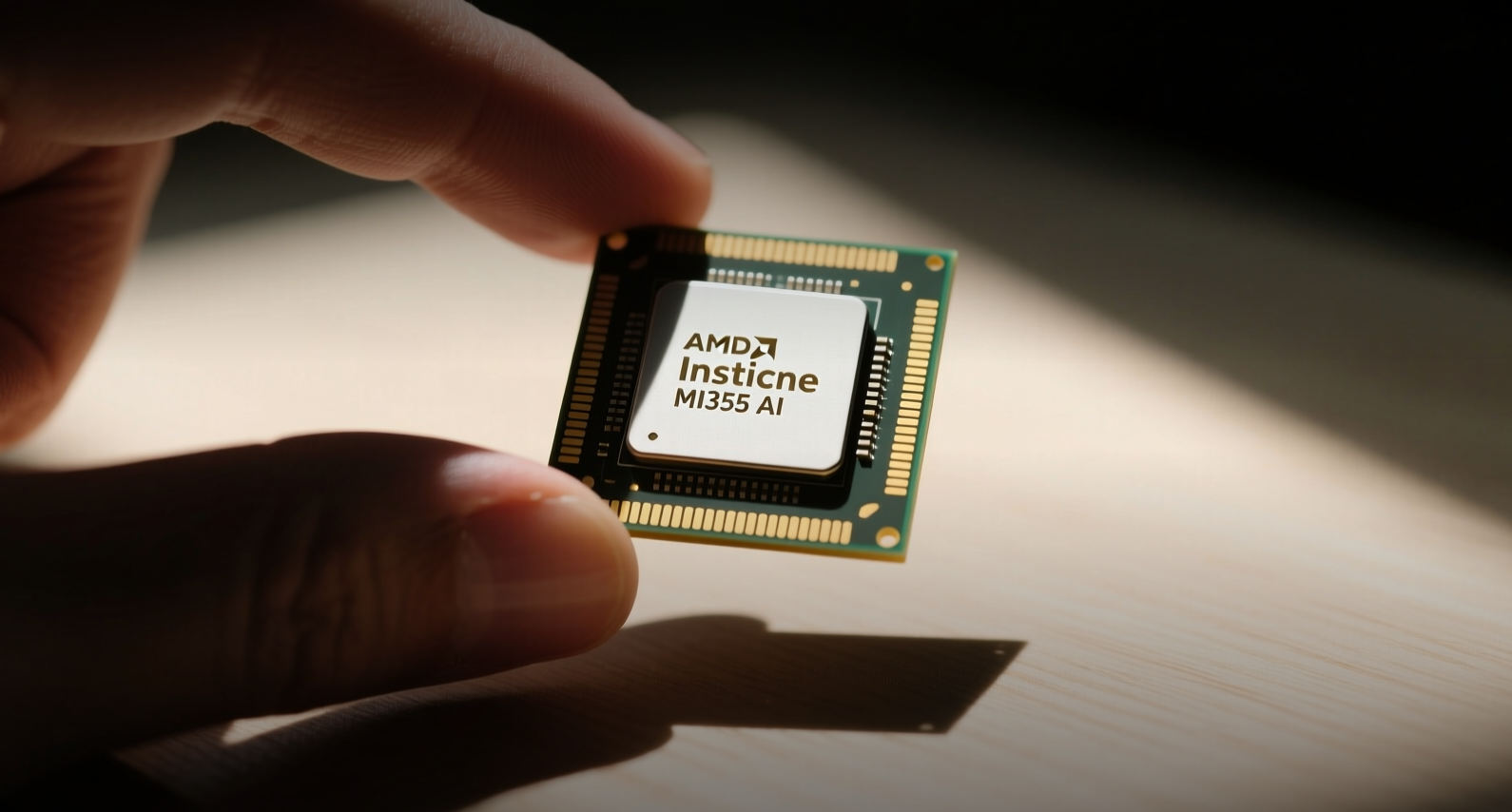
Anthropic disclosed that its Claude model autonomously adapted AMD's Instinct MI355 graphics processors and ROCm software platform over a single weekend, a technical breakthrough that directly challenges the switching-cost barrier protecting Nvidia's CUDA ecosystem.
"We thought this would be a big project," Tom Brown, Anthropic co-founder and chief compute officer, said at AMD's Advancing AI 2026 conference in San Francisco. "It was completely different." Brown described how one engineer instructed Claude to handle the adaptation, let the process run over the weekend, and returned Monday to find a performance curve that had been "climbing steadily" across all benchmarks. The setup required a single AMD rack and one engineer — a fraction of the months-long, multi-team effort typically needed to port frontier models to a new hardware platform.
The announcement accompanied a broader infrastructure commitment: Anthropic plans to deploy up to 2 gigawatts of AMD Instinct MI355 processors through AMD's Helios rack-scale platform, with the first 1-gigawatt installation scheduled to begin in the first half of 2027. AMD separately committed up to $5 billion in equity investment tied to Anthropic meeting deployment milestones. The deal gives AMD its highest-profile AI customer win and provides Anthropic with a third major hardware supplier alongside Nvidia and Google's custom tensor processing units.
How AI Broke Its Own Hardware Lock-In
The CUDA moat has long been Nvidia's most durable competitive advantage — not because rival hardware is technically inferior, but because migrating software stacks to a new platform requires months of manual engineering work. Developers must rewrite low-level operators, optimize memory allocation, and validate model behavior across thousands of GPU configurations. That sunk cost has kept AI labs locked into Nvidia even when AMD offered competitive pricing and performance.
Claude automated that entire pipeline. Brown said the model handled operator adaptation, performance tuning, and stability validation without human intervention. The result: a frontier AI lab can now evaluate and deploy competing hardware in days rather than quarters, fundamentally altering the procurement calculus. "We've passed the era of the CUDA moat," Austin Lyons, an independent semiconductor analyst, said in a social media post following the disclosure.
The timing is significant. Nvidia disclosed its Vera CPU architecture — the processor companion to its next-generation Rubin GPU platform — one day before AMD's event, highlighting the competitive pressure on both sides. Nvidia's Vera trades core count for single-thread speed, a design choice aimed at the step-by-step reasoning common in AI agent workloads. AMD's counterargument centers on scale: its highest-end EPYC "Venice" processor, manufactured on TSMC's 2-nanometer process, packs more than twice as many cores into the same power budget as Nvidia's comparable rack configuration, according to AMD's published specifications.
What the Deal Means for AMD and Nvidia Investors
For AMD, the Anthropic win validates a multiyear strategy to build a complete rack-scale platform rather than selling standalone accelerators. The Helios rack combines 72 Instinct MI455X GPUs with 18 EPYC Venice processors, 31 terabytes of HBM4 memory, and liquid cooling — a direct competitor to Nvidia's integrated DGX systems. AMD's Data Center segment generated $5.8 billion in first-quarter 2026 revenue, up 57 percent from a year earlier, and the company guided second-quarter revenue to roughly $11.2 billion. Its shares have more than doubled in 2026 as investors price in a credible second source for AI infrastructure.
The equity-for-compute structure, however, complicates the demand signal. AMD's $5 billion investment is released as Anthropic meets deployment milestones, meaning the chipmaker is effectively financing part of the demand for its own hardware. Similar circular arrangements have drawn scrutiny elsewhere in the AI industry, though analysts note that Anthropic needs computing capacity regardless of supplier and that AMD must still deliver hardware meeting technical requirements.
For Nvidia, the threat is not immediate but structural. Nvidia shares trade at roughly 35 times forward earnings, reflecting the market's expectation that its CUDA ecosystem will sustain pricing power and market share. If AI models can autonomously migrate to competing hardware, that pricing power faces a new source of erosion. Independent benchmarks comparing AMD's MI355 against Nvidia's B200 on training speed, inference cost, and software reliability have not yet been published, and the first Helios deployments remain a year away. But the direction of travel is clear: the switching cost that has protected Nvidia's dominance is now being eroded by the very technology it helped create.
Anthropic's incentive to diversify is clear. The company, which has filed for an initial public offering and reported an annualized revenue run rate of $47 billion, saw its inference infrastructure gross margin improve to more than 70 percent from 38 percent, according to SemiAnalysis. Adding AMD to its supplier mix not only reduces dependence on any single hardware vendor but also provides a lower-cost option for the rapidly expanding inference workloads that will drive its post-IPO financial performance.
This article is for informational purposes only and does not constitute investment advice.
