
Tesla shares fell 6 percent after the Cybercab update underwhelmed investors, while NHTSA opened a safety audit into the robotaxi's federal compliance.
Tesla shares fell 6 percent after the Cybercab update underwhelmed investors, while NHTSA opened a safety audit into the robotaxi's federal compliance.
Tesla's path to robotaxi commercialization faces new uncertainty after shares fell 6 percent Friday and the National Highway Traffic Safety Administration opened a safety audit into whether the Cybercab complies with federal vehicle standards. The decline erased the prior session's 5.4 percent gain, when investors had bid up the stock ahead of the event.
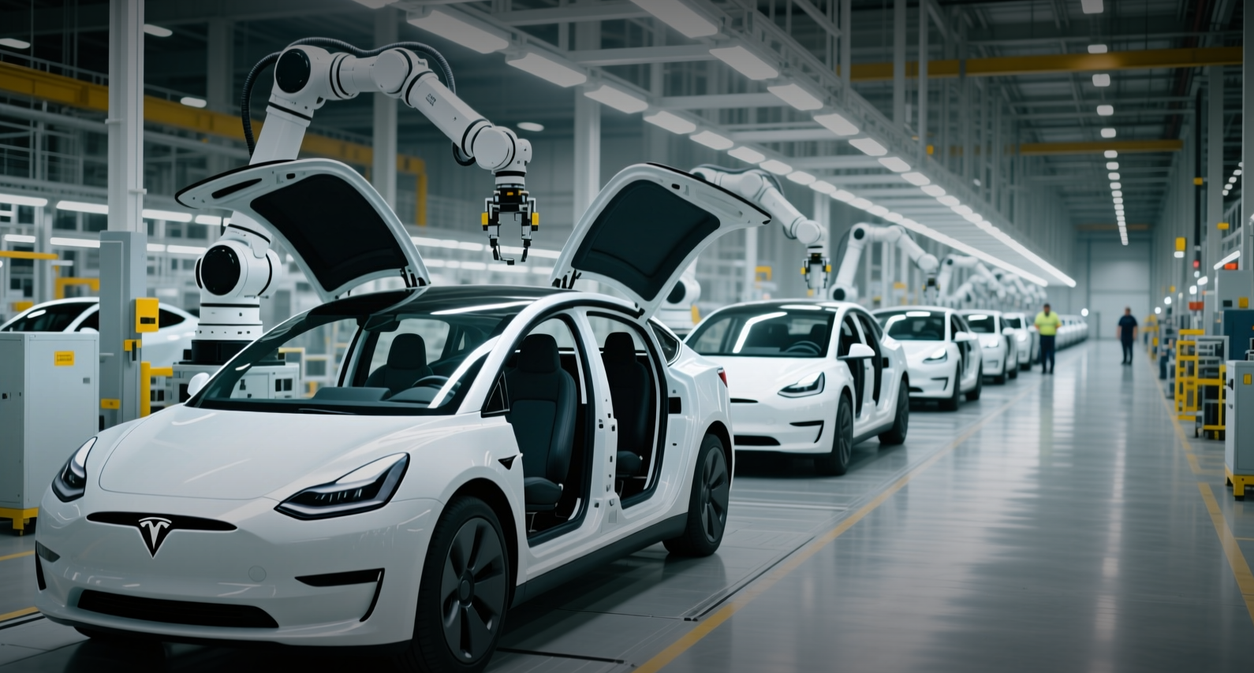
The Cybercab, in production since April at Tesla's Giga Texas facility, is a two-seat vehicle with butterfly doors and no steering wheel or pedals. Tesla began commercial deployment Thursday in a geofenced area around Austin, with 45 Cybercabs registered for driverless operations out of 420 total autonomous Tesla vehicles in Texas, according to state DMV records.
"Given the limited update and lack of surprises typically expected at TSLA events, the launch likely fell short of investor expectations," Colin Langan, analyst at Wells Fargo, said in a note. The firm rates Tesla underweight with a $130 price target.
The event was invite-only with no public livestream — a departure from Tesla's traditionally theatrical reveals — and CEO Elon Musk did not appear. RBC Capital Markets analysts said the company "offered limited new incremental disclosure relative to prior announcements, with key outstanding questions around pricing, production cadence, and regulatory approvals remaining open."
NHTSA's audit query, opened Thursday, reviews whether Tesla properly self-certified the Cybercab as compliant with Federal Motor Vehicle Safety Standards. The agency is examining whether Tesla concluded certain standards were not applicable to a vehicle lacking standard driver-operated hardware such as a steering wheel, brake pedal, and mirrors. The probe covers approximately 1,000 Cybercab vehicles.
The regulatory scrutiny echoes NHTSA's 2022 audit of Amazon-owned Zoox's cube-shaped robotaxi, which also lacked manual controls. Zoox spent years navigating the exemption process before receiving federal approval in July 2026 and launching commercial service in Las Vegas. Whether Tesla faces a comparable timeline remains unclear.
Tesla VP of Vehicle Engineering Lars Moravy had said the Cybercab was designed to meet all federal safety standards from the start, allowing the company to self-certify without seeking a special exemption. The Department of Transportation has proposed removing manual control requirements for autonomous vehicles, though those rules remain in effect.
Wall Street reaction was split. JPMorgan, neutral-rated with a $445 price target, said it expects "a modest pull-back given limited details on pace of roll-out and deployment targets." Morgan Stanley, equal weight at $400, said further evidence of fleet expansion "will be key to driving additional share outperformance." Goldman Sachs, neutral at $360, estimated Cybercab's $20,000 to $30,000 cost target could deliver a $0.05 to $0.30 per mile cost advantage versus competitor autonomous vehicles.
Bulls remained constructive. RBC, outperform at $480, models roughly 40,000 Tesla-owned Cybercabs in the U.S. by 2030 with a steeper ramp from 2040 to 2050. Baird, outperform at $475, justified its premium valuation on Tesla's "growth initiatives and competitive moat."
Tesla faces at least two other active NHTSA probes into its driver-assistance systems. The company's robotaxi ambitions also compete directly with Alphabet's Waymo, which currently dominates the U.S. autonomous ride-hailing market. Musk has said material revenue from the Cybercab is unlikely before at least 2027.
For investors, the Cybercab's credibility now hinges on two fronts: Tesla's ability to scale its Austin deployment beyond 45 vehicles while maintaining safety, and the outcome of NHTSA's audit, which could slow commercialization similar to Zoox's multi-year regulatory path. Tesla shares, which had gained 15 percent in the 30 days before the event, now face a regulatory overhang that could persist for months. The stock's valuation — trading at a premium to traditional automakers on expectations of robotaxi-driven growth — leaves little room for further disappointment on either front.
This article is for informational purposes only and does not constitute investment advice.
