Content
Limitless 2025 Q4 Outlook: Architecting the Future of Forecast...
TL;DR
What is Limitless?
Project Fundamentals
Strategic Direction & Narrative Trajectory
Product & Technology Prowess
Market Adoption & Developer Activity
Team & Backers
Brand & Ecosystem Longevity
On-Chain & Market Depth Analysis
Sustainable Tokenomics & Value Accrual
Forward-Looking Analysis (Catalysts & Opportunities)
Near-Term Outlook (<1 Month)
Mid-Term Outlook (1-3 Months)
Long-Term Outlook (6+ Months)
Valuation & Competitive Position
Valuation Scenarios
Competitive Landscape
Final Thesis
Key Takeaways
Next Steps

Markets Confusing? Ask Edgen Search.

Instant answers, zero BS, and trading decisions your future self will thank you for.

Try Search Now

Limitless 2025 Q4 Outlook: Architecting the Future of Forecasting

· Mar 31 2026
Limitless 2025 Q4 Outlook: Architecting the Future of Forecasting

Limitless 2025 Q4 Outlook: Architecting the Future of Forecasting

Limitless is a decentralized social prediction protocol transforming how future events are forecasted and traded.

TL;DR

  • Pioneers high-frequency prediction markets with a superior Central Limit Order Book (CLOB) architecture.
  • Backed by an elite syndicate of investors, including Coinbase Ventures and Arthur Hayes' Maelstrom.
  • Demonstrates remarkable early traction with over $500M in cumulative volume and a strong user base.
  • Positioned to capture significant share in a prediction market sector projected to reach $95.5 billion.

What is Limitless?

Limitless is a decentralized prediction market platform enabling users to trade on the outcomes of real-world events using natural language. Built on the high-performance Base blockchain, it offers a seamless, low-cost trading experience with near-instant execution. The protocol focuses on short-term markets, such as hourly price movements, effectively creating a new category of "micro-forecasting". By combining professional-grade trading infrastructure with a user-friendly, mobile-first interface, Limitless aims to make sophisticated forecasting accessible to a broad audience.

Project Fundamentals

Strategic Direction & Narrative Trajectory

Limitless is strategically positioned at the confluence of several powerful market trends, targeting the rapidly growing on-chain prediction market sector. The broader predictive analytics market is projected to grow to over $91 billion by 2032, indicating a massive appetite for forecasting tools. More specifically, the on-chain prediction market sector is forecast to expand to $95.5 billion by 2035, growing at a compound annual growth rate (CAGR) of 46.8%. Limitless's vision to become a "forecasting and risk engine for the global economy" aligns perfectly with this secular tailwind, positioning it to capture substantial value as the market matures.

Product & Technology Prowess

The protocol's technical foundation provides a significant competitive advantage.

  • CLOB Architecture: Unlike competitors using Automated Market Maker (AMM) models, Limitless employs a Central Limit Order Book (CLOB). This architecture, standard in traditional finance, facilitates deeper liquidity, tighter spreads, and more efficient price discovery, attracting sophisticated traders.
  • High-Performance Infrastructure: Building on the Base blockchain enables sub-$0.01 transaction fees and near-instant trade execution, which is critical for the platform's focus on high-frequency, short-term markets.
  • User-Centric Features: Limitless lowers the barrier to entry with a mobile-first interface, natural language market creation, and a gasless Smart Wallet, enhancing accessibility for mainstream users.

Market Adoption & Developer Activity

Limitless has demonstrated remarkable early traction, signaling strong product-market fit with active traders.

Metric

Value

Insight

Cumulative Trading Volume

>$500M

Confirms high user engagement and platform utility.

Peak Monthly Volume

$425M (Sep 2025)

Shows capacity for explosive, viral growth.

Daily Active Users (DAU)

22,000 - 25,000

Represents a substantial and active user base for a new protocol.

Total Value Locked (TVL)

$2.25M

Highlights a capital-efficient model focused on trading velocity.

The high-volume, low-TVL profile confirms its identity as a capital-efficient trading venue. While public development metrics are an area for future enhancement, existing GitHub repositories confirm ongoing work on core infrastructure, including account abstraction and exchange mechanics.

Team & Backers

The project is led by a highly capable team and supported by top-tier institutional investors, providing remarkable foundational strength.

  • Experienced Leadership: The team is led by Co-Founder & CEO CJ Hetherington, whose background includes roles at TA Ventures and Gitcoin, blending venture capital acumen with deep Web3 expertise. The founding team's prior success in creating a viral consumer AI application further underscores their execution capabilities.
  • Elite Investor Syndicate: Limitless has raised $17 million, including a $10 million seed round led by 1confirmation. Its backers include Coinbase Ventures, Maelstrom (Arthur Hayes' family office), Digital Currency Group, and Arrington Capital.

Brand & Ecosystem Longevity

Limitless launched with powerful market momentum and is deeply integrated into a high-growth ecosystem. The token sale on Kaito Capital Launchpad was massively oversubscribed, attracting over $50 million in commitments for a $1 million target, which indicates powerful initial community demand. The project's strategic deployment on the Coinbase-incubated Base blockchain and its planned expansion to the BNB Chain demonstrate a clear intent to embed itself within liquid, high-growth ecosystems for long-term relevance and user acquisition.

On-Chain & Market Depth Analysis

Sustainable Tokenomics & Value Accrual

The LMTS token's economic model incorporates foundational pillars for long-term value accrual. With a total supply of 1 billion tokens, the current circulating supply is approximately 13.16%. This provides a long runway for fundamental growth to build a strong demand base ahead of scheduled future emissions. Key mechanisms include:

  • Staking: A staking program incentivizes long-term holding, with over 9 million LMTS (6.88% of circulating supply) staked shortly after launch. This serves as a primary demand sink and aligns holder incentives with platform success.
  • Buyback Program: The protocol uses 0.25% of every trade to repurchase LMTS tokens, creating a direct link between platform activity and token value.Token Holder Distribution & On-Chain Metrics

The on-chain landscape reflects a young project with strong initial growth. With 15,646 unique holders on the Base network, distribution is developing. A high degree of supply concentration within core protocol contracts (e.g., vesting and treasury wallets) is typical for a new project and ensures the long-term alignment of core stakeholders with the project's future success. The rapid adoption of the staking contract further demonstrates positive holder conviction.

Forward-Looking Analysis (Catalysts & Opportunities)

Near-Term Outlook (<1 Month)

  • Epoch 2 Rewards Program: The ongoing rewards program, concluding in January 2026, is a direct catalyst for user engagement. It is designed to boost key metrics like DAUs and trading volume, reinforcing a narrative of community growth and rewarding early adopters.

Mid-Term Outlook (1-3 Months)

  • BNB Chain Expansion: The planned deployment on the BNB Chain in Q4 2025 is the most significant near-term catalyst. This expansion will tap into a massive new user base, potentially increasing DAUs and trading volume, which directly fuels the buyback mechanism and strengthens the project's multi-chain narrative.

Long-Term Outlook (6+ Months)

  • Shorter Market Timeframes: The planned 2026 rollout of 15, 10, and 1-minute markets will solidify Limitless's unique selling proposition as the premier destination for "ultra-fast" prediction markets, catering to high-frequency traders.
  • Tier-1 CEX Listing: A potential listing on a top-tier exchange like Binance or Coinbase in 2026 remains a powerful speculative catalyst. Such a listing would provide a massive influx of liquidity and accessibility, positioning the asset for a new valuation plateau.
  • Structured Token Emissions: Scheduled token unlocks beginning in 2026 are a key consideration. Strong execution on the product roadmap is essential to ensure that fundamental growth in demand outpaces these planned emissions, presenting an opportunity for the protocol to demonstrate its economic resilience.

Valuation & Competitive Position

Valuation Scenarios

The future valuation of Limitless is dependent on project execution and market conditions. The following scenarios outline a spectrum of potential outcomes based on its Fully Diluted Valuation (FDV).

Scenario

FDV Range (USD)

Justification & Narrative

Bull Case

$2.2B - $3.3B

Flawless execution and a favorable bull market.

Base Case

$330M - $560M

Strong execution in an unfavorable market.

Bear Case

$450M - $900M

Weak execution buoyed by a favorable market.

Competitive Landscape

Limitless is a technically differentiated challenger in a market with giants whose private valuations signal a high ceiling for the sector.

Project

Valuation (FDV in USD)

Note

Polymarket

$9.0B - $15.0B

Private valuation, no public token.

Kalshi

$5.0B

Private valuation, regulated entity.

Limitless (Base Case)

$330M - $560M

Projected FDV based on strong execution.

Final Thesis

Limitless presents a compelling venture-style opportunity with an exceptionally high ceiling for success. Its fundamental strengths are rooted in a technically superior CLOB architecture, strategic alignment with the high-growth prediction market narrative, and the institutional validation of an elite backing syndicate. Strong early traction confirms product-market fit. The primary challenge is executing its growth strategy at a pace that outpaces its pre-programmed token emissions. Success is contingent on the team's ability to deliver on its ambitious roadmap, making the next two quarters a decisive period to unlock its significant long-term potential.

Key Takeaways

  • Limitless possesses undeniable strengths: superior technology, elite backers, and a clear strategic vision in a high-growth sector.
  • The project has demonstrated strong early traction and product-market fit, validating its core offering for active traders.
  • The valuation gap between Limitless and its private competitors highlights a significant opportunity for appreciation as it executes its roadmap.

Next Steps

  • Monitor the successful deployment and initial user traction of the BNB Chain expansion in Q4 2025.
  • Track key performance indicators like Daily Active Users (DAU) and trading volume to gauge the impact of growth initiatives.
  • Watch for announcements regarding the 2026 product roadmap, particularly the launch of shorter-term markets and any potential CEX listing news.

Recommend
Redeem miles for gift cards and each is worth ~1 cent; redeem for long-haul business and they're worth 2.5-4+. With programs now dynamically priced, the one check that decides every redemption.

How to redeem airline miles without wasting them

The single biggest mistake with miles is redeeming them for the easy stuff: gift cards, merchandise, seat upgrades at the gate. Do that and each mile is worth about one cent. Redeem the *same* miles for flights, especially long-haul or premium-cabin flights, and they're often worth two to five cents each, sometimes more. So the real skill isn't earning miles; it's not throwing away their value at the finish line. Here's how to actually use them. A mile has no fixed price; its value depends entirely on what you redeem it for. The way to judge any redemption is simple math: (cash price of the flight) ÷ (miles it costs) = cents per mile. If a flight costs $400 or 20,000 miles, that's 2 cents a mile, a solid deal. If a $90 flight costs 18,000 miles, that's half a cent, which is terrible; pay cash and keep the miles. Run this check before every redemption. It instantly separates a great use from a waste, and it's the one habit that makes miles worth having. As a rule of thumb, most major ai
Edgen
·
Jun 30 2026
Short-term goals (under ~3 years) belong in safe cash; long-term goals (5+ years) can take market risk. The best HYSAs now pay ~4-5% APY. How to sort yours and run both.

Long-term vs short-term financial goals (and how to plan both)

The difference comes down to one thing: time. A short-term goal is money you'll need within roughly three years (an emergency fund, a trip, a wedding, next year's tax bill), so it has to be *safe and reachable*. A long-term goal is five-plus years out (retirement, a house down the road, a kid's education), so it can take market risk, because time smooths the bumps out. Get that match right and you've done most of the work. It's not the size, it's the deadline. A $2,000 goal you need in six months is short-term; a $2,000 goal you won't touch for fifteen years is long-term, and they belong in completely different places. This is the part that actually matters, and where people lose money without realizing it. Short-term money should not be in the stock market. If your emergency fund is in stocks and the market drops 20% the same month your car dies, you're selling at the worst possible time. Short-term goals go somewhere stable and accessible, and a high-yield savings account is the clas
Edgen
·
Jun 30 2026
Mortgages near 6.5%, home prices flat, and the Fed split on rate cuts vs hikes. With timing a coin flip, the 3 questions that actually decide whether to buy now or wait.

Should you buy a house now or wait? How to actually decide

The honest answer: buy when you'll stay put for at least five years and you'll still have an emergency fund left after the down payment. Otherwise, waiting (and renting) is often the smarter money move, not the weaker one. "Rent vs buy" isn't a math problem with one right answer, and it's almost never really about timing the market. It's about your *life*, in three questions. Before the three questions, here's the mid-2026 backdrop — because "now or wait" usually hides a bet on rates and prices, and the data says that bet is a coin flip. The picture: mortgages are still pricey, prices have gone flat (more than half of the 20 big metros saw year-over-year declines in March), and the cheap-money era hasn't returned. So "buy before it runs away" and "wait for the crash" are *both* weak arguments right now. The whole "wait for rates to drop" plan rests on the Fed, and the Fed is split down the middle. In its June 2026 projections, policymakers were divided: 8 expected no change this year,
Edgen
·
Jun 30 2026
Most financial goals fail because they're wishes, not systems. Here's the 3-part anatomy of a goal that sticks (a number, a date, one automatic move), plus why 37% of adults can't cover a $400 surprise.

How to set financial goals you'll actually hit

A financial goal you'll actually hit has three things a vague wish doesn't: a number, a date, and one automatic move that happens whether or not you remember it. "Save more" is a wish. "$6,000 in a separate account by next December, $500 auto-transferred on payday" is a goal. The gap between those two sentences is the reason most goals quietly die, and it has almost nothing to do with willpower. Key Takeaways A real financial goal answers three questions: how much, by when, and what for. Drop any one and it stops working. "Pay off debt" has no number and no date, so there's nothing to aim at or measure, while "$8,000 of card debt cleared in 18 months" tells you exactly whether you're on track and the day you're done. The "what for" matters more than people expect. A goal tied to something real (a buffer so a bad month isn't a crisis, a deposit on a first place) survives the months when motivation dips. In our experience reading how people actually use a money tool, the goals that get
Edgen
·
Jun 30 2026
A big RSU grant just vested — now what? Here's what a modern money tool actually surfaces first, using Ed as a worked example: a reality check, the 22% tax gap most high earners miss, and the concentration risk nobody flags.

Your RSUs Just Vested. Here's What a Money Tool Surfaces First.

You just had a big RSU grant vest. Congratulations — and now the awkward part: a six-figure pile of your own company's stock, a vague sense you should "do something," and no one actually telling you what. An advisor, a spreadsheet, and a piece of software each handle this moment differently. Here's what a modern money tool surfaces in a moment like this — using Ed as a worked example — so you can decide what kind of help actually fits. Key takeaways You connect your brokerage and bank through read-only aggregation, so the tool can read balances but can't move a dollar. Ed's framing is simple: precise about your money, blind to your identity. Instead of sorting your lattes into categories, Ed opens on a single Financial Reality Check — a read on whether your money could survive a bad month. For a lot of high earners, that one number lands harder than any budget, because it answers a question the other apps never ask. (If the Reality Check is the numbers side, your money type is the beha
Edgen
·
Jun 26 2026
A money personality test is more than a quiz if it measures behavior, not just vibes. Here's the science behind money types, how Ed's test works, and how to use your result.

What Is a Money Personality Test? The Science Behind Your Money Type

The short version: a good money personality test should feel like a roast and work like a mirror — fun on the surface, behavioral underneath. The useful ones don't tell you what you know; they show you how you act with money, and the one blind spot worth watching. Key takeaways Here's the uncomfortable backdrop. U.S. financial literacy has been stuck for a decade — adults answer only about 49% of the standard knowledge questions correctly, essentially flat since 2017 (TIAA Institute–GFLEC, 2025) — even as free financial information became infinite. If facts fixed money, they'd have fixed it by now. They don't, because the thing that actually drives your outcomes lives one level below the facts: how you're wired to behave when money is on the line. That's the whole premise of financial fitness — and it's what a money personality test is built to surface. Not what you know. What you do. The idea has real research behind it — money behavior is patterned and measurable, and a few tradition
Edgen
·
Jun 23 2026
A financial reality check scores where you actually stand across safety, control, progress, upside, and Mental Load. Here's why a money score matters, how Ed's checkup works, and what to do with your weakest area.

What Is a Financial Reality Check? Why Your Credit Score Isn't Enough

The short version: your credit score measures how safe you are to lend to. Almost nobody has ever seen the number that measures whether you are actually secure. A financial reality check is that second number. Key takeaways Ask people for their credit score and many can recite it. Ask whether they could survive three months without income, or where their money quietly leaks each month, and you get a shrug. That's the gap. A credit score answers a lender's question — how risky is it to extend this person debt? It can be high while your life is fragile, or low while you're genuinely fine, because it was never built to measure you. A financial reality check answers the question the credit score ignores: are you safe, clear, progressing, building, and at ease? Here's the simple version, with the research behind each axis.
Edgen
·
Jun 23 2026
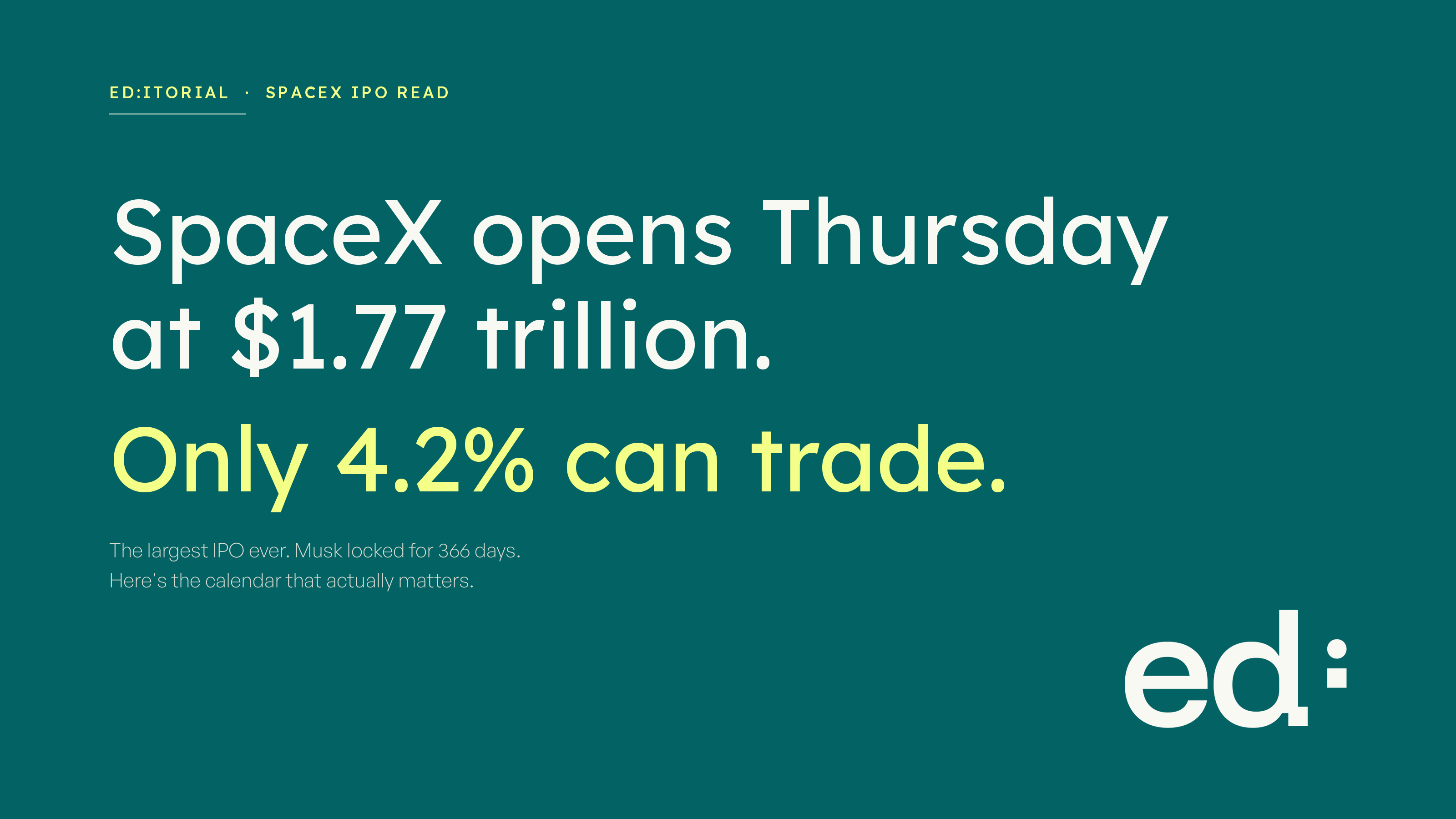
SpaceX opens Thursday at a $1.77 trillion valuation — the largest IPO ever. Only 4.2% of stock actually trades. Musk is locked up for 366 days. The next 366 days run on an unusually clean calendar of supply releases. Here are the 13 dates worth watching.

SpaceX goes public Thursday with a possible $5 trillion hit. Here's the calendar that actually matters.

SpaceX prices Wednesday night and opens Thursday on Nasdaq at $135 per share — a $1.77 trillion valuation, the largest IPO ever. Most coverage will frame what comes next as a sentiment trade, an Elon story, or a race to Goldman's $5 trillion bull case. The reality is more grounded and more useful: the next 366 days are governed by an unusually clean calendar of supply releases — when 95.8% of the company can or cannot trade, when index funds add weight, when the lock-up cliff arrives, when Musk himself becomes a potential seller for the first time. Read the calendar and you've already understood the structure most market commentary will spend the next quarter trying to explain. Here are the 13 dates worth watching. Two things keep showing up in headlines that don't survive a careful read. The first is the idea that index funds are about to be forced into a massive single-event SpaceX buy. They aren't. Nasdaq did create a fast-track inclusion rule that lets SpaceX join the Nasdaq 100 wi
Edgen
·
Jun 10 2026

Your money person, finally.

Try Ed free. No credit card. No commitment.