Content
Ether.fi 2025 Q3 Review: Architecting the DeFi Neobank
TL;DR
Project Fundamentals
What is Ether.fi?
Strategic Pivot to DeFi Neobanking
Strategic Expansion: Ether.fi Liquid and Cash
Team & Backers
On-Chain & Market Depth Analysis
Core Product: eETH
Valuation & Competitive Position
TGE Forecast Scenarios
Competitor Landscape
Key Takeaways
Next Steps

Markets Confusing? Ask Edgen Search.

Instant answers, zero BS, and trading decisions your future self will thank you for.

Try Search Now

Ether.fi 2025 Q3 Review: Architecting the DeFi Neobank

· Mar 31 2026
Ether.fi 2025 Q3 Review: Architecting the DeFi Neobank

Ether.fi 2025 Q3 Review: Architecting the DeFi Neobank

Ether.fi(ETHFI) is a major decentralized liquid staking protocol with $9.7 billion in TVL as of October 2025, making it one of the largest DeFi protocols. The platform offers institutional-grade ETH staking services and has expanded into crypto banking with positive user feedback.

TL;DR

  • Leading non-custodial liquid restaking with user-controlled validator keys.
  • Expanding into full DeFi banking via Ether.fi Liquid and Cash.
  • Bridging DeFi yields to real-world use through a capital-efficient ecosystem.
  • Accelerating growth via buybacks, institutions, and a clear roadmap.

Project Fundamentals

What is Ether.fi?

Ether.fi is a decentralized, non-custodial liquid staking protocol built on Ethereum. It enables users to stake their ETH to earn rewards while maintaining control over their private keys, a key differentiator in the liquid staking space.

When users stake, they mint eETH, a liquid restaking token (LRT) that can be used across the DeFi ecosystem to generate additional yield. The protocol natively integrates with EigenLayer, allowing staked assets to be "restaked" to secure other networks, thereby amplifying yield potential.

By simplifying the non-custodial staking process and offering innovative products, Ether.fi aims to provide a seamless and secure financial experience that bridges the gap between DeFi and traditional finance.

Strategic Pivot to DeFi Neobanking

Ether.fi is strategically evolving from its origins as a decentralized liquid restaking protocol into a comprehensive DeFi neobank. The ecosystem is structured around three core products analogous to traditional banking services: "Stake" functions as a savings account, "Liquid" as an investment account, and "Cash" as a spending and borrowing tool.

This vision extends beyond the core DeFi market to target the larger CeFi and neobank sectors, which represent a user base of 30-50 million and a market valuation of $176 billion, respectively. The protocol's impressive growth, marked by a Total Value Locked (TVL) that reached $6.86 billion as of May 2025, demonstrates strong product-market fit and provides a solid foundation for this expansion. Projections for 2025 estimate total revenue between $65 million and $96 million, indicating significant commercial traction for its integrated financial services model.

Strategic Expansion: Ether.fi Liquid and Cash

Building on its staking foundation, Ether.fi has launched two new product lines to create a comprehensive financial platform.

  • Ether.fi Liquid: This product offers automated DeFi strategy vaults for a variety of assets, including ETH, BTC, and stablecoins. It is projected to generate $28 million in revenue in 2025, demonstrating its potential as a significant growth driver.
  • Ether.fi Cash: Launched in April 2025, this product is a crypto-native credit card and smart wallet that allows users to spend against their staked assets without selling them. It has already achieved notable traction, processing over $10 million in daily volumes as of June 2025, and is projected to generate over $60 million in revenue in its second year.

Team & Backers

Ether.fi has secured significant backing and validation from both institutional investors and influential market participants. The project has raised $32.3 million across three funding rounds, providing substantial capital for growth and development.

Funding Round

Date

Amount Raised

Lead Investors

Other Notable Investors

Series A

Feb/Mar 2024

$23M to $27M

Bullish Capital, CoinFund

OKX Ventures, Foresight Ventures, Consensys, Amber, Selini, Draper Dragon, Bankless Ventures, and founders/executives from Aave, Polygon, Kraken, Curve, Ethena, and DeFi Llama.

Seed Round

Q1 2023

$5.3 Million

North Island Ventures, Chapter One

Maelstrom (Arthur Hayes' fund), Node Capital, Arrington Capital, Version One Ventures, Purpose Investments.

Unannounced/SAFE Round

Late 2023

$4 Million

On-Chain & Market Depth Analysis

Robust Token Model and Buyback Mechanism

The ETHFI token is integral to the protocol's governance and economic model. With a maximum supply of 1 billion tokens, the allocation is structured to align the interests of all stakeholders, including investors, the core team, and the community.

Allocation Category

Percentage

Investors

33.74%

Treasury

21.62%

Core Contributors

21.47%

User Airdrops

19.27%

Partnerships & Liquidity

3.90%

A key feature of the token's economic design is the protocol's commitment to using 25% of all revenue for token buybacks. This mechanism is designed to reduce the circulating supply and return value to token holders, creating a sustainable demand driver for ETHFI.

Core Product: eETH

The protocol's primary value proposition is its liquid restaking token, eETH, which allows users to earn staking and restaking rewards while maintaining liquidity. As of a recent 2025 report, eETH has a market cap of $871.36 million and a 24-hour trading volume of $113,751. The health and adoption of eETH are central to Ether.fi's long-term success, as it is the primary driver of the protocol's TVL and revenue.

Valuation & Competitive Position

TGE Forecast Scenarios

Based on market analysis and growth projections, the following scenarios outline potential valuation ranges for Ether.fi's Fully Diluted Valuation (FDV) over the next 6-18 months.

Scenario

FDV Range (USD)

Narrative

Bull Case

$2.5B – $3.5B

Assumes successful execution of the DeFi neobank strategy, strong revenue growth from Liquid and Cash products, and favorable market conditions.

Base Case

$1.1B – $1.8B

Reflects continued growth in TVL and steady adoption of new products, with the protocol solidifying its position as a leader in the restaking market.

Bear Case

$0.9B – $1.1B

Considers potential market headwinds, increased competition, or slower-than-expected adoption of new products, leading to more moderate price appreciation.

Competitor Landscape

Ether.fi is a leading project in the rapidly growing liquid restaking sector. When compared to its peers, its market capitalization reflects a strong competitive position with significant room for growth.

Token

Symbol

Market Cap

Wrapped eETH

weETH

$10.43B

Kelp DAO Restaked ETH

rsETH

$1.54B

Renzo Restaked ETH

ezETH

$1.22B

Ether.fi

ETHFI

$0.55B

Key Takeaways

  • Ether.fi is successfully transitioning from a staking protocol to an integrated DeFi neobank, creating multiple revenue streams and a stickier user base.
  • The protocol's non-custodial model and user-controlled keys offer a compelling security and decentralization advantage over competitors.
  • Strong revenue growth, a robust token buyback program, and increasing institutional adoption provide powerful tailwinds for future valuation appreciation.

Next Steps

  • Monitor the revenue growth from Ether.fi Liquid and Ether.fi Cash, as these are critical to validating the DeFi bank thesis.
  • Track the execution of the token buyback program and its impact on the ETHFI circulating supply.

Recommend
Redeem miles for gift cards and each is worth ~1 cent; redeem for long-haul business and they're worth 2.5-4+. With programs now dynamically priced, the one check that decides every redemption.

How to redeem airline miles without wasting them

The single biggest mistake with miles is redeeming them for the easy stuff: gift cards, merchandise, seat upgrades at the gate. Do that and each mile is worth about one cent. Redeem the *same* miles for flights, especially long-haul or premium-cabin flights, and they're often worth two to five cents each, sometimes more. So the real skill isn't earning miles; it's not throwing away their value at the finish line. Here's how to actually use them. A mile has no fixed price; its value depends entirely on what you redeem it for. The way to judge any redemption is simple math: (cash price of the flight) ÷ (miles it costs) = cents per mile. If a flight costs $400 or 20,000 miles, that's 2 cents a mile, a solid deal. If a $90 flight costs 18,000 miles, that's half a cent, which is terrible; pay cash and keep the miles. Run this check before every redemption. It instantly separates a great use from a waste, and it's the one habit that makes miles worth having. As a rule of thumb, most major ai
Edgen
·
Jun 30 2026
Short-term goals (under ~3 years) belong in safe cash; long-term goals (5+ years) can take market risk. The best HYSAs now pay ~4-5% APY. How to sort yours and run both.

Long-term vs short-term financial goals (and how to plan both)

The difference comes down to one thing: time. A short-term goal is money you'll need within roughly three years (an emergency fund, a trip, a wedding, next year's tax bill), so it has to be *safe and reachable*. A long-term goal is five-plus years out (retirement, a house down the road, a kid's education), so it can take market risk, because time smooths the bumps out. Get that match right and you've done most of the work. It's not the size, it's the deadline. A $2,000 goal you need in six months is short-term; a $2,000 goal you won't touch for fifteen years is long-term, and they belong in completely different places. This is the part that actually matters, and where people lose money without realizing it. Short-term money should not be in the stock market. If your emergency fund is in stocks and the market drops 20% the same month your car dies, you're selling at the worst possible time. Short-term goals go somewhere stable and accessible, and a high-yield savings account is the clas
Edgen
·
Jun 30 2026
Mortgages near 6.5%, home prices flat, and the Fed split on rate cuts vs hikes. With timing a coin flip, the 3 questions that actually decide whether to buy now or wait.

Should you buy a house now or wait? How to actually decide

The honest answer: buy when you'll stay put for at least five years and you'll still have an emergency fund left after the down payment. Otherwise, waiting (and renting) is often the smarter money move, not the weaker one. "Rent vs buy" isn't a math problem with one right answer, and it's almost never really about timing the market. It's about your *life*, in three questions. Before the three questions, here's the mid-2026 backdrop — because "now or wait" usually hides a bet on rates and prices, and the data says that bet is a coin flip. The picture: mortgages are still pricey, prices have gone flat (more than half of the 20 big metros saw year-over-year declines in March), and the cheap-money era hasn't returned. So "buy before it runs away" and "wait for the crash" are *both* weak arguments right now. The whole "wait for rates to drop" plan rests on the Fed, and the Fed is split down the middle. In its June 2026 projections, policymakers were divided: 8 expected no change this year,
Edgen
·
Jun 30 2026
Most financial goals fail because they're wishes, not systems. Here's the 3-part anatomy of a goal that sticks (a number, a date, one automatic move), plus why 37% of adults can't cover a $400 surprise.

How to set financial goals you'll actually hit

A financial goal you'll actually hit has three things a vague wish doesn't: a number, a date, and one automatic move that happens whether or not you remember it. "Save more" is a wish. "$6,000 in a separate account by next December, $500 auto-transferred on payday" is a goal. The gap between those two sentences is the reason most goals quietly die, and it has almost nothing to do with willpower. Key Takeaways A real financial goal answers three questions: how much, by when, and what for. Drop any one and it stops working. "Pay off debt" has no number and no date, so there's nothing to aim at or measure, while "$8,000 of card debt cleared in 18 months" tells you exactly whether you're on track and the day you're done. The "what for" matters more than people expect. A goal tied to something real (a buffer so a bad month isn't a crisis, a deposit on a first place) survives the months when motivation dips. In our experience reading how people actually use a money tool, the goals that get
Edgen
·
Jun 30 2026
A big RSU grant just vested — now what? Here's what a modern money tool actually surfaces first, using Ed as a worked example: a reality check, the 22% tax gap most high earners miss, and the concentration risk nobody flags.

Your RSUs Just Vested. Here's What a Money Tool Surfaces First.

You just had a big RSU grant vest. Congratulations — and now the awkward part: a six-figure pile of your own company's stock, a vague sense you should "do something," and no one actually telling you what. An advisor, a spreadsheet, and a piece of software each handle this moment differently. Here's what a modern money tool surfaces in a moment like this — using Ed as a worked example — so you can decide what kind of help actually fits. Key takeaways You connect your brokerage and bank through read-only aggregation, so the tool can read balances but can't move a dollar. Ed's framing is simple: precise about your money, blind to your identity. Instead of sorting your lattes into categories, Ed opens on a single Financial Reality Check — a read on whether your money could survive a bad month. For a lot of high earners, that one number lands harder than any budget, because it answers a question the other apps never ask. (If the Reality Check is the numbers side, your money type is the beha
Edgen
·
Jun 26 2026
A money personality test is more than a quiz if it measures behavior, not just vibes. Here's the science behind money types, how Ed's test works, and how to use your result.

What Is a Money Personality Test? The Science Behind Your Money Type

The short version: a good money personality test should feel like a roast and work like a mirror — fun on the surface, behavioral underneath. The useful ones don't tell you what you know; they show you how you act with money, and the one blind spot worth watching. Key takeaways Here's the uncomfortable backdrop. U.S. financial literacy has been stuck for a decade — adults answer only about 49% of the standard knowledge questions correctly, essentially flat since 2017 (TIAA Institute–GFLEC, 2025) — even as free financial information became infinite. If facts fixed money, they'd have fixed it by now. They don't, because the thing that actually drives your outcomes lives one level below the facts: how you're wired to behave when money is on the line. That's the whole premise of financial fitness — and it's what a money personality test is built to surface. Not what you know. What you do. The idea has real research behind it — money behavior is patterned and measurable, and a few tradition
Edgen
·
Jun 23 2026
A financial reality check scores where you actually stand across safety, control, progress, upside, and Mental Load. Here's why a money score matters, how Ed's checkup works, and what to do with your weakest area.

What Is a Financial Reality Check? Why Your Credit Score Isn't Enough

The short version: your credit score measures how safe you are to lend to. Almost nobody has ever seen the number that measures whether you are actually secure. A financial reality check is that second number. Key takeaways Ask people for their credit score and many can recite it. Ask whether they could survive three months without income, or where their money quietly leaks each month, and you get a shrug. That's the gap. A credit score answers a lender's question — how risky is it to extend this person debt? It can be high while your life is fragile, or low while you're genuinely fine, because it was never built to measure you. A financial reality check answers the question the credit score ignores: are you safe, clear, progressing, building, and at ease? Here's the simple version, with the research behind each axis.
Edgen
·
Jun 23 2026
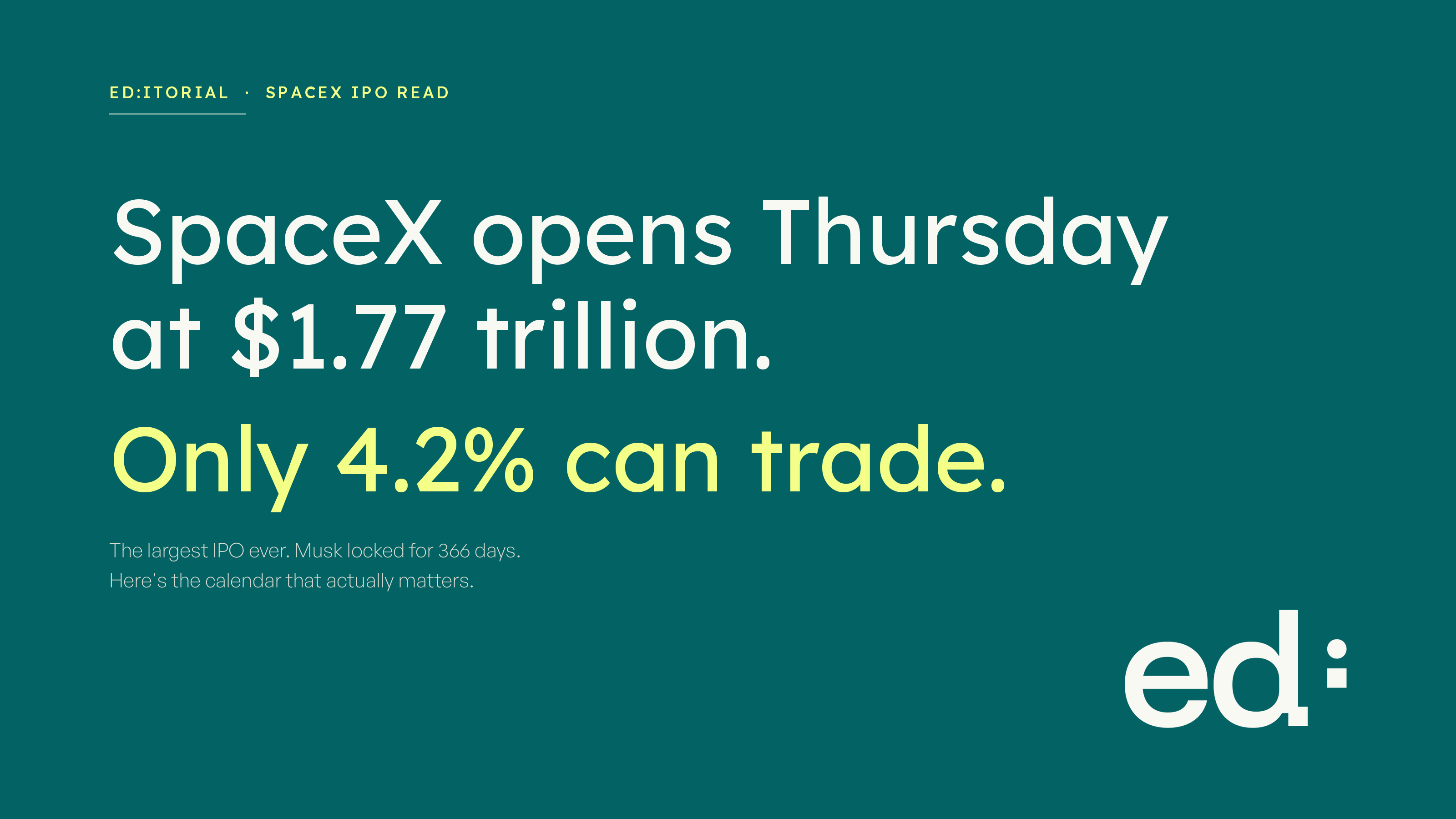
SpaceX opens Thursday at a $1.77 trillion valuation — the largest IPO ever. Only 4.2% of stock actually trades. Musk is locked up for 366 days. The next 366 days run on an unusually clean calendar of supply releases. Here are the 13 dates worth watching.

SpaceX goes public Thursday with a possible $5 trillion hit. Here's the calendar that actually matters.

SpaceX prices Wednesday night and opens Thursday on Nasdaq at $135 per share — a $1.77 trillion valuation, the largest IPO ever. Most coverage will frame what comes next as a sentiment trade, an Elon story, or a race to Goldman's $5 trillion bull case. The reality is more grounded and more useful: the next 366 days are governed by an unusually clean calendar of supply releases — when 95.8% of the company can or cannot trade, when index funds add weight, when the lock-up cliff arrives, when Musk himself becomes a potential seller for the first time. Read the calendar and you've already understood the structure most market commentary will spend the next quarter trying to explain. Here are the 13 dates worth watching. Two things keep showing up in headlines that don't survive a careful read. The first is the idea that index funds are about to be forced into a massive single-event SpaceX buy. They aren't. Nasdaq did create a fast-track inclusion rule that lets SpaceX join the Nasdaq 100 wi
Edgen
·
Jun 10 2026

Your money person, finally.

Try Ed free. No credit card. No commitment.