Content
1. Your Setup Looks the Same Everywhere Now
2. Ed Draws the Data For You
3. You Can See How Ed Is Thinking
4. Just Talk to Ed
5. Your Homepage Now Knows You

Markets Confusing? Ask Edgen Search.

Instant answers, zero BS, and trading decisions your future self will thank you for.

Try Search Now

Ed Got Smarter This Week (May 22 Update) — Here's How

Edgen
· May 26 2026
Ed Got Smarter This Week (May 22 Update) — Here's How

By Edgen | 2026-05-26

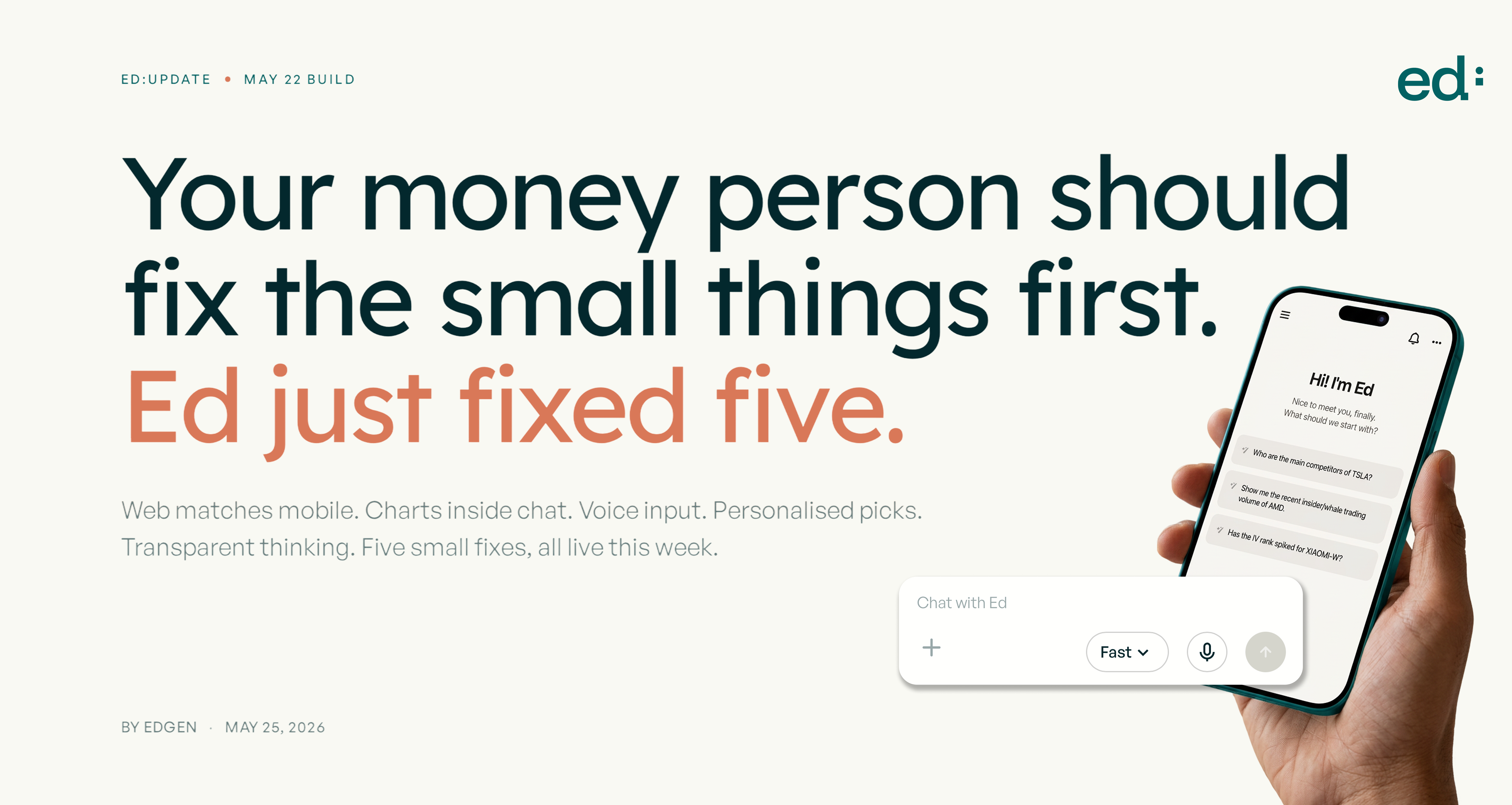
Your money person should solve the small annoyances first. This week Ed knocked out five of them — desktop and mobile felt like two different products, data answers were lifeless, you couldn't tell what he was thinking, typing detailed questions on the go was a pain, and the homepage didn't really know you. All five just got better.

1. Your Setup Looks the Same Everywhere Now

Web just picked up the same brand color, clean cards, and bell-notification setup the mobile app already had. Whether you open Ed on your phone in the morning or your laptop at lunch, it's one consistent product — and alerts find you on both.

2. Ed Draws the Data For You

Ask Ed about a stock price, a market-cap split, or a year-over-year trend — the answer now comes back with a clean chart inside the reply. Same data, much easier to read at a glance, no need to imagine the picture from a wall of numbers.

3. You Can See How Ed Is Thinking

Ed is a proactive AI — what he's doing for you matters as much as the final answer. The thinking process is now one clean line you can follow: "Reading Goldman Sachs' latest Micron note for you…" or "Pulling today's market-moving headlines together…" or "Tracking your portfolio overnight…" — not a wall of multi-agent traces. You see Ed at work, in human time.

4. Just Talk to Ed

Tap the mic in the chat input and ask your question by voice. On the way to work, in the car, holding a coffee — when typing a long question feels like work, you just talk.

5. Your Homepage Now Knows You

Open Ed and the experience now reflects you — from Ed's Picks on the homepage to the questions Ed pre-loads inside Ask Ed. Both are tuned to what you track and what you've asked about. No more generic feed.

All five are live. Open Ed on web, or take him with you — download for iPhone or Android. Got feedback or want something new? Tell us — we read every reply.

This is a product update from the Edgen team. Not investment advice. Features and availability subject to change.

Recommend
Aschenbrenner's Q1 13F: $5.52B in AI infrastructure longs (BE, SNDK, CRWV) + $1.6B NVDA puts. The puts are most likely a hedge — not a short.

Leopold Aschenbrenner's Real AI Bets: Bloom Energy, SanDisk, CoreWeave — the NVDA Put Is Probably a Hedge

What are the world's most-watched investors actually buying right now? The Q1 2026 13F filings — released May 15 — give the clearest answer in years: every major filer is building AI exposure. The disagreement is over how. The most-headlined case is Leopold Aschenbrenner — the ex-OpenAI researcher who wrote the Situational Awareness essay and now runs Situational Awareness LP ($9.28B regulatory AUM per the March 2026 SEC Form ADV; $5.52B of that is the disclosed U.S. equity book). The press ran with "Aschenbrenner bet $8.46 billion against AI chips." That headline is technically true and practically misleading. What he actually did with real capital: load up on the AI infrastructure that makes the boom possible — power, memory, data-center capacity. The $8.46B against NVDA and other chipmakers is almost certainly a hedge on those AI longs, not a directional bet against AI itself. If you're trying to build AI exposure for the long run, his buy list — and what 4 other big names are doing
Edgen
·
May 21 2026
Nomura raised SK Hynix's price target from ₩840K to ₩4M in 6 months — 5x. Goldman lifted MU's 2026 EPS estimate 133%. Why MU and SNDK move from Hold to Buy.

Nomura Quintupled SK Hynix's Target in 6 Months — A Tailwind for MU and SNDK

On May 17, Nomura raised SK Hynix's price target to ₩4 million won — roughly five times the level it set just six months ago. The size of that revision matters less than what Nomura wrote underneath it: AI memory demand is entering a "new regime" that breaks the historical cycle model. We're updating our #66 AI hardware basket map on the back of it — MU and SNDK move from Hold to Buy. The trajectory is the story, not the endpoint. Four sequential raises. Each one looked aggressive when published. Each one was conservative within weeks. The current PT implies +119.9% upside from the May 15 close of ₩1.82M — Nomura's bull case explicitly recalibrating to a "new regime," not extrapolating from the prior cycle. I'd argue the May 17 raise matters more than the four that came before it. The earlier raises tracked rising EPS estimates inside the same cyclical model. This one reframes the model itself — what Nomura calls "memory stock re-rating driven by exponential demand growth from AI." Nom
Edgen
·
May 18 2026
NVDA isn't the whole AI hardware trade. SanDisk +3,362%, Micron +340% past year prove it. Which AI hardware sectors still have upside — and which don't?

NVDA Is One Basket of AI Hardware. Here Are the Other Four, Ranked.

SanDisk is up 3,362% over the past 12 months (Yahoo Finance). Micron is up around 340% in the same window (Yahoo Finance). Both are AI hardware. Neither is NVIDIA. If you call yourself "long AI" but own only NVDA, you're not long AI — you're long one basket, and the other four ran without you. SNDK and MU are the proof of how expensive that miss can be. Here's the map. Five baskets. Where I'd put new money today (Basket 4) and where I wouldn't (Basket 1). Bottom line first. If you can only add to one basket today, I'd add to Basket 4 — Optical Interconnect. Not NVDA. Not HBM. Not foundry. One sentence: AI's bottleneck is shifting from "memory can't feed the GPU fast enough" (the 2024 problem) to "the wires can't connect 100,000 GPUs at once" (the 2026-2028 problem). The market hasn't fully priced this yet. AI-themed funds barely own any of the optical names.
Edgen
·
May 15 2026
earnings-beats-fail-2026-edgen-3-signal-framework_header.png

Why Earnings Beats Fail in 2026: Edgen's 3-Signal Framework

Something broke in Q1 2026 earnings that contradicts what most retail investors learned in 2023-2024. Affirm reported adjusted EPS of $0.37 against a $0.27 consensus — nearly 40% above the Street — and the stock fell 5%. Coinbase missed revenue by 31% — a catastrophic shortfall by any historical standard — and the stock declined only 2.5%. SoFi beat the quarter and raised full-year guidance, then dropped 15%. Palantir reported 85% year-over-year revenue growth — and went sideways. These are the four prints Edgen Research covered in real time during April and May 2026. Across them, the relationship between an earnings beat and stock direction has visibly decoupled. This is not a noisy small sample — it is a structural change in how the market processes quarterly information. Three signals appeared in every single beat-and-fade case we tracked, and they also predict — in reverse — the rare cases that beat and rally, such as NXP's +18% reaction to its Q1 print. This article is the framewo
Edgen
·
May 14 2026
affirm-investor-forum-may-12-2026-4-numbers-decide-stock_header.png
Coinbase missed Q1 by $70M and posted a $394M GAAP loss — yet the stock dropped just 2.5%. Why the bear case isn't paying out, and the OCC trade still works.
affirm-q3-2026-beat-raised-guide-may-12-forum-thesis_header.png
ZEC just hit $590 in 3 days — nearly our $600 PT from Monday. Now what? Monero (XMR) at $409 hasn't moved. Here's the privacy coin rotation play.
zcash-zec-stock-400-surge-2026-privacy-coin-narrative-bitcoin-younger-sibling_header.png
Biren 06082.HK opened +76% in January and has barely moved in four months. The cornerstone lockup is two months out. So is the better Chinese chip bet.

Your money person, finally.

Try Ed free. No credit card. No commitment.