Content
BWXT 2026 Q1 outlook: Powering the Nuclear Renaissance
TL;DR
Foundational Business Analysis
Corporate & Segment Overview
Competitive Landscape & Economic Moat
Industry Analysis & Total Addressable Market (TAM)
Financial Performance & Health
Revenue & Profitability
Cash Flow & Balance Sheet
Capital Allocation & Efficiency
Market Sentiment & Momentum
Technical & Relative Strength Analysis
Ownership & Shareholder Base
Analyst Consensus & Market Narrative
Forward-Looking Analysis & Valuation
Key Catalysts for Growth
Strategic Considerations
Valuation Scenarios
Final Investment Thesis

Markets Confusing? Ask Edgen Search.

Instant answers, zero BS, and trading decisions your future self will thank you for.

Try Search Now

BWXT 2026 Q1 outlook: Powering the Nuclear Renaissance

· Mar 31 2026
BWXT 2026 Q1 outlook: Powering the Nuclear Renaissance

BWXT 2026 Q1 outlook: Powering the Nuclear Renaissance

BWX Technologies (BWXT) is a prominent U.S.-based manufacturing and engineering innovator that provides specialized nuclear solutions across the global security, clean energy, and medical sectors. Currently, BWXT is a key leader in the nuclear energy renaissance, actively developing advanced microreactors like Project Pele and small modular reactors (SMRs) to meet the growing power demands of AI data centers and military installations.

TL;DR

  • BWX Technologies (BWXT) is a premier investment opportunity due to its unique position at the forefront of the global nuclear renaissance and national security.
  • The company boasts an impenetrable competitive moat as the sole-source provider of naval nuclear reactors for the U.S. Navy and holds crucial licenses.
  • A record $7.4 billion backlog provides exceptional revenue visibility and underscores a powerful, de-risked growth story.
  • BWXT is strategically expanding into high-growth commercial markets like Small Modular Reactors (SMRs) and medical isotopes, significantly broadening its Total Addressable Market.

Foundational Business Analysis

Corporate & Segment Overview

BWX Technologies, Inc. (BWXT) is a specialized manufacturer of mission-critical nuclear components, fuel, and services. The company's business model is built on long-term, high-value contracts with government and commercial entities, leveraging decades of experience in complex, high-consequence manufacturing.

  • Government Operations: This segment is the cornerstone of BWXT's business, accounting for approximately 71% of revenue. It serves as the sole-source manufacturer of naval nuclear reactors and fuel for the U.S. Navy's submarine and aircraft carrier fleet, providing exceptional revenue stability and visibility.
  • Commercial Operations: This segment represents a significant growth vector, leveraging BWXT's expertise for commercial nuclear power and a rapidly expanding medical isotopes business. Bolstered by strategic acquisitions, this segment is capitalizing on the global demand for clean energy and advanced radiopharmaceuticals.

The company is led by a deeply experienced team, including CEO Rex Geveden (former NASA COO) and Government Operations President Joseph Miller (former U.S. Navy nuclear officer), whose track records are perfectly aligned with navigating the complex technical and governmental landscapes in which BWXT operates.

Competitive Landscape & Economic Moat

BWXT possesses a formidable and durable competitive moat, granting it a powerful and sustainable market position.

  • Primary Competitors: While BWXT competes with large industrial and defense firms like Huntington Ingalls (HII), General Electric (GE), and Curtiss-Wright (CW) in specific commercial areas, its core government business is virtually unrivaled.
  • Competitive Advantage (The Moat): The company's advantage is anchored by near-impenetrable barriers. It holds the only two NRC Category 1 licenses for commercial handling of highly enriched uranium (HEU) and possesses decades of proprietary, classified manufacturing know-how. This creates an "ecosystem lock-in" with the U.S. government, characterized by exceptionally high switching costs.
  • Market Position: BWXT holds a near-monopolistic leadership position as the sole-source provider for the U.S. Naval Nuclear Propulsion Program. In emerging commercial markets like SMRs and medical isotopes, it is strategically positioned as a key technology and manufacturing partner.

Industry Analysis & Total Addressable Market (TAM)

BWXT is positioned at the confluence of two powerful secular trends: rising global defense spending and a "nuclear renaissance" driven by the push for decarbonization and energy security. These trends are dramatically expanding the company's Total Addressable Market (TAM) in its key end markets, particularly in Small Modular Reactors (SMRs) and nuclear medicine, which are projected to grow at an accelerated double-digit pace.

Financial Performance & Health

Revenue & Profitability

BWXT's financial profile is characterized by accelerating growth and robust profitability, supported by its unique market position.

Financial Metric

Q3 2025 Performance

Interpretation

Consolidated Revenue

$866.3M (+28.9% YoY)

Accelerating top-line growth driven by both government and commercial segments.

Government Revenue

$616.7M (+10% YoY)

Stable, foundational growth from core defense contracts.

Commercial Revenue

$251.0M (+122% YoY)

Explosive growth validating the strategic pivot to commercial markets.

Profitability

Strong indicators

Operating margins are robust, with the high-growth commercial segment showing expanding profitability and providing a positive lift to the consolidated profile.

Cash Flow & Balance Sheet

The company demonstrates a strong and improving capacity for cash generation, underpinning its financial health and strategic flexibility.

Financial Health Metric

Q3 2025 Status

Interpretation

Cash from Operations

$143.2M (+339% YoY)

Exceptional growth in operating cash flow, indicating high-quality earnings.

Free Cash Flow

$94.9M

Dramatic improvement, showcasing strong conversion of profit into cash.

Financial Health

Strong indicators

The balance sheet shows profound financial stability. Strategic use of leverage to fund acquisitions is well-supported by predictable, long-term government revenue streams.

Capital Allocation & Efficiency

Management has a proven track record of effective capital allocation, balancing shareholder returns with strategic investments for future growth. The company maintains a consistent and growing dividend, complemented by a standing share repurchase authorization. This balanced approach signals confidence in the long-term stability of its cash flows and appeals to a broad investor base. Efficiency metrics like Return on Invested Capital (ROIC) remain competitive, indicating efficient capital deployment.

Market Sentiment & Momentum

Technical & Relative Strength Analysis

BWXT's stock has demonstrated strong performance, rewarding patient investors with superior risk-adjusted returns. While short-term momentum indicators have normalized from previous highs, the stock's performance over a one-year horizon has significantly outpaced its peers and benchmarks. Key metrics like the Sharpe and Sortino ratios have shown marked improvement, confirming that investors have been well-compensated for the stock's volatility.

Ownership & Shareholder Base

Investor confidence in BWXT's long-term thesis is firm, evidenced by high institutional ownership and low short interest. The narrative is driven by sophisticated investors and analysts who understand the long-cycle nature of the nuclear industry. There remains significant potential for the narrative to accelerate as the company continues to execute on its high-profile projects, broadening its appeal.

Analyst Consensus & Market Narrative

The prevailing narrative for BWXT has successfully reframed the company from a stable defense incumbent to a high-growth technology leader. This story is strongly validated by an increasingly bullish analyst consensus.

Analyst Consensus

As of Jan 2026

High Price Target

$285.60

Median Price Target

$229.50

Mean Price Target

$225.99

Low Price Target

$183.82

Forward-Looking Analysis & Valuation

Key Catalysts for Growth

  • Record Backlog Execution: The $7.4B backlog provides a clear and secured path to significant mid-to-high-teens revenue growth through 2026.
  • Commercial Market Validation: Final Investment Decisions (FIDs) on major new nuclear builds (e.g., SMR deployments) would convert a multi-billion-dollar opportunity pipeline into firm backlog, validating the "nuclear renaissance" thesis.
  • Advanced Technology Leadership: Progress on the Project Pele microreactor prototype and the development of a TRISO fuel facility, supported by state-level funding, de-risks and accelerates the company's strategy to supply advanced reactors.

Strategic Considerations

BWXT's strategic position allows it to adeptly navigate market dynamics. Its heavy reliance on the U.S. government, rather than being a risk, provides a foundation of unparalleled stability. The company's operational expertise enables it to manage the complexities of ramping up large manufacturing programs, while its strong cash flow supports the strategic leverage used for growth-oriented acquisitions. Intensified regulatory interest, such as the inquiry into the Kinectrics acquisition, is a testament to the company's critical and expanding role in the market.

Valuation Scenarios

The valuation analysis reveals a wide spectrum of potential outcomes, with the company's flawless execution and a supportive macro environment unlocking significant upside.

  • Bull Case: Strong execution on the backlog, coupled with a landmark SMR contract and a favorable macro environment, could lead to significant multiple expansion. This scenario projects a target market cap in the $33.2B - $36.1B range.
  • Base Case: Continued strong company growth, even in a less favorable macro environment, supports a valuation reflecting the company's premium position. This scenario projects a target market cap in the $14.6B - $16.6B range.
  • Bear Case: A scenario where internal execution falters during a risk-off market environment could lead to a price correction. This projects a target market cap in the $10.7B - $12.7B range.

Final Investment Thesis

Bullish. BWX Technologies presents a premier investment opportunity, anchored by an impenetrable competitive moat and a clear, de-risked growth path. The company is the central technology enabler for powerful secular tailwinds in national security, clean energy, and medical innovation. With a record backlog providing exceptional revenue visibility and a strategic pivot to high-growth commercial markets gaining momentum, BWXT is uniquely positioned for sustained, long-term value creation. Its premium valuation is a reflection of its unparalleled strategic importance and a powerful, de-risked growth story that is just beginning to unfold.

Recommend
Redeem miles for gift cards and each is worth ~1 cent; redeem for long-haul business and they're worth 2.5-4+. With programs now dynamically priced, the one check that decides every redemption.

How to redeem airline miles without wasting them

The single biggest mistake with miles is redeeming them for the easy stuff: gift cards, merchandise, seat upgrades at the gate. Do that and each mile is worth about one cent. Redeem the *same* miles for flights, especially long-haul or premium-cabin flights, and they're often worth two to five cents each, sometimes more. So the real skill isn't earning miles; it's not throwing away their value at the finish line. Here's how to actually use them. A mile has no fixed price; its value depends entirely on what you redeem it for. The way to judge any redemption is simple math: (cash price of the flight) ÷ (miles it costs) = cents per mile. If a flight costs $400 or 20,000 miles, that's 2 cents a mile, a solid deal. If a $90 flight costs 18,000 miles, that's half a cent, which is terrible; pay cash and keep the miles. Run this check before every redemption. It instantly separates a great use from a waste, and it's the one habit that makes miles worth having. As a rule of thumb, most major ai
Edgen
·
Jun 30 2026
Short-term goals (under ~3 years) belong in safe cash; long-term goals (5+ years) can take market risk. The best HYSAs now pay ~4-5% APY. How to sort yours and run both.

Long-term vs short-term financial goals (and how to plan both)

The difference comes down to one thing: time. A short-term goal is money you'll need within roughly three years (an emergency fund, a trip, a wedding, next year's tax bill), so it has to be *safe and reachable*. A long-term goal is five-plus years out (retirement, a house down the road, a kid's education), so it can take market risk, because time smooths the bumps out. Get that match right and you've done most of the work. It's not the size, it's the deadline. A $2,000 goal you need in six months is short-term; a $2,000 goal you won't touch for fifteen years is long-term, and they belong in completely different places. This is the part that actually matters, and where people lose money without realizing it. Short-term money should not be in the stock market. If your emergency fund is in stocks and the market drops 20% the same month your car dies, you're selling at the worst possible time. Short-term goals go somewhere stable and accessible, and a high-yield savings account is the clas
Edgen
·
Jun 30 2026
Mortgages near 6.5%, home prices flat, and the Fed split on rate cuts vs hikes. With timing a coin flip, the 3 questions that actually decide whether to buy now or wait.

Should you buy a house now or wait? How to actually decide

The honest answer: buy when you'll stay put for at least five years and you'll still have an emergency fund left after the down payment. Otherwise, waiting (and renting) is often the smarter money move, not the weaker one. "Rent vs buy" isn't a math problem with one right answer, and it's almost never really about timing the market. It's about your *life*, in three questions. Before the three questions, here's the mid-2026 backdrop — because "now or wait" usually hides a bet on rates and prices, and the data says that bet is a coin flip. The picture: mortgages are still pricey, prices have gone flat (more than half of the 20 big metros saw year-over-year declines in March), and the cheap-money era hasn't returned. So "buy before it runs away" and "wait for the crash" are *both* weak arguments right now. The whole "wait for rates to drop" plan rests on the Fed, and the Fed is split down the middle. In its June 2026 projections, policymakers were divided: 8 expected no change this year,
Edgen
·
Jun 30 2026
Most financial goals fail because they're wishes, not systems. Here's the 3-part anatomy of a goal that sticks (a number, a date, one automatic move), plus why 37% of adults can't cover a $400 surprise.

How to set financial goals you'll actually hit

A financial goal you'll actually hit has three things a vague wish doesn't: a number, a date, and one automatic move that happens whether or not you remember it. "Save more" is a wish. "$6,000 in a separate account by next December, $500 auto-transferred on payday" is a goal. The gap between those two sentences is the reason most goals quietly die, and it has almost nothing to do with willpower. Key Takeaways A real financial goal answers three questions: how much, by when, and what for. Drop any one and it stops working. "Pay off debt" has no number and no date, so there's nothing to aim at or measure, while "$8,000 of card debt cleared in 18 months" tells you exactly whether you're on track and the day you're done. The "what for" matters more than people expect. A goal tied to something real (a buffer so a bad month isn't a crisis, a deposit on a first place) survives the months when motivation dips. In our experience reading how people actually use a money tool, the goals that get
Edgen
·
Jun 30 2026
A big RSU grant just vested — now what? Here's what a modern money tool actually surfaces first, using Ed as a worked example: a reality check, the 22% tax gap most high earners miss, and the concentration risk nobody flags.

Your RSUs Just Vested. Here's What a Money Tool Surfaces First.

You just had a big RSU grant vest. Congratulations — and now the awkward part: a six-figure pile of your own company's stock, a vague sense you should "do something," and no one actually telling you what. An advisor, a spreadsheet, and a piece of software each handle this moment differently. Here's what a modern money tool surfaces in a moment like this — using Ed as a worked example — so you can decide what kind of help actually fits. Key takeaways You connect your brokerage and bank through read-only aggregation, so the tool can read balances but can't move a dollar. Ed's framing is simple: precise about your money, blind to your identity. Instead of sorting your lattes into categories, Ed opens on a single Financial Reality Check — a read on whether your money could survive a bad month. For a lot of high earners, that one number lands harder than any budget, because it answers a question the other apps never ask. (If the Reality Check is the numbers side, your money type is the beha
Edgen
·
Jun 26 2026
A money personality test is more than a quiz if it measures behavior, not just vibes. Here's the science behind money types, how Ed's test works, and how to use your result.

What Is a Money Personality Test? The Science Behind Your Money Type

The short version: a good money personality test should feel like a roast and work like a mirror — fun on the surface, behavioral underneath. The useful ones don't tell you what you know; they show you how you act with money, and the one blind spot worth watching. Key takeaways Here's the uncomfortable backdrop. U.S. financial literacy has been stuck for a decade — adults answer only about 49% of the standard knowledge questions correctly, essentially flat since 2017 (TIAA Institute–GFLEC, 2025) — even as free financial information became infinite. If facts fixed money, they'd have fixed it by now. They don't, because the thing that actually drives your outcomes lives one level below the facts: how you're wired to behave when money is on the line. That's the whole premise of financial fitness — and it's what a money personality test is built to surface. Not what you know. What you do. The idea has real research behind it — money behavior is patterned and measurable, and a few tradition
Edgen
·
Jun 23 2026
A financial reality check scores where you actually stand across safety, control, progress, upside, and Mental Load. Here's why a money score matters, how Ed's checkup works, and what to do with your weakest area.

What Is a Financial Reality Check? Why Your Credit Score Isn't Enough

The short version: your credit score measures how safe you are to lend to. Almost nobody has ever seen the number that measures whether you are actually secure. A financial reality check is that second number. Key takeaways Ask people for their credit score and many can recite it. Ask whether they could survive three months without income, or where their money quietly leaks each month, and you get a shrug. That's the gap. A credit score answers a lender's question — how risky is it to extend this person debt? It can be high while your life is fragile, or low while you're genuinely fine, because it was never built to measure you. A financial reality check answers the question the credit score ignores: are you safe, clear, progressing, building, and at ease? Here's the simple version, with the research behind each axis.
Edgen
·
Jun 23 2026
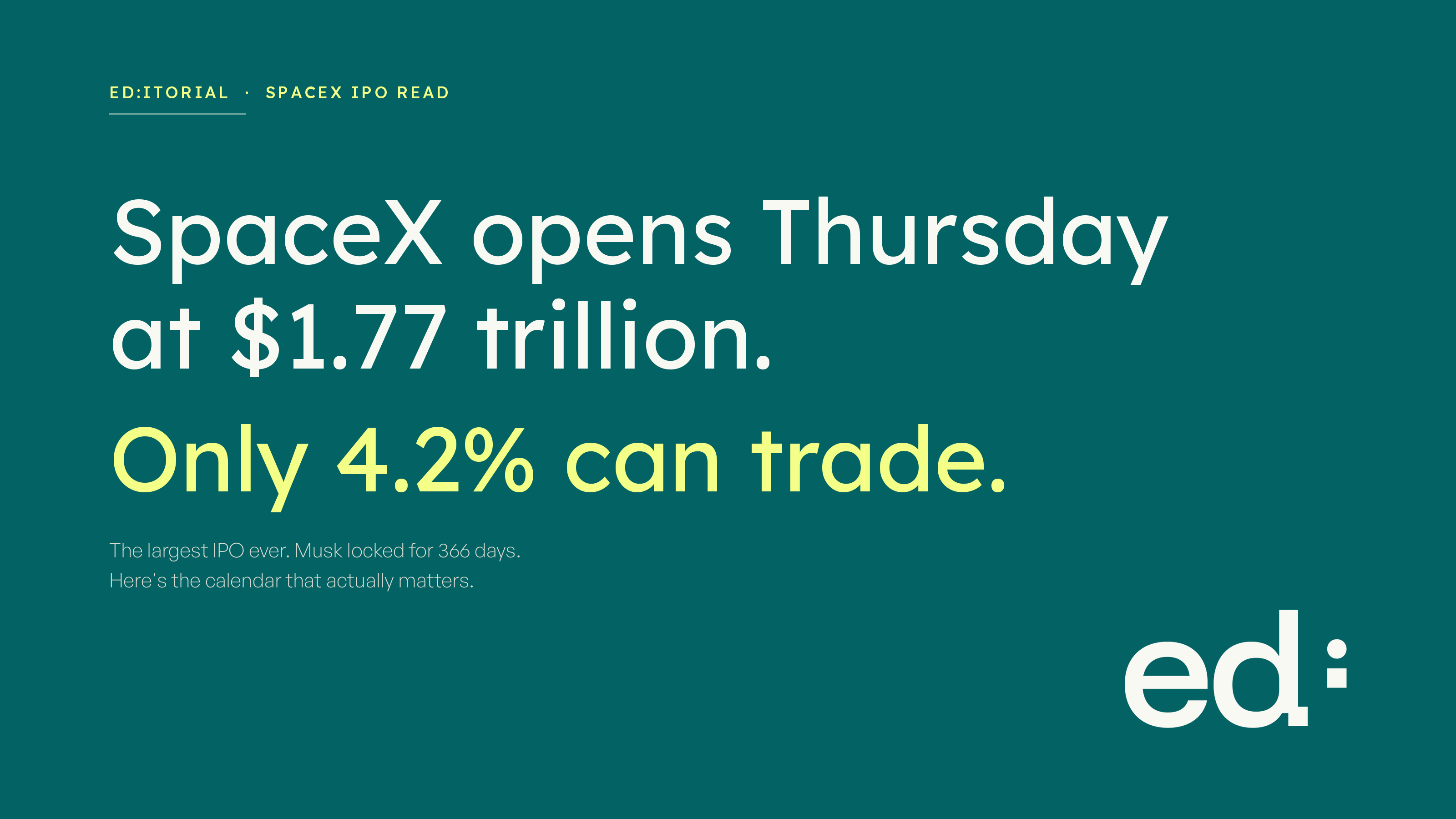
SpaceX opens Thursday at a $1.77 trillion valuation — the largest IPO ever. Only 4.2% of stock actually trades. Musk is locked up for 366 days. The next 366 days run on an unusually clean calendar of supply releases. Here are the 13 dates worth watching.

SpaceX goes public Thursday with a possible $5 trillion hit. Here's the calendar that actually matters.

SpaceX prices Wednesday night and opens Thursday on Nasdaq at $135 per share — a $1.77 trillion valuation, the largest IPO ever. Most coverage will frame what comes next as a sentiment trade, an Elon story, or a race to Goldman's $5 trillion bull case. The reality is more grounded and more useful: the next 366 days are governed by an unusually clean calendar of supply releases — when 95.8% of the company can or cannot trade, when index funds add weight, when the lock-up cliff arrives, when Musk himself becomes a potential seller for the first time. Read the calendar and you've already understood the structure most market commentary will spend the next quarter trying to explain. Here are the 13 dates worth watching. Two things keep showing up in headlines that don't survive a careful read. The first is the idea that index funds are about to be forced into a massive single-event SpaceX buy. They aren't. Nasdaq did create a fast-track inclusion rule that lets SpaceX join the Nasdaq 100 wi
Edgen
·
Jun 10 2026

Your money person, finally.

Try Ed free. No credit card. No commitment.