
Applied Digital Corporation Q1 2026 Review: The AI Factory Floor, Market Hasn't Priced It Yet
EDGEN · AI Infrastructure & HPC Hosting Stock Analysis
Applied Digital Corporation Q1 2026 Review: The AI Factory Floor, Market Hasn't Priced It Yet
NASDAQ: APLD
RATING | PRICE TARGET | CURRENT PRICE | UPSIDE | REPORT DATE |
|---|---|---|---|---|
BUY | $42.50 | $27.96 | +52% | March 17, 2026 |
Investment Summary
Applied Digital Corporation (APLD) is emerging as one of the most compelling pure-play AI infrastructure names in the public markets. The company designs, builds, and operates purpose-built hyperscale data centers optimized for GPU-dense high-performance computing (HPC) workloads — the backbone of the AI training and inference revolution.
We initiate coverage with a BUY rating and a 12-month price target of $42.50, implying +52% upside from the current price of $27.96. Key catalysts include the $5B Polaris Forge 2 lease, ramp of the CoreWeave $11B agreement, and sequential revenue acceleration.
Bull Case Thesis
– $16B contracted backlog with investment-grade hyperscalers provides 15-year revenue visibility
– Q2 FY2026 revenue of $126.6M (+250% YoY) demonstrates HPC ramp is ahead of expectations
– Purpose-built facilities in low-cost, power-rich North Dakota campuses compress construction to 12–14 months
– Polaris Forge 2 campus 200MW lease signed with second US hyperscaler — $5B over 15 years
– First-mover advantage in building AI factories for hyperscalers rather than competing with them
Bear Case Risks
– Customer concentration: CoreWeave accounts for the majority of the $11B in contracted backlog
– High leverage: $2.6B debt vs $2.3B cash as of Q2 FY2026 — construction-phase balance sheet
– Ongoing net losses (-$161M FY2025); profitability dependent on scale and ramp timeline
– Short interest elevated at ~26–33% of float; downward price pressure on negative catalysts
– Execution risk: large-scale facility buildouts are complex, capital-intensive, and time-sensitive
Sector Snapshot
The AI data center infrastructure market is in secular hypergrowth. Major hyperscalers including Microsoft, Google, Amazon, and Meta have collectively committed over $300B in capital expenditure for FY2025 and FY2026, with a significant portion directed toward GPU-dense compute campuses. This creates a multi-year tailwind for specialized operators like APLD.

Financial Overview
Applied Digital operates on a fiscal year ending May 31. The company pivoted decisively from crypto mining infrastructure to AI/HPC hosting beginning FY2024, and the revenue inflection is now materializing at scale.
Revenue Trend
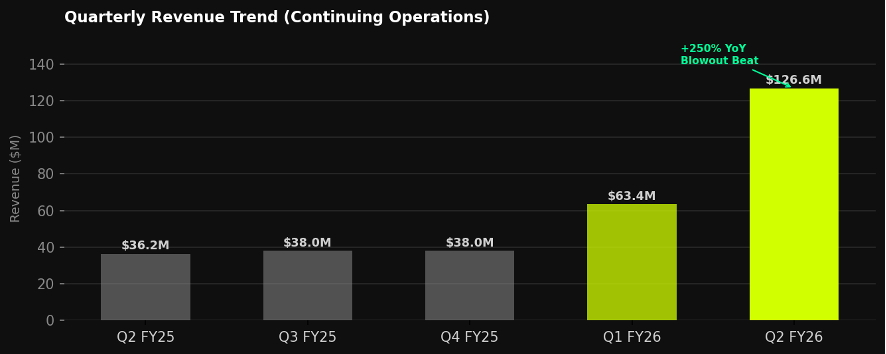
Q2 FY2026 (quarter ended November 30, 2025) was a defining moment: total revenues surged to $126.6M, up 250% year-over-year and representing a 46% beat versus consensus estimates of $86.7M. HPC Hosting contributed $85.0M and Data Center Hosting contributed $41.6M (+15% YoY).
Revenue by Segment — Q2 FY2026

Key Financial Metrics
Metric | FY2024 | FY2025 | Q1 FY26 | Q2 FY26 | Note |
|---|---|---|---|---|---|
Revenue ($M) | $136.6M | $144.2M | ~$63.4M | $126.6M | +250% YoY |
Net Loss ($M) | -$73.8M | -$161.0M | — | — | Scaling losses |
Cash & Equiv. | — | $114M | $114M | $2.3B | Post-financing surge |
Total Debt | — | $687M | $687M | $2.6B | Construction-phase leverage |
Shares Out. | — | 209M | — | 277M | +32% YoY dilution |
Company Profile
Applied Digital Corporation (formerly Applied Blockchain) was founded in 2014 and is headquartered in Dallas, Texas. The company operates two primary business segments:
HPC Hosting (Polaris Forge Campuses)
The HPC Hosting segment builds and operates purpose-built AI factory campuses in Ellendale, North Dakota. These facilities are engineered for extreme compute density, with direct-to-chip liquid cooling, high-density power distribution, and modular construction timelines compressed to 12–14 months. The flagship campus, Polaris Forge 1 (ELN-02), became fully energized during Q2 FY2026, unlocking the step-change in rental revenues. Polaris Forge 2 is under construction with a 200MW lease signed.
Data Center Hosting
The legacy data center hosting segment operates 286 megawatts across two North Dakota facilities, providing co-location services primarily for ASIC-based crypto mining and GPU compute customers. This segment delivered $41.6M in Q2 FY2026 (+15% YoY) and remains a stable cash-generative base.
Attribute | Detail |
|---|---|
Ticker | NASDAQ: APLD |
Sector | Technology — AI Infrastructure / Data Centers |
HQ | Dallas, TX (Operations: Ellendale, ND) |
Key Customer | CoreWeave ($11B, 15-yr) + Second US Hyperscaler ($5B, 15-yr) |
Total Backlog | ~$16B contracted revenue (as of Q2 FY2026) |
Capacity | 286MW operational (DC Hosting) + 200MW under construction (Polaris Forge 2) |
Technology Edge | Direct-to-chip liquid cooling, modular construction, purpose-built for GPU density |
Price Target Analysis
Analyst coverage has expanded significantly as APLD's revenue ramp has materialized. The consensus 12-month price target of $42.50 (14 analysts, all Buy/Strong Buy) reflects HPC ramp optionality and backlog conversion. The Street high of $99 implies a multi-year DCF on full backlog monetization.

Scenario | Price Target | Upside | Key Assumption | Probability |
|---|---|---|---|---|
Bull | $99 | +254% | Full $16B backlog converts on schedule; no customer default | 25% |
Base | $42.50 | +52% | Backlog ramps with 12-mo lag; moderate capital raise dilution | 50% |
Bear | $15 | -46% | CoreWeave counterparty risk or construction delay crystallizes | 25% |
Competitive Landscape
APLD operates at the intersection of traditional data center REITs and next-generation AI cloud infrastructure. Its closest peer is Core Scientific (CORZ), which has also transitioned from crypto to AI hosting. Established players like Equinix (EQIX) and Digital Realty (DLR) compete on scale and geographic diversity but lack APLD's HPC-native design advantages.

Company | Ticker | Mkt Cap | Revenue (TTM) | Gross Margin | AI/HPC Focus | Rating | PT |
|---|---|---|---|---|---|---|---|
Applied Digital | APLD | $7.7B | ~$254M* | — | Pure-Play | BUY | $42.50 |
Core Scientific | CORZ | ~$3.8B | ~$610M | ~45% | Transitioning | Buy | — |
Equinix | EQIX | ~$73B | $8.8B | ~47% | Indirect | Buy | — |
Digital Realty | DLR | ~$50B | $5.6B | ~34% | Indirect | Hold | — |
* TTM estimated as of Q2 FY2026 annualized.
Key Catalysts
– Polaris Forge 2 (200MW): Construction progress updates and energization milestones
– Q3 FY2026 earnings (March 2026): Sequential HPC rental revenue ramp confirmation
– Additional hyperscaler leases: Management has signaled pipeline for Forge 3+ campuses
– CoreWeave IPO correlation: CRWV's public market performance reflects AI cloud health
– Power access expansion: New interconnection agreements in ND unlock capacity
– Potential REIT conversion or infrastructure monetization: Strategic optionality
Risk Factors
– Customer concentration: CoreWeave ~70% of backlog — any stress at CRWV flows directly to APLD
– Execution risk: Large-scale construction projects carry cost overrun and timeline risk
– Capital structure: $2.6B debt load at construction phase requires continued access to capital markets
– Dilution: Shares outstanding grew 32% YoY in FY2026; future capital raises are likely
– Competition: Hyperscalers may accelerate in-house buildouts or work with EQIX/DLR at scale
– Macro risk: Rate environment affects REIT-like valuations; tighter credit could impact refinancing
– Regulatory: Energy permitting, grid interconnection, and data sovereignty rules in flux
Verdict
BUY | PT $42.50 | +52% Upside | Rating: Strong Buy (Consensus)
Applied Digital is executing on the most important infrastructure buildout of the current tech cycle. The Q2 FY2026 blowout quarter — $126.6M in revenue, +250% YoY — demonstrates that the HPC Hosting ramp is real, ahead of schedule, and backed by contractually committed revenue from investment-grade hyperscalers. With $16B in contracted backlog, a sub-$8B market cap, and a construction pipeline that is capital-financed and de-risked through long-term leases, APLD offers a rare combination of high conviction near-term catalysts and multi-year compounding potential.
The primary risk is customer concentration in CoreWeave — a risk that is well-understood but structural to APLD's growth story for the next 2–3 years. Investors comfortable with that exposure and the construction-phase balance sheet will find APLD one of the most asymmetric risk/reward setups in the AI infrastructure space.
FAQ
How does APLD differ from a traditional data center REIT?
Traditional REITs like EQIX and DLR focus on colocation for enterprise and cloud customers across diverse geographies. APLD builds bespoke, GPU-optimized campuses in low-cost power locations for hyperscalers training foundation models. APLD's facilities are 5–10x higher density per square foot and are purpose-leased rather than multi-tenant.
What is the timeline to profitability?
Management has guided toward Adjusted EBITDA turning positive at the campus level as ELN-02 reaches full energization. Net income profitability is likely 2–3 years away as depreciation and interest on the $2.6B construction debt weigh on GAAP earnings. Cash flow from operations should turn positive before net income, likely in FY2027.
Is CoreWeave's creditworthiness a concern?
CoreWeave raised $1.5B in a Series C at a $19B valuation and subsequently IPO'd in 2025. Its revenue has grown over 500% YoY driven by AI model training for OpenAI, Meta, and Microsoft. While not a traditional investment-grade counterparty, its contractual commitments with APLD are secured leases, limiting APLD's exposure relative to an unsecured receivable.
Why is short interest so high at 26–33%?
The elevated short interest reflects the bear case: construction-phase losses, CoreWeave concentration, and execution uncertainty. However, the Q2 FY2026 revenue beat and $16B backlog announcement have triggered meaningful short covering. High short interest can serve as a contrarian bullish signal if the catalyst trajectory continues to improve.
DISCLAIMER
This report is produced by Edgen Research for informational purposes only and does not constitute investment advice, a solicitation, or an offer to buy or sell any security. The information contained herein is based on sources believed to be reliable but is not guaranteed as to accuracy or completeness. Past performance is not indicative of future results. Investments in small- and mid-cap companies involve significant risks including liquidity risk and potential loss of principal. This research does not take into account individual investment objectives, financial situations, or needs. Recipients should seek independent financial advice before making investment decisions. Edgen Research and its affiliates may hold positions in the securities discussed.







Your money person, finally.
Try Ed free. No credit card. No commitment.