
Vietnam's $114 billion H1 trade surplus with the US surpassed China's, but the record now invites deeper origin scrutiny.
Vietnam's $114 billion H1 trade surplus with the US surpassed China's, but the record now invites deeper origin scrutiny.
Vietnam's $114 billion H1 trade surplus with the US surpassed China's, but the record now invites deeper origin scrutiny.
Vietnam recorded a $114 billion trade surplus with the US in H1 2026, surpassing China and Mexico, as tariff-driven production shifts from China boosted exports — but the record now invites closer origin scrutiny.
"Global supply diversification does not mean orders automatically shift to Vietnam," said Do Ngoc Hung, trade counsellor and head of the Vietnam Trade Office in the US. "To win customers, businesses need to build capacity, improve quality, adapt to market changes and comply with increasingly stringent standards."
US imports from Vietnam reached $123 billion in the first half, up 40 percent from a year earlier, while Chinese imports fell to $129 billion from $168 billion, according to federal data. The effective tariff rate on Chinese imports stood at 23.2 percent in June versus 6.5 percent for Vietnam, per the Penn Wharton Budget Model. Two-way trade between Vietnam and the US reached about $132.4 billion in the first six months of 2026.
The surplus positions Vietnam as a critical node in US supply chains — about 60 percent of Vietnamese exports to the US are machinery, electronics or appliances, per Mark Gillin, president of the American Chamber of Commerce in Vietnam. But the White House Office of Trade and Manufacturing Policy has placed Vietnam in a high-risk group for transshipment alongside Brazil, Indonesia, Malaysia, Türkiye and Thailand, meaning Vietnamese goods face continued scrutiny as US authorities deploy AI-powered systems to detect origin discrepancies.
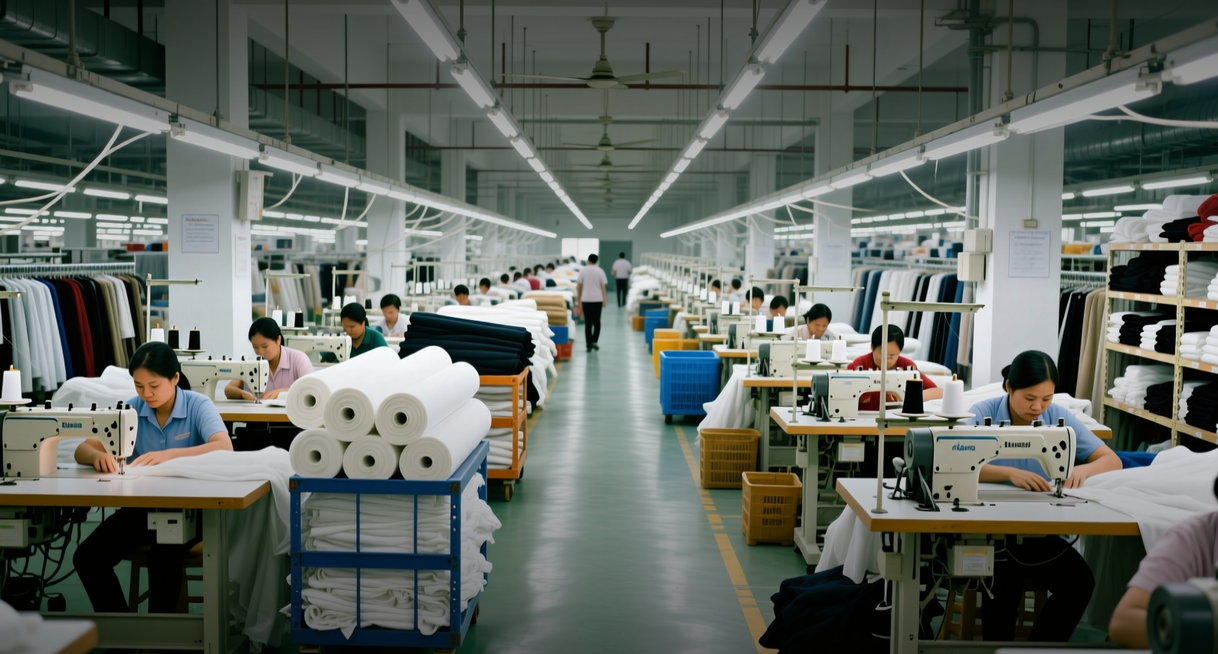
The textile and garment sector illustrates the compliance challenge. Exports exceeded $27 billion in the first seven months of 2026, including about $10.5 billion to the US, with a trade surplus of more than $11 billion, up about 10 percent year on year. The sector's growth was supported partly by increased domestic sourcing and stronger supplier networks — but it also sits squarely in the crosshairs of US anti-transshipment enforcement.
Vu Tu Thanh, acting managing director and Vietnam chief country representative at the US-ASEAN Business Council, said Vietnamese businesses face risks related to origin and illegal transshipment, dependence on imported materials, and increasingly stringent requirements on environmental, social and governance standards, emissions reduction, clean energy and supply-chain transparency.
Trade experts note that the concept of "China-linked goods" is relatively broad, potentially creating risks for many export sectors. US inspections are shifting from traditional document checks toward analysis of trade data, production data and entire supply chains. This requires businesses to demonstrate genuine production capacity, the sources of raw materials, manufacturing processes and the value added in Vietnam.
Dr. Vo Tri Thanh, director of the Institute for Brand and Competitiveness Strategy Research, said new requirements on production, the environment, labour and product quality are forcing exporters to adapt to higher standards. As an export-driven economy, Vietnam must continue to engage with markets that tighten standards and increase protectionism, he said, stressing the need to build sufficient capacity to meet requirements and maximise the benefits of trade ties.
Ann Ha, CEO of Defenova Global Connect, said Vietnam has an opportunity to increase imports of US technology, equipment and solutions as global supply chains shift toward "friend-shoring." Potential US imports include semiconductors, electronics, machinery, aviation products, high-tech agriculture, digital technologies and cybersecurity solutions, she said.
Access to advanced technologies will help businesses improve productivity and quality and meet requirements for joining global supply chains, particularly those of US corporations, Ha added.
The last time US tariff escalation reshaped sourcing patterns was during Trump's first term, when effective rates on Chinese goods rose sharply and prompted Apple, Nike and Lululemon to shift production to Vietnam over the past decade. Smaller producers followed — Miami-based TOV Furniture now sources 60 percent of its sofas and beds from Vietnam versus 25 percent from China, flipping its pre-2024 mix, because Vietnamese imports face a 25 percent tariff, half the rate levied on Chinese products.
The question now is whether Vietnam can convert its surplus into a durable trade relationship. If Vietnamese exporters demonstrate genuine production capacity and transparent origins, the surplus could stabilise as a structural feature of US supply chains. If not, the risk of new US trade actions targeting Vietnam's surplus grows — a scenario that would ripple through the electronics, furniture and apparel sectors that now depend on Vietnamese manufacturing.
This article is for informational purposes only and does not constitute investment advice.
