
Low Earth orbit now holds more than 46,000 tracked objects, and satellite operators are spending increasing resources on collision avoidance.
Low Earth orbit now holds more than 46,000 tracked objects, and satellite operators are spending increasing resources on collision avoidance.
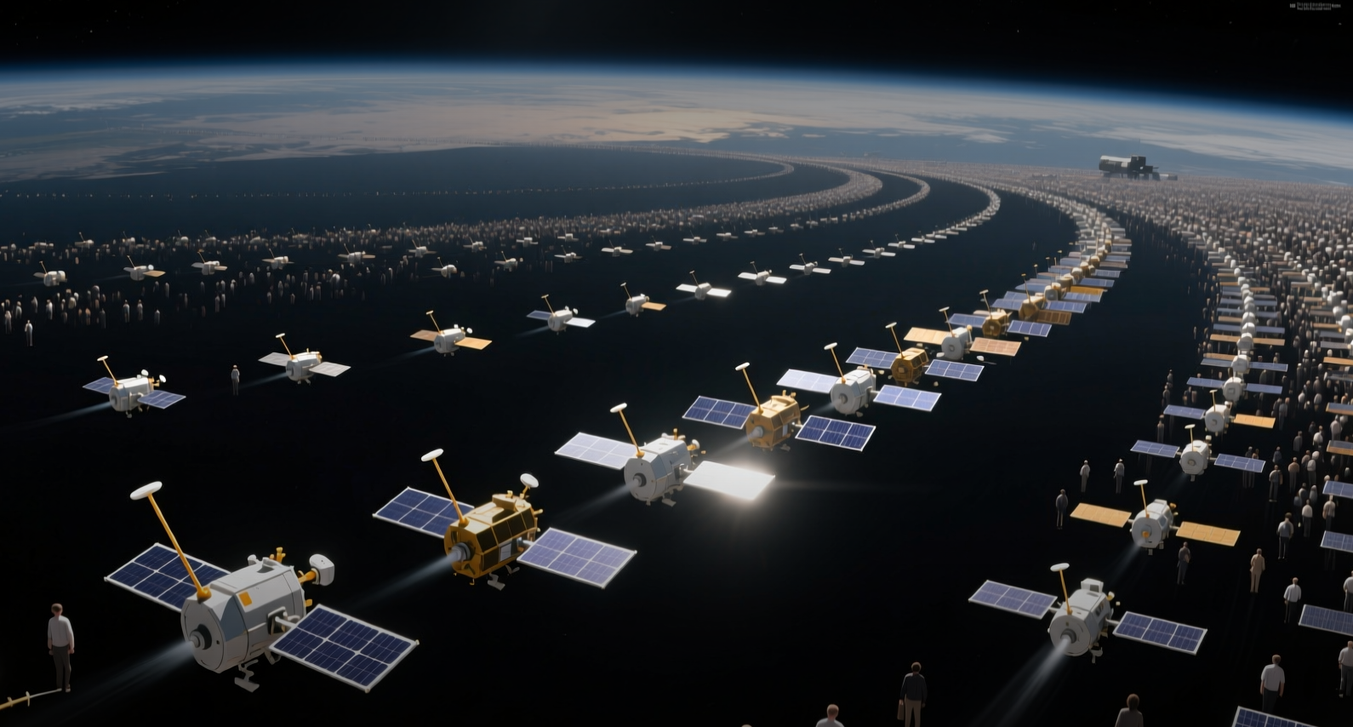
Low Earth orbit now holds more than 46,000 tracked objects, and satellite operators are spending increasing resources on collision avoidance.
SpaceX and rival satellite operators are executing more collision-avoidance maneuvers as low Earth orbit fills with more than 46,000 tracked objects — roughly 16,000 functioning satellites plus dead spacecraft, rocket stages and debris fragments traveling at speeds exceeding 17,000 miles per hour.
"Earth's orbital environment is a finite resource," the European Space Agency said in its latest Space Environment Statistics, updated July 31. "The number of debris objects posing a threat at around 550 kilometers altitude is now of the same order of magnitude as the number of active satellites."
The orbital population has grown rapidly as commercial constellations transformed the space economy. SpaceX's Starlink constellation surpassed 11,000 satellites in physical orbit in August, accounting for more than two-thirds of the world's functioning satellites, according to independent astronomer Jonathan McDowell. Eutelsat OneWeb operates 654 satellites at roughly 1,200 kilometers altitude, while Amazon Leo — formerly Project Kuiper — reported nearly 400 satellites in orbit in its second-quarter results and plans a constellation numbering in the thousands.
The congestion carries direct economic consequences. ESA has recorded more than 660 break-ups, explosions and collisions since the space age began, and debris larger than 1 centimeter can cause catastrophic damage to spacecraft. Insurance premiums for commercial satellite launches are surging as underwriters price in collision risk, and a single cascading event — the so-called Kessler syndrome — could render certain orbital regions unusable for generations.
The growth of satellite constellations has been the primary driver. Instead of launching one large communications satellite into geostationary orbit, operators now deploy hundreds or thousands of smaller spacecraft into low Earth orbit, where signal latency is lower but each satellite covers less ground. ESA estimates there are approximately 54,000 objects larger than 10 centimeters in orbit, another 1.2 million pieces between 1 and 10 centimeters, and roughly 140 million fragments between 1 millimeter and 1 centimeter.
Active satellites can maneuver away from known threats, but dead satellites, rocket bodies and fragments cannot. ESA says debris would continue increasing even if humanity stopped launching satellites tomorrow, because collisions and fragmentation create new objects faster than existing debris naturally falls back into the atmosphere.
The cleanup bottleneck
Aerospace startups are developing orbital debris removal vehicles — magnetic nets, robotic grappling arms and laser systems designed to capture dead satellites and drag them into Earth's atmosphere to burn up. But the effort is constrained by international law. Under Cold War-era treaties, a dead satellite remains the legal property of its launching nation indefinitely, meaning a private cleanup company cannot remove an obsolete Russian or Chinese satellite without diplomatic consequences.
ESA is pushing its Zero Debris Approach, which aims to significantly limit debris generation from future missions by 2030 and support the active removal of existing objects. Operators can also reduce risk by reliably deorbiting spacecraft, disposing of rocket stages and choosing lower orbits where atmospheric drag removes failed satellites more quickly.
For satellite operators, the rising collision risk translates directly into higher operating costs. Insurance premiums for commercial satellite launches are climbing as underwriters factor in the probability of impact with untracked debris. Smaller startups are increasingly priced out of the space race because they cannot absorb the liability insurance costs. Meanwhile, established operators like SpaceX, Eutelsat and Amazon are investing in autonomous collision-avoidance systems and end-of-life disposal protocols as a competitive differentiator.
The question is whether operators can launch, maneuver and dispose of satellites quickly enough to keep Earth's orbital highways usable. With roughly 16,000 functioning satellites already overhead and thousands more planned, the orbital population will continue to grow — and the cost of managing that growth will increasingly fall on the companies that profit from it.
This article is for informational purposes only and does not constitute investment advice.
