
China's State Council directed a coordinated push across four communication network fronts, a policy signal expected to accelerate state-backed telecom spending.
China's State Council directed a coordinated push across four communication network fronts, a policy signal expected to accelerate state-backed telecom spending.
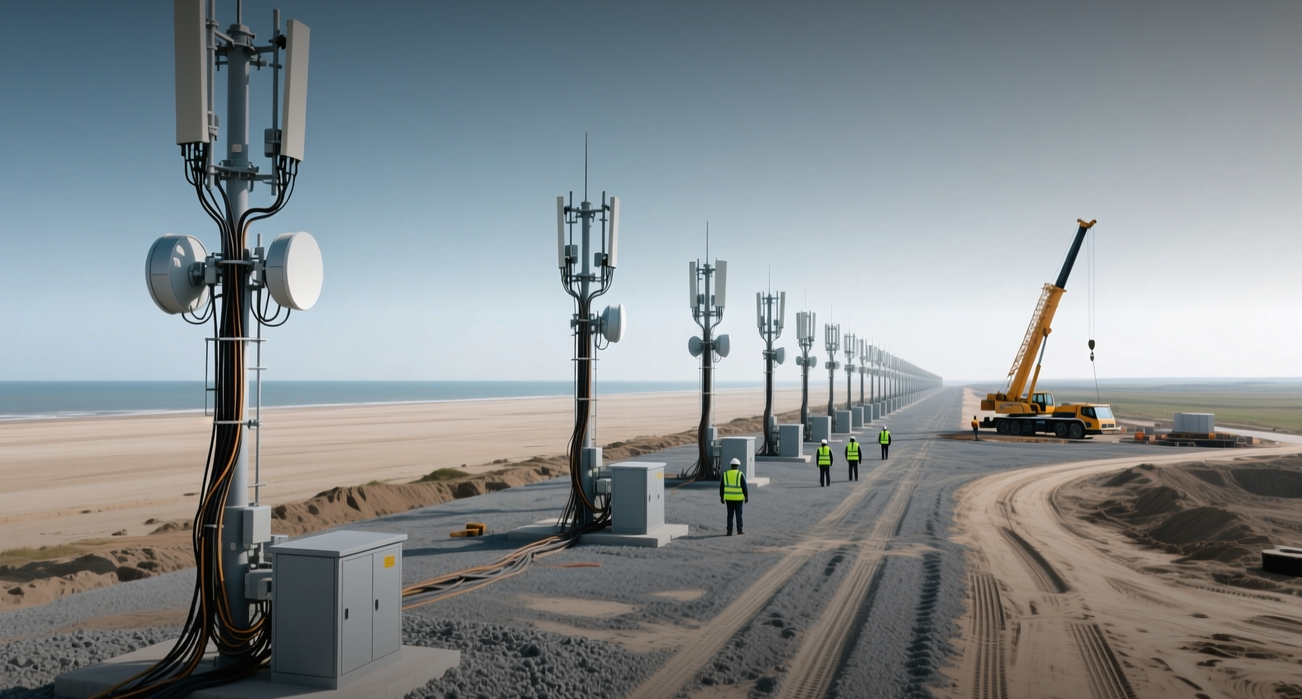
China's State Council directed a coordinated push across four communication network fronts, a policy signal expected to accelerate state-backed telecom spending.
China's State Council on Aug. 21 ordered a moderately forward-looking buildout of next-generation communication networks across four fronts, a directive expected to accelerate state-backed telecom capex and lift equipment makers including Huawei and ZTE.
"The meeting noted that we should actively adapt to the trends of the new round of technological revolution and industrial transformation, firmly grasp the opportunities of next-generation communication network construction, adhere to application-driven and moderately forward-looking principles, and coordinate the construction of basic, space, international, and converged networks," the State Council said in a statement after the executive meeting chaired by Premier Li Qiang.
The four-network framework spans terrestrial fiber infrastructure, low-earth-orbit satellite constellations, international submarine cable capacity, and converged networks integrating 5G with industrial internet. The directive names no specific budget figures, but the "moderately forward-looking" (适度超前) language signals the government's willingness to front-load investment ahead of commercial demand — the same approach that drove China's 5G rollout, which saw operators build out coverage well before subscriber adoption justified it.
For investors, the directive positions communication infrastructure as a strategic pillar of China's industrial policy, with direct beneficiaries including China Mobile, China Telecom, and China Unicom, alongside equipment suppliers in the Huawei supply chain and satellite communication companies. The next concrete step would be sector-specific implementation plans from the Ministry of Industry and Information Technology, which would clarify the scale and timeline of the capex cycle.
The State Council's framing represents a broadening of China's connectivity strategy beyond terrestrial 5G. The space network component points to China's expanding satellite ambitions, competing with SpaceX's Starlink constellation, while the international network element signals continued investment in submarine cable routes. The converged network component suggests deeper integration of telecommunications with industrial applications, a priority under Beijing's push for digital transformation of manufacturing.
The policy arrives as China's economy faces headwinds. The State Council has separately been unveiling targeted measures to support slowing growth, and infrastructure investment — including digital infrastructure — has been a key counter-cyclical tool. Communication network construction fits squarely within this framework, offering both short-term stimulus through capex and long-term productivity gains through digitalization.
For the telecom operators, the directive could translate into elevated capital expenditure budgets in the coming years. China Mobile, the world's largest telecom operator by subscribers, has been a steady dividend payer, and any acceleration in network investment would need to be weighed against its commitment to shareholder returns. China Telecom and China Unicom face similar considerations.
The equipment supply chain stands to benefit more directly. Huawei, despite U.S. sanctions, remains the dominant supplier of 5G equipment in China, and ZTE is a key secondary supplier. Satellite communication companies, including those involved in China's Guowang (national network) satellite constellation project, would be direct beneficiaries of the space network component.
The "moderately forward-looking" principle is the key signal for investors. It suggests the government is willing to accept some overcapacity in network infrastructure to ensure China maintains its competitive edge in information and communication technology. This is consistent with China's approach to 5G, where the government pushed operators to build out networks ahead of demand, and with its broader industrial policy of strategic self-reliance.
The directive also has geopolitical implications. As the U.S. and its allies restrict Chinese technology companies' access to advanced semiconductors and equipment, China's push to build out its own communication infrastructure — including satellite networks — is part of a broader strategy to reduce dependence on foreign technology.
For global investors, the key question is whether this translates into meaningful earnings growth for Chinese telecom and equipment companies. The answer will depend on the scale of the capex cycle, which the MIIT implementation plans will clarify. If the government commits to a multi-year, multi-billion-dollar buildout, the telecom complex could see a sustained re-rating.
This article is for informational purposes only and does not constitute investment advice.
