
Content
L'avenir du trading crypto est l'IA : découvrez Edgen AI
Qu'est-ce que le trading de jetons alimenté par l'intelligence...
Pourquoi l'IA est-elle importante dans le trading de cryptomon...
Les mémo-coïnsExpliqué : Plus que des blagues ?
ConnuLes mémo-coïns:
Pourquoi investir dansLes mémoïdes?
Comment l'intelligence artificielle révolutionne le trading de...
1. Analyse prédictive du marché
2. Bots de trading automatisé
3. Sentiment en temps réel ("Pumpamentals)
4. Suppression de l'émotion
5. Sécurité renforcée
Guide étape par étape : Investir en jetons etLes mémo-coïnsAve...
Étape 1 : Rechercher comme un professionnel
Étape 2 : Sélectionner un échange de confiance
Étape 3 : Achetez votre cryptomonnaie
Étape 4 : Surveiller les marchés avec l'intelligence artificie...
Étape 5 : Gérer les risques de manière prudente
Risques et réalités : Ce que tout trader devrait savoir
1. Volatilité extrême
2. Les arnaques de type Rug Pull et les escroqueries
3. L'IA n'est pas de la magie
4. Risques réglementaires
FAQ : Ce que les débutants posent le plus souvent
1.Le trading de jetons avec l'intelligence artificielle est-il...
2.Comment fonctionnent les bots de trading en intelligence art...
3.Qu'est-ce quemémecoinrisques ?
4.Peut l'IA prédire précisément les prix des cryptomonnaies ?
5.Comment les débutants commencent-ils à investir ?
Dernières réflexions : L'IA +MémecoinRévolution du commerce

Markets Confusing? Ask Edgen Search.

Instant answers, zero BS, and trading decisions your future self will thank you for.

Try Search Now

Comment trader les jetons alimentés par l'IA et les memecoins : un guide pour investir plus intelligemment en crypto
Edgen
· Mar 31 2026
Comment trader les jetons alimentés par l'IA et les memecoins : un guide pour investir plus intelligemment en crypto

L'avenir du trading crypto est l'IA : découvrez Edgen AI

Le trading de cryptomonnaies évolue à une vitesse fulgurante. Clignez des yeux, et vous manquerez la prochaine grande tendance. Récemment, deux tendances ont dominé les titres de presse : les jetons alimentés par l'intelligence artificielle etmemecoinsle commerce. Qu'est-ce que ce sont exactement, et pourquoi cela devrait-vous importer ?

Les jetons alimentés par l'intelligence artificielle utilisent l'intelligence artificielle pour prédire les mouvements du marché, repérer les tendances et exécuter des opérations avec une précision millimétrique.Les mémo-coïns, sont des cryptomonnaies ludiques inspirées des canulars d'internet et de la culture en ligne. Elles commencent souvent comme des blagues mais peuvent parfois se transformer en investissements sérieux (regarde-toi, Dogecoin).

Avec des plateformes commeEdgen AI, les traders obtiennent une analyse du marché en temps réel, suivant tout, des sentiments sociaux aux données sur la chaîne. Si vous êtes débutant, accrochez-vous : ce guide explique exactement ce que sont les jetons etmémecoinle commerce, comment il fonctionne, et comment investir intelligemment et en toute sécurité.

Qu'est-ce que le trading de jetons alimenté par l'intelligence artificielle ?

En bref, le trading alimenté par l'intelligence artificielle utilise des algorithmes avancés pour analyser les échanges de cryptomonnaies plus intelligemment et plus rapidement. Il est guidé par des données, des modèles prédictifs et l'apprentissage automatique.

Pourquoi l'IA est-elle importante dans le trading de cryptomonnaies :

  • Puissance de traitement des données :L'IA analyse instantanément des montagnes de données du marché.
  • Précision prédictive :Les variations des prix à l'actif avant la meute.
  • Le commerce dépourvu d'émotion :Élimine les biais humains et les erreurs causées par la panique.
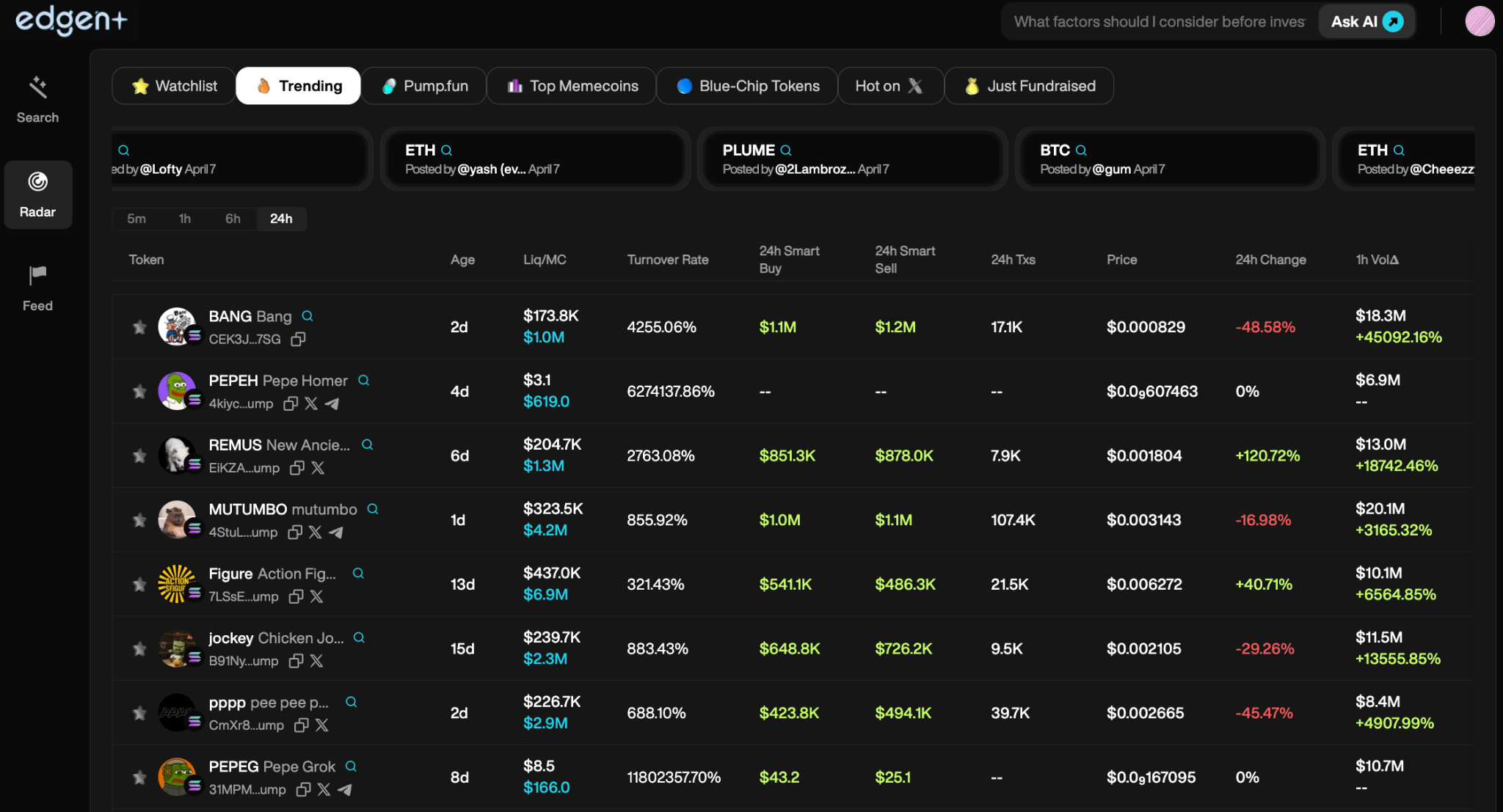
  • Suivi de l'opinion sociale :Détecte les excès précocement en utilisant des outils comme Edgen Radar

Échanger des cryptomonnaies sans IA ? C’est mignon… mais obsolète.

Les mémo-coïnsExpliqué : Plus que des blagues ?

Les mémo-coïnssont des cryptomonnaies qui capturent la culture et l'humour d'internet, transformant la popularité virale en valeur crypto. Nées à partir de récits, elles prospèrent grâce à l'excitation de la communauté et à la dynamique virale.

ConnuLes mémo-coïns:

  • Dogecoin (DOGE) :Veuillez traduire la phrase suivante en français. Conservez la structure et les termes techniques précis. Évitez la surtraduction.

    Originalmémecoinné d'une blague, maintenant un acteur sérieux.
  • Shiba Inu (SHIB) :Rival populaire de Dogecoin, grande communauté, forte volatilité.
  • Pepe Coin (PEPE) :S'inspirant du célèbre motif de Pepe le Grenouille, a rapidement acquis un statut de culte.

Pourquoi investir dansLes mémoïdes?

  • Croissance guidée par la communauté :Les mémo-coïnsexplose quand l'hype rencontre le FOMO.
  • Grand potentiel de récompense :Les gains (et les pertes) rapides sont fréquents.
  • Divertissements culturels :Investir dansmemecoinssignifie souvent rejoindre une communauté dynamique.

Maismemecoinsviennum avec une mention de risque élevé : ils sont volatils et imprévisibles. UtiliserEdgen Radar, les traders peuvent suivre les tendances sociales en temps réel, offrant un avantage pour naviguer dans lemémecoinmontagnes russes
Crypto trading

Comment l'intelligence artificielle révolutionne le trading de cryptomonnaies

L'IA n'est pas seulement un luxe ; c'est la nouvelle norme dans l'investissement moderne. Du pronostic du marché à l'exécution automatisée, l'IA aide les traders à opérer avec précision. Si vous souhaitez explorer comment ces technologies transforment la finance traditionnelle, consultez le CFA Institute’s report on AI in asset management.

1. Analyse prédictive du marché

L'IA analyse les tendances et prédit les mouvements du marché plus rapidement que les traders humains ne peuvent réagir.

2. Bots de trading automatisé

Les bots d'IA exécutent des stratégies 24/7, maximisant l'efficacité de votre trading sans interruption.

3. Sentiment en temps réel ("Pumpamentals)

Edgen AIsuivi des comptes intelligents, des KOL et de la hype sociale. Vous repérerez la prochaine tendance virale.mémecointôt, pas tard.

4. Suppression de l'émotion

Les humainsla panique,L'IA ne le fait pas. Les décisions de trading sont fondées sur les données, disciplinées et fiables.

5. Sécurité renforcée

L'IA détecte plus rapidement la fraude, les activités suspectes et les escroqueries, protégeant ainsi votre crypto-monnaie.

Guide étape par étape : Investir en jetons etLes mémo-coïnsAvec l'intelligence artificielle

Crypto Trading

Prêt à trader plus intelligemment ? Voici votre manuel :

Étape 1 : Rechercher comme un professionnel

UtilisezEdgen Searchpour explorer en profondeur l'histoire des jetons, les cas d'utilisation, les mouvements du marché et le buzz social.

Étape 2 : Sélectionner un échange de confiance

Choisissez un DEX réputé (Uniswap,Pancakeswapou CEX (Binance, Coinbase, Kraken) après s'être connecté de manière transparente àEdgen Radar.

Étape 3 : Achetez votre cryptomonnaie

Déposez des fonds, échangez vos jetons et stockez-les en toute sécurité.

Étape 4 : Surveiller les marchés avec l'intelligence artificielle

Utiliser l'avantageEdgen Radarpour des signaux de marché en temps réel, en suivant à la fois les activités sur la chaîne et les tendances sociales.

Étape 5 : Gérer les risques de manière prudente

Investissez de manière responsable. Les deux jetons etmemecoinssont à risque élevé,haute récompenseJoue. Ne YOLO pas ton épargne entière.

Crypto Trading

Risques et réalités : Ce que tout trader devrait savoir

Excitant ? Absolument. Sans risque ? Absolument pas. Voici ce à quoi faire attention :

1. Volatilité extrême

Les marchés cryptographiques sont imprévisibles, et même l'intelligence artificielle ne peut pas attraper chaque seule surprise.

2. Les arnaques de type Rug Pull et les escroqueries

Vérifiez toujours les projets avant d'investir. Utilisez Edgen Searchpour filtrer les fraudes.

3. L'IA n'est pas de la magie

L'IA repose sur des données historiques, qui ne prédisent pas toujours parfaitement les mouvements futurs à 100 %.

4. Risques réglementaires

Les actions du gouvernement peuvent modifier rapidement le paysage des cryptomonnaies en une seule nuit.

FAQ : Ce que les débutants posent le plus souvent

1.Le trading de jetons avec l'intelligence artificielle est-il un bon investissement ?

Potentiellement, oui. Il offre des analyses basées sur les données et une exécution rapide des transactions, mais il comporte toujours un risque de marché. Faites toujours une recherche approfondie.

2.Comment fonctionnent les bots de trading en intelligence artificielle ?

Les bots analysent les données du marché et sociales en temps réel, puis automatisent les échanges instantanément. Des plateformes commeEdgen Radarsuivre les portefeuilles intelligents et les tendances du marché, vous maintenant en avance.

3.Qu'est-ce quemémecoinrisques ?

Les mémo-coïnssont extrêmement volatils et spéculatifs. Le prix est déterminé par la communauté et le buzz plutôt que par des fondamentaux solides. Faites attention aux opérations de pompage et de vidange ainsi qu'aux arnaques.

4.Peut l'IA prédire précisément les prix des cryptomonnaies ?

L'IA améliore considérablement les prévisions, mais la crypto reste imprévisible. Les facteurs externes toutefois (régulation, actualité, événements majeurs) peuvent encore surprendre les marchés.

5.Comment les débutants commencent-ils à investir ?

Utilisez Edgen Searchchoisissez une bonne plateforme d'échange, investissez en toute sécurité et suivez votre parcours via Edgen Feed.

Dernières réflexions : L'IA +MémecoinRévolution du commerce

L'avenir du trading crypto intègre l'intelligence artificielle et la hype portée par la communauté. L'intelligence artificielle aide les traders à naviguer dans la complexité, tandis quememecoinsoffrir des investissements culturels excitants, bien que risqués.

Les plateformes commeEdgen AIdiriger cette révolution, en combinant des analyses en temps réel sur la chaîne de blocs avec l'analyse sociale. C'est une vision claire du présent, plus intelligente et plus rapide que quiconque.

Prêt à adopter des jetons alimentés par l'IA etmemecoinsCommencez petit, négociez intelligemment, restez informé et laissezEdgen AIaidez-vous à dominer le marché dynamique des cryptomonnaies.


Recommend
banner.jpg

What is a money person? The plain-English alternative to a financial advisor

The short version: a money person is a smart, warm friend who happens to be good with money and explains it like a person, not a bank. Practically, it's a second opinion on your whole financial picture — cash, debt, tax exposure, concentration, and the goals you're working toward — that tells you in plain language what to look at first. It's not a traditional advisor managing your portfolio for 1% a year, and it's not a coach cheering you on. It's the honest read a good advisor's first meeting would give you, without the fee or the asset minimum. It's the role Ed Wealth was built to play. Strip away the label and a money person does four concrete things: Just as important is what it doesn't do: it doesn't take custody of your money, it doesn't sell you products for commission, and it doesn't pretend a forecast is a promise. It's a second opinion: it shows you the structure and lets you decide. People reach for four different things when they say "I should talk to someone." They're not
Edgen
·
Jul 10 2026
banner.jpg

Is a financial advisor worth it? Advisor vs robo vs money person

The short version: a financial advisor is worth it when your money has real complexity — a business, concentrated stock, an estate, a divorce, or turning savings into retirement income. There, a fee pays for itself. But most people don't have a complexity problem; they have a clarity one, and paying 1% of your assets a year — about $3,000 on a $300,000 portfolio, every year — is a lot to pay for reassurance. You have three tiers to choose from: a human advisor (~1% of assets), a robo-advisor (~0.25%), and a money person — a flat-fee second opinion that doesn't grow as your savings do. Start with the honest case for paying. A good advisor earns their fee when your situation is genuinely complex: selling a business, a big block of company stock or options, an estate with kids, a divorce, a windfall, or building a retirement-income plan with real moving parts. In those moments, one right call can save you many times the fee, and the job becomes picking a good one (that's how to choose a f
Edgen
·
Jul 10 2026
banner.jpg

Do You Actually Need a Financial Advisor? (An Honest Test)

The short version: you need a financial advisor when your money has genuine complexity — equity comp across several employers, a business sale, an estate with kids involved, a divorce, a sudden windfall, or a retirement-drawdown plan with real moving parts. If your situation is closer to "I earn well but somehow feel behind," that's a clarity problem, not a complexity one, and hiring someone to manage your money for about 1% a year is an expensive way to solve it. Here's how to tell which one you have. Almost everyone reaching for an advisor falls into one of two camps, and confusing them is where money gets wasted. A complexity problem is when there are real moving parts that interact: decisions where a wrong move costs far more than any fee. Selling a company, exercising stock options with a tax bill attached, splitting assets in a divorce, planning how to draw income across a 30-year retirement. Here, a good advisor earns their keep. A clarity problem looks different. Good income, a
Edgen
·
Jul 06 2026
banner.jpg

How to Choose a Financial Advisor in 2026 (and Whether You Even Need One)

The short version: picking a financial advisor isn't about finding the "smartest" one. It comes down to three boring questions that actually predict whether you'll be treated well: are they legally a fiduciary, how do they get paid, and do you even need one yet. Get those right and the rest is noise. Here's how to run the check — and what to do if you want guidance but can't (or don't want to) meet a $250,000 minimum. Before you choose one, ask whether this is the right tool at all. A full-service advisor earns their fee when your situation is genuinely complex — a business sale, equity comp across several companies, estate planning, a divorce, a sudden windfall, or a retirement-income plan with real moving parts. But a lot of people reaching for an advisor don't have a complexity problem. They have a clarity problem: a good income, a few scattered accounts, and a nagging sense of being behind. That doesn't need someone to manage your money for 1% a year. It needs a clear read on where
Edgen
·
Jul 06 2026
Redeem miles for gift cards and each is worth ~1 cent; redeem for long-haul business and they're worth 2.5-4+. With programs now dynamically priced, the one check that decides every redemption.

How to redeem airline miles without wasting them

The single biggest mistake with miles is redeeming them for the easy stuff: gift cards, merchandise, seat upgrades at the gate. Do that and each mile is worth about one cent. Redeem the *same* miles for flights, especially long-haul or premium-cabin flights, and they're often worth two to five cents each, sometimes more. So the real skill isn't earning miles; it's not throwing away their value at the finish line. Here's how to actually use them. A mile has no fixed price; its value depends entirely on what you redeem it for. The way to judge any redemption is simple math: (cash price of the flight) ÷ (miles it costs) = cents per mile. If a flight costs $400 or 20,000 miles, that's 2 cents a mile, a solid deal. If a $90 flight costs 18,000 miles, that's half a cent, which is terrible; pay cash and keep the miles. Run this check before every redemption. It instantly separates a great use from a waste, and it's the one habit that makes miles worth having. As a rule of thumb, most major ai
Edgen
·
Jun 30 2026
Short-term goals (under ~3 years) belong in safe cash; long-term goals (5+ years) can take market risk. The best HYSAs now pay ~4-5% APY. How to sort yours and run both.

Long-term vs short-term financial goals (and how to plan both)

The difference comes down to one thing: time. A short-term goal is money you'll need within roughly three years (an emergency fund, a trip, a wedding, next year's tax bill), so it has to be *safe and reachable*. A long-term goal is five-plus years out (retirement, a house down the road, a kid's education), so it can take market risk, because time smooths the bumps out. Get that match right and you've done most of the work. It's not the size, it's the deadline. A $2,000 goal you need in six months is short-term; a $2,000 goal you won't touch for fifteen years is long-term, and they belong in completely different places. This is the part that actually matters, and where people lose money without realizing it. Short-term money should not be in the stock market. If your emergency fund is in stocks and the market drops 20% the same month your car dies, you're selling at the worst possible time. Short-term goals go somewhere stable and accessible, and a high-yield savings account is the clas
Edgen
·
Jun 30 2026
Mortgages near 6.5%, home prices flat, and the Fed split on rate cuts vs hikes. With timing a coin flip, the 3 questions that actually decide whether to buy now or wait.

Should you buy a house now or wait? How to actually decide

The honest answer: buy when you'll stay put for at least five years and you'll still have an emergency fund left after the down payment. Otherwise, waiting (and renting) is often the smarter money move, not the weaker one. "Rent vs buy" isn't a math problem with one right answer, and it's almost never really about timing the market. It's about your *life*, in three questions. Before the three questions, here's the mid-2026 backdrop — because "now or wait" usually hides a bet on rates and prices, and the data says that bet is a coin flip. The picture: mortgages are still pricey, prices have gone flat (more than half of the 20 big metros saw year-over-year declines in March), and the cheap-money era hasn't returned. So "buy before it runs away" and "wait for the crash" are *both* weak arguments right now. The whole "wait for rates to drop" plan rests on the Fed, and the Fed is split down the middle. In its June 2026 projections, policymakers were divided: 8 expected no change this year,
Edgen
·
Jun 30 2026
Most financial goals fail because they're wishes, not systems. Here's the 3-part anatomy of a goal that sticks (a number, a date, one automatic move), plus why 37% of adults can't cover a $400 surprise.

How to set financial goals you'll actually hit

A financial goal you'll actually hit has three things a vague wish doesn't: a number, a date, and one automatic move that happens whether or not you remember it. "Save more" is a wish. "$6,000 in a separate account by next December, $500 auto-transferred on payday" is a goal. The gap between those two sentences is the reason most goals quietly die, and it has almost nothing to do with willpower. Key Takeaways A real financial goal answers three questions: how much, by when, and what for. Drop any one and it stops working. "Pay off debt" has no number and no date, so there's nothing to aim at or measure, while "$8,000 of card debt cleared in 18 months" tells you exactly whether you're on track and the day you're done. The "what for" matters more than people expect. A goal tied to something real (a buffer so a bad month isn't a crisis, a deposit on a first place) survives the months when motivation dips. In our experience reading how people actually use a money tool, the goals that get
Edgen
·
Jun 30 2026
A big RSU grant just vested — now what? Here's what a modern money tool actually surfaces first, using Ed as a worked example: a reality check, the 22% tax gap most high earners miss, and the concentration risk nobody flags.

Your RSUs Just Vested. Here's What a Money Tool Surfaces First.

You just had a big RSU grant vest. Congratulations — and now the awkward part: a six-figure pile of your own company's stock, a vague sense you should "do something," and no one actually telling you what. An advisor, a spreadsheet, and a piece of software each handle this moment differently. Here's what a modern money tool surfaces in a moment like this — using Ed as a worked example — so you can decide what kind of help actually fits. Key takeaways You connect your brokerage and bank through read-only aggregation, so the tool can read balances but can't move a dollar. Ed's framing is simple: precise about your money, blind to your identity. Instead of sorting your lattes into categories, Ed opens on a single Financial Reality Check — a read on whether your money could survive a bad month. For a lot of high earners, that one number lands harder than any budget, because it answers a question the other apps never ask. (If the Reality Check is the numbers side, your money type is the beha
Edgen
·
Jun 26 2026
A money personality test is more than a quiz if it measures behavior, not just vibes. Here's the science behind money types, how Ed's test works, and how to use your result.

What Is a Money Personality Test? The Science Behind Your Money Type

The short version: a good money personality test should feel like a roast and work like a mirror — fun on the surface, behavioral underneath. The useful ones don't tell you what you know; they show you how you act with money, and the one blind spot worth watching. Key takeaways Here's the uncomfortable backdrop. U.S. financial literacy has been stuck for a decade — adults answer only about 49% of the standard knowledge questions correctly, essentially flat since 2017 (TIAA Institute–GFLEC, 2025) — even as free financial information became infinite. If facts fixed money, they'd have fixed it by now. They don't, because the thing that actually drives your outcomes lives one level below the facts: how you're wired to behave when money is on the line. That's the whole premise of financial fitness — and it's what a money personality test is built to surface. Not what you know. What you do. The idea has real research behind it — money behavior is patterned and measurable, and a few tradition
Edgen
·
Jun 23 2026

Investir, enfin, tu n'es plus seul.

Essaie Edgen gratuitement. Sans carte, sans engagement.