
Content
¿Qué es el Trading Alfa?
Definir Alpha en el trading
Cómo los operadores encuentran Alpha hoy en día
Cómo la IA Cambia Alpha Trading
Las ventajas del trading con inteligencia artificial:
Alpha Signal Trading: Encontrando Operaciones Ganadoras
Ejemplos de Señales Alpha:
Mejores Estrategias para el Trading Alfa Definidas
1. Seguimiento de Tendencias
2. Reversión a la media
3. Arbitraje Inteligente
¿Por qué los datos en cadena son importantes en el trading de ...
Errores Comunes de los Comerciantes Explicados (Y Cómo Evitarl...
El Futuro de la Comerciación Alfa y la IA
¿A dónde va la Dirección de Alpha Trading:
Cómo los operadores se mantienen a la vanguardia

Markets Confusing? Ask Edgen Search.

Instant answers, zero BS, and trading decisions your future self will thank you for.

Try Search Now

Alpha Trading: La forma inteligente de superar al mercado
Edgen
· Mar 31 2026
Alpha Trading: La forma inteligente de superar al mercado

¿Qué es el Trading Alfa?

La mayoría de los traders de criptomonedas pierden dinero. ¿Por qué? Les falta una ventaja crítica. Una ventaja llamada "alpha".

El trading alfa implica superar consistentemente los índices del mercado. Va más allá de gráficos básicos o fundamentos. Los movimientos del mercado actual siguen narrativas, tendencias de datos y momentum social.

Plataformas impulsadas por IA comoEdgen AI procesar datos del mercado en grandes cantidades de forma inmediata, identificando patrones y señales de alpha que los traders humanos pasan por alto. Al combinar análisis de blockchain, sentimiento social y inteligencia artificial avanzada, Edgen elimina puntos ciegos y proporciona una ventaja competitiva.

Definir Alpha en el trading

Alpha mide los rendimientos por encima del rendimiento estándar del mercado.

Por ejemplo:

  • Si la referencia del mercado crece un 7 %, pero su cartera sube un 12 %, su alpha es igual a +5 %.
  • Esos 5% adicionales se deben a una mejor inteligencia de mercado, reacciones más rápidas y decisiones más inteligentes.

Esos 5% adicionales se deben a una mejor inteligencia de mercado, reacciones más rápidas y decisiones más acertadas.Para una vista más detallada de cómo funciona el alpha en el rendimiento del portafolio, consulte laCorporate Finance Institute’s explanation of alpha.

Cómo los operadores encuentran Alpha hoy en día

Las señales Alpha provienen de fuentes identificables:

  • Insights impulsados por IA: Las máquinas analizan grandes conjuntos de datos más allá de la capacidad humana.
  • Seguimiento de Sentimiento Social: Los movimientos del mercado a menudo siguen narrativas impulsadas por las redes sociales.
  • Análisis en cadena: Las actividades significativas de billeteras indican posibles cambios.
  • Respuesta Rápida del Mercado: Las reacciones rápidas determinan la rentabilidad en mercados volátiles.

Los métodos tradicionales de comercio proporcionan una visibilidad incompleta. Las plataformas comoEdgen AIrevelar señales alfa en tiempo real, permitiendo a los operadores actuar primero.
Crypto trading

Cómo la IA Cambia Alpha Trading

La inteligencia artificial ya no representa el futuro del comercio. Actualmente define el éxito en los mercados.

Las ventajas del trading con inteligencia artificial:

  • Procesamiento de Datos en Tiempo Real: La IA evalúa grandes conjuntos de datos y lo hace de inmediato.
  • Detección Temprana de Patrones: La IA detecta tendencias antes que los operadores humanos.
  • Comercio sin Emociones: Elimina la venta desesperada y las compras impulsivas.
  • Detección en Tiempo Real de Alpha: Descubre oportunidades ocultas antes de la conciencia general.

El AI Edgen ofrece herramientas distintas diseñadas para el trading de alfa:

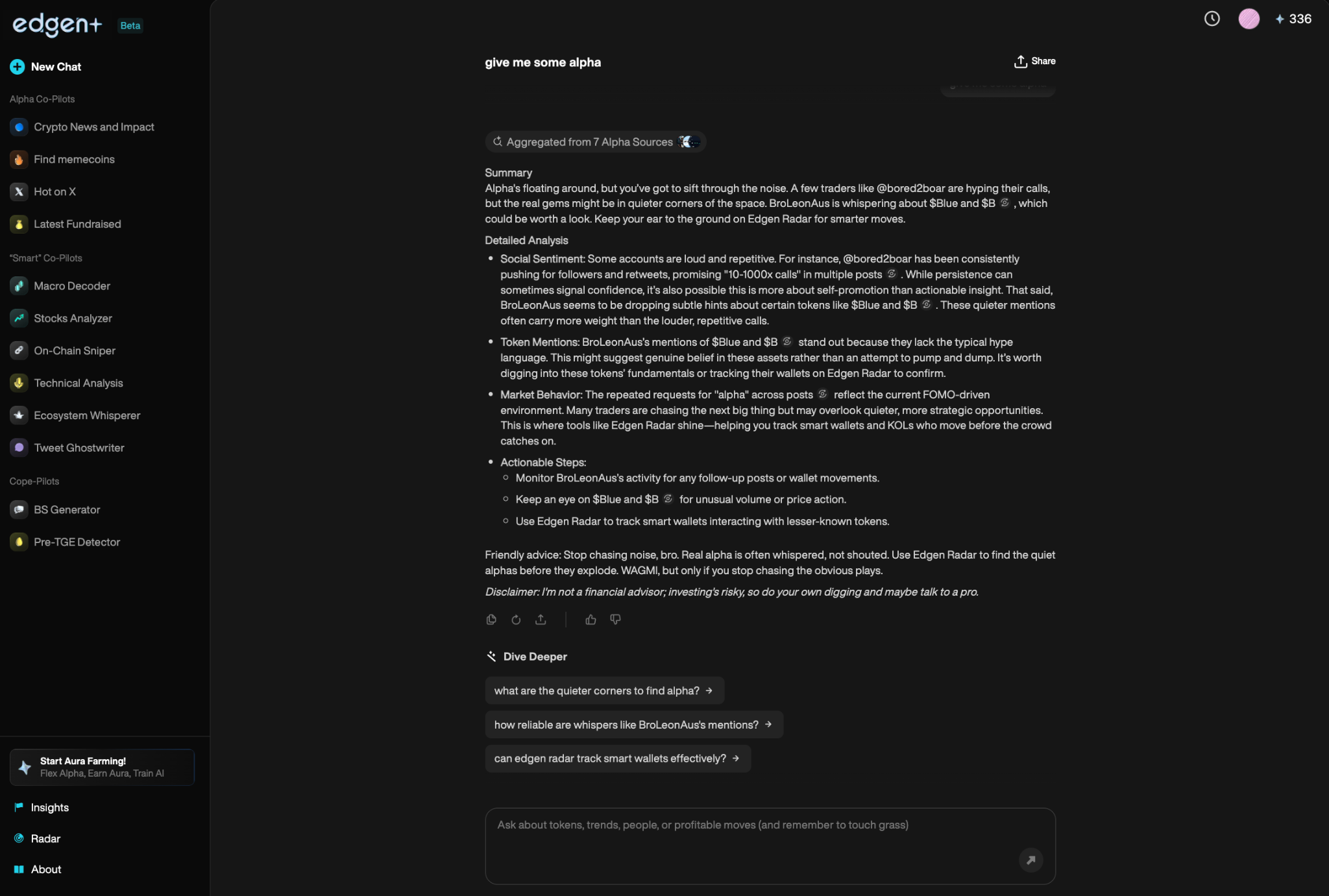
  • Edgen Radarmuestra la sentimiento del mercado en tiempo real, los cambios de precio y las señales de alpha.
  • Edgen Searchrespuestas preguntas detalladas del mercado utilizando datos verificados, eliminando el ruido.
  • Edgen InsightsProporciona un centro colaborativo para que los comerciantes compartan opiniones de inmediato.

El comercio sin IA limita significativamente la visibilidad del mercado. Edgen AI permite a los traders ver lo que otros pasan por alto.

Alpha Signal Trading: Encontrando Operaciones Ganadoras

Las señales Alpha proporcionan indicaciones tempranas de operaciones rentables.

Ejemplos de Señales Alpha:

  • Movimientos Súbitos en el Precio: Subidas o caídas rápidas indican puntos de acción.
  • Aumentos de Volumen: Una alta actividad de trading indica oportunidades.
  • Actividades en cadena: los billeteras de ballenas y los movimientos de billeteras influyentes predicen los movimientos del mercado.
  • Sentimiento Social: El entusiasmo de la comunidad predice aumentos en el precio de las criptomonedas.

Edgen Radaridentifica estas señales de inmediato, mientrasEdgen Searchrastrea a los comerciantes influyentes y temas en tendencia, permitiendo a los comerciantes actuar primero.

Mejores Estrategias para el Trading Alfa Definidas

Para comerciar con beneficios, siga estrategias de alpha probadas:

1. Seguimiento de Tendencias

identificar temprano las tendencias del mercado. Usar alertas de IA para entradas y salidas oportunas.

2. Reversión a la media

El comercio identifica condiciones de sobrecompra o sobreventa hacia el valor justo. La IA detecta los momentos óptimos para operar.

3. Arbitraje Inteligente

Captura instantánea de diferencias de precios entre intercambios. Los bots de IA automatizan la ejecución de manera eficiente.

Edgen AI desarrolla herramientas especializadas para ejecutar estas estrategias con precisión.

¿Por qué los datos en cadena son importantes en el trading de alpha

Las transacciones de blockchain proporcionan información, revelando señales críticas de trading:

  • Movimientos de la Cartera Inteligente: Los principales monederos influyen en los precios del mercado criptográfico.
  • Actividad de Contrato Inteligente: Las tendencias DeFi surgen de las dApps activas.
  • Flujos de liquidez: Los movimientos de dinero hacia y desde las bolsas indican cambios en el mercado.

Edgen Radarproporciona información en tiempo real sobre blockchain, permitiendo a los traders actuar con decisión antes que otros.

Errores Comunes de los Comerciantes Explicados (Y Cómo Evitarlos)

  • Error: Comerciar sin un plan.

Solución: Definir los puntos de entrada y salida antes de ingresar a una operación.

  • Error: Ignorar los datos sociales y blockchain.

Solución: Reconocer que las narrativas y las actividades de blockchain impulsan los mercados hoy en día.

  • Error: Sobreturismo debido a FOMO.

Solución: Priorizar la calidad sobre la cantidad. La IA ayuda a eliminar los sesgos emocionales.

  • Error: Operar como inversores minoristas típicos.

Solución: Utilizar inteligencia artificial, análisis de blockchain y herramientas de automatización para obtener una ventaja decisiva.
El Futuro de la Comerciación Alfa y la IA

Los estrategias de trading se centraron en inteligencia artificial, análisis de blockchain e inteligencia social.

¿A dónde va la Dirección de Alpha Trading:

  • Dominio de la IA: Las máquinas predicen y ejecutan operaciones mejor que los humanos.
  • Análisis de Blockchain: Los datos en cadena se convierten en análisis de mercado estándar.
  • Inteligencia Social: captura la sensibilidad como la nueva métrica fundamental.

Edgen AI impulsa este cambio, integrando de manera fluida las perspectivas de blockchain, el sentimiento social y las estrategias impulsadas por inteligencia artificial.

Cómo los operadores se mantienen a la vanguardia

Los traders que tienen éxito en el trading alfa siguen consistentemente estas reglas doradas:

  • usarEdgen Radar,Edgen SearchyEdgen Feedpara obtener información precisa.
  • monitorear las actividades de la cadena de bloques, especialmente los movimientos de las billeteras de ballena.
  • seguir las tendencias de la sentimiento social, ya que la euforia mueve a los mercados de manera decisiva.
  • evitar el comercio emocional siguiendo estrictamente las señales de IA basadas en datos.
  • permanecer adaptable; las dinámicas del mercado evolucionan constantemente.

Los mejores traders anticipan los movimientos del mercado antes de que otros los sigan.

Recommend
banner.jpg

What is a money person? The plain-English alternative to a financial advisor

The short version: a money person is a smart, warm friend who happens to be good with money and explains it like a person, not a bank. Practically, it's a second opinion on your whole financial picture — cash, debt, tax exposure, concentration, and the goals you're working toward — that tells you in plain language what to look at first. It's not a traditional advisor managing your portfolio for 1% a year, and it's not a coach cheering you on. It's the honest read a good advisor's first meeting would give you, without the fee or the asset minimum. It's the role Ed Wealth was built to play. Strip away the label and a money person does four concrete things: Just as important is what it doesn't do: it doesn't take custody of your money, it doesn't sell you products for commission, and it doesn't pretend a forecast is a promise. It's a second opinion: it shows you the structure and lets you decide. People reach for four different things when they say "I should talk to someone." They're not
Edgen
·
Jul 10 2026
banner.jpg

Is a financial advisor worth it? Advisor vs robo vs money person

The short version: a financial advisor is worth it when your money has real complexity — a business, concentrated stock, an estate, a divorce, or turning savings into retirement income. There, a fee pays for itself. But most people don't have a complexity problem; they have a clarity one, and paying 1% of your assets a year — about $3,000 on a $300,000 portfolio, every year — is a lot to pay for reassurance. You have three tiers to choose from: a human advisor (~1% of assets), a robo-advisor (~0.25%), and a money person — a flat-fee second opinion that doesn't grow as your savings do. Start with the honest case for paying. A good advisor earns their fee when your situation is genuinely complex: selling a business, a big block of company stock or options, an estate with kids, a divorce, a windfall, or building a retirement-income plan with real moving parts. In those moments, one right call can save you many times the fee, and the job becomes picking a good one (that's how to choose a f
Edgen
·
Jul 10 2026
banner.jpg

Do You Actually Need a Financial Advisor? (An Honest Test)

The short version: you need a financial advisor when your money has genuine complexity — equity comp across several employers, a business sale, an estate with kids involved, a divorce, a sudden windfall, or a retirement-drawdown plan with real moving parts. If your situation is closer to "I earn well but somehow feel behind," that's a clarity problem, not a complexity one, and hiring someone to manage your money for about 1% a year is an expensive way to solve it. Here's how to tell which one you have. Almost everyone reaching for an advisor falls into one of two camps, and confusing them is where money gets wasted. A complexity problem is when there are real moving parts that interact: decisions where a wrong move costs far more than any fee. Selling a company, exercising stock options with a tax bill attached, splitting assets in a divorce, planning how to draw income across a 30-year retirement. Here, a good advisor earns their keep. A clarity problem looks different. Good income, a
Edgen
·
Jul 06 2026
banner.jpg

How to Choose a Financial Advisor in 2026 (and Whether You Even Need One)

The short version: picking a financial advisor isn't about finding the "smartest" one. It comes down to three boring questions that actually predict whether you'll be treated well: are they legally a fiduciary, how do they get paid, and do you even need one yet. Get those right and the rest is noise. Here's how to run the check — and what to do if you want guidance but can't (or don't want to) meet a $250,000 minimum. Before you choose one, ask whether this is the right tool at all. A full-service advisor earns their fee when your situation is genuinely complex — a business sale, equity comp across several companies, estate planning, a divorce, a sudden windfall, or a retirement-income plan with real moving parts. But a lot of people reaching for an advisor don't have a complexity problem. They have a clarity problem: a good income, a few scattered accounts, and a nagging sense of being behind. That doesn't need someone to manage your money for 1% a year. It needs a clear read on where
Edgen
·
Jul 06 2026
Redeem miles for gift cards and each is worth ~1 cent; redeem for long-haul business and they're worth 2.5-4+. With programs now dynamically priced, the one check that decides every redemption.

How to redeem airline miles without wasting them

The single biggest mistake with miles is redeeming them for the easy stuff: gift cards, merchandise, seat upgrades at the gate. Do that and each mile is worth about one cent. Redeem the *same* miles for flights, especially long-haul or premium-cabin flights, and they're often worth two to five cents each, sometimes more. So the real skill isn't earning miles; it's not throwing away their value at the finish line. Here's how to actually use them. A mile has no fixed price; its value depends entirely on what you redeem it for. The way to judge any redemption is simple math: (cash price of the flight) ÷ (miles it costs) = cents per mile. If a flight costs $400 or 20,000 miles, that's 2 cents a mile, a solid deal. If a $90 flight costs 18,000 miles, that's half a cent, which is terrible; pay cash and keep the miles. Run this check before every redemption. It instantly separates a great use from a waste, and it's the one habit that makes miles worth having. As a rule of thumb, most major ai
Edgen
·
Jun 30 2026
Short-term goals (under ~3 years) belong in safe cash; long-term goals (5+ years) can take market risk. The best HYSAs now pay ~4-5% APY. How to sort yours and run both.

Long-term vs short-term financial goals (and how to plan both)

The difference comes down to one thing: time. A short-term goal is money you'll need within roughly three years (an emergency fund, a trip, a wedding, next year's tax bill), so it has to be *safe and reachable*. A long-term goal is five-plus years out (retirement, a house down the road, a kid's education), so it can take market risk, because time smooths the bumps out. Get that match right and you've done most of the work. It's not the size, it's the deadline. A $2,000 goal you need in six months is short-term; a $2,000 goal you won't touch for fifteen years is long-term, and they belong in completely different places. This is the part that actually matters, and where people lose money without realizing it. Short-term money should not be in the stock market. If your emergency fund is in stocks and the market drops 20% the same month your car dies, you're selling at the worst possible time. Short-term goals go somewhere stable and accessible, and a high-yield savings account is the clas
Edgen
·
Jun 30 2026
Mortgages near 6.5%, home prices flat, and the Fed split on rate cuts vs hikes. With timing a coin flip, the 3 questions that actually decide whether to buy now or wait.

Should you buy a house now or wait? How to actually decide

The honest answer: buy when you'll stay put for at least five years and you'll still have an emergency fund left after the down payment. Otherwise, waiting (and renting) is often the smarter money move, not the weaker one. "Rent vs buy" isn't a math problem with one right answer, and it's almost never really about timing the market. It's about your *life*, in three questions. Before the three questions, here's the mid-2026 backdrop — because "now or wait" usually hides a bet on rates and prices, and the data says that bet is a coin flip. The picture: mortgages are still pricey, prices have gone flat (more than half of the 20 big metros saw year-over-year declines in March), and the cheap-money era hasn't returned. So "buy before it runs away" and "wait for the crash" are *both* weak arguments right now. The whole "wait for rates to drop" plan rests on the Fed, and the Fed is split down the middle. In its June 2026 projections, policymakers were divided: 8 expected no change this year,
Edgen
·
Jun 30 2026
Most financial goals fail because they're wishes, not systems. Here's the 3-part anatomy of a goal that sticks (a number, a date, one automatic move), plus why 37% of adults can't cover a $400 surprise.

How to set financial goals you'll actually hit

A financial goal you'll actually hit has three things a vague wish doesn't: a number, a date, and one automatic move that happens whether or not you remember it. "Save more" is a wish. "$6,000 in a separate account by next December, $500 auto-transferred on payday" is a goal. The gap between those two sentences is the reason most goals quietly die, and it has almost nothing to do with willpower. Key Takeaways A real financial goal answers three questions: how much, by when, and what for. Drop any one and it stops working. "Pay off debt" has no number and no date, so there's nothing to aim at or measure, while "$8,000 of card debt cleared in 18 months" tells you exactly whether you're on track and the day you're done. The "what for" matters more than people expect. A goal tied to something real (a buffer so a bad month isn't a crisis, a deposit on a first place) survives the months when motivation dips. In our experience reading how people actually use a money tool, the goals that get
Edgen
·
Jun 30 2026
A big RSU grant just vested — now what? Here's what a modern money tool actually surfaces first, using Ed as a worked example: a reality check, the 22% tax gap most high earners miss, and the concentration risk nobody flags.

Your RSUs Just Vested. Here's What a Money Tool Surfaces First.

You just had a big RSU grant vest. Congratulations — and now the awkward part: a six-figure pile of your own company's stock, a vague sense you should "do something," and no one actually telling you what. An advisor, a spreadsheet, and a piece of software each handle this moment differently. Here's what a modern money tool surfaces in a moment like this — using Ed as a worked example — so you can decide what kind of help actually fits. Key takeaways You connect your brokerage and bank through read-only aggregation, so the tool can read balances but can't move a dollar. Ed's framing is simple: precise about your money, blind to your identity. Instead of sorting your lattes into categories, Ed opens on a single Financial Reality Check — a read on whether your money could survive a bad month. For a lot of high earners, that one number lands harder than any budget, because it answers a question the other apps never ask. (If the Reality Check is the numbers side, your money type is the beha
Edgen
·
Jun 26 2026
A money personality test is more than a quiz if it measures behavior, not just vibes. Here's the science behind money types, how Ed's test works, and how to use your result.

What Is a Money Personality Test? The Science Behind Your Money Type

The short version: a good money personality test should feel like a roast and work like a mirror — fun on the surface, behavioral underneath. The useful ones don't tell you what you know; they show you how you act with money, and the one blind spot worth watching. Key takeaways Here's the uncomfortable backdrop. U.S. financial literacy has been stuck for a decade — adults answer only about 49% of the standard knowledge questions correctly, essentially flat since 2017 (TIAA Institute–GFLEC, 2025) — even as free financial information became infinite. If facts fixed money, they'd have fixed it by now. They don't, because the thing that actually drives your outcomes lives one level below the facts: how you're wired to behave when money is on the line. That's the whole premise of financial fitness — and it's what a money personality test is built to surface. Not what you know. What you do. The idea has real research behind it — money behavior is patterned and measurable, and a few tradition
Edgen
·
Jun 23 2026

Invertir, por fin, ya no es cosa de uno solo.

Prueba Edgen gratis. Sin tarjeta, sin compromiso.