内容
市场永远地改变了。
梗币、替代币和股票详解
meme币:带有严肃收益的玩笑
山寨币:不仅仅是比特币的替代品
股票:传统资产的演变
人工智能如何定义现代市场趋势
AI即时预测市场情绪
用人工智能掌握链上数据
阿尔法信号:人工智能的终极优势
加密货币和股票中的AI驱动交易算法
AI交易机器人:新标准
人工智能与社会共识
AI比人类更快地检测社会情绪
人工智能在未来市场趋势中的关键作用
AI + DeFi:下一个市场前沿
区块链与人工智能:一种强大的交易组合
为什么现在AI对交易员至关重要
聪明交易,否则落后于人

市场太复杂?来问 Edgen Search。

答案即刻呈现,信息绝无水分,让你做出决胜未来的交易决策。

立即体验 Search

表情包币、替代币与股票:为什么AI是把握市场趋势的关键

Edgen
· Mar 31 2026
表情包币、替代币与股票:为什么AI是把握市场趋势的关键

市场永远地改变了。

资金流动迅速。市场变动更快。

投资已经超越了图表、资产负债表和基本面。表情包币、替代币和股票现在开始跟随社交热潮、网红情绪和实时区块链活动。

AI是这场变革的引擎,引导交易者做出更明智的决策、更清晰的预测和更快的行动。Edgen AI将这一新的市场力量称为“Pumpamentals”,即社交动量、影响力和社区驱动的价格波动的交汇点。

没有人工智能的交易意味着错过他人清晰看到的信号。人工智能交易定义了市场成功。

梗币、替代币和股票详解

meme币:带有严肃收益的玩笑

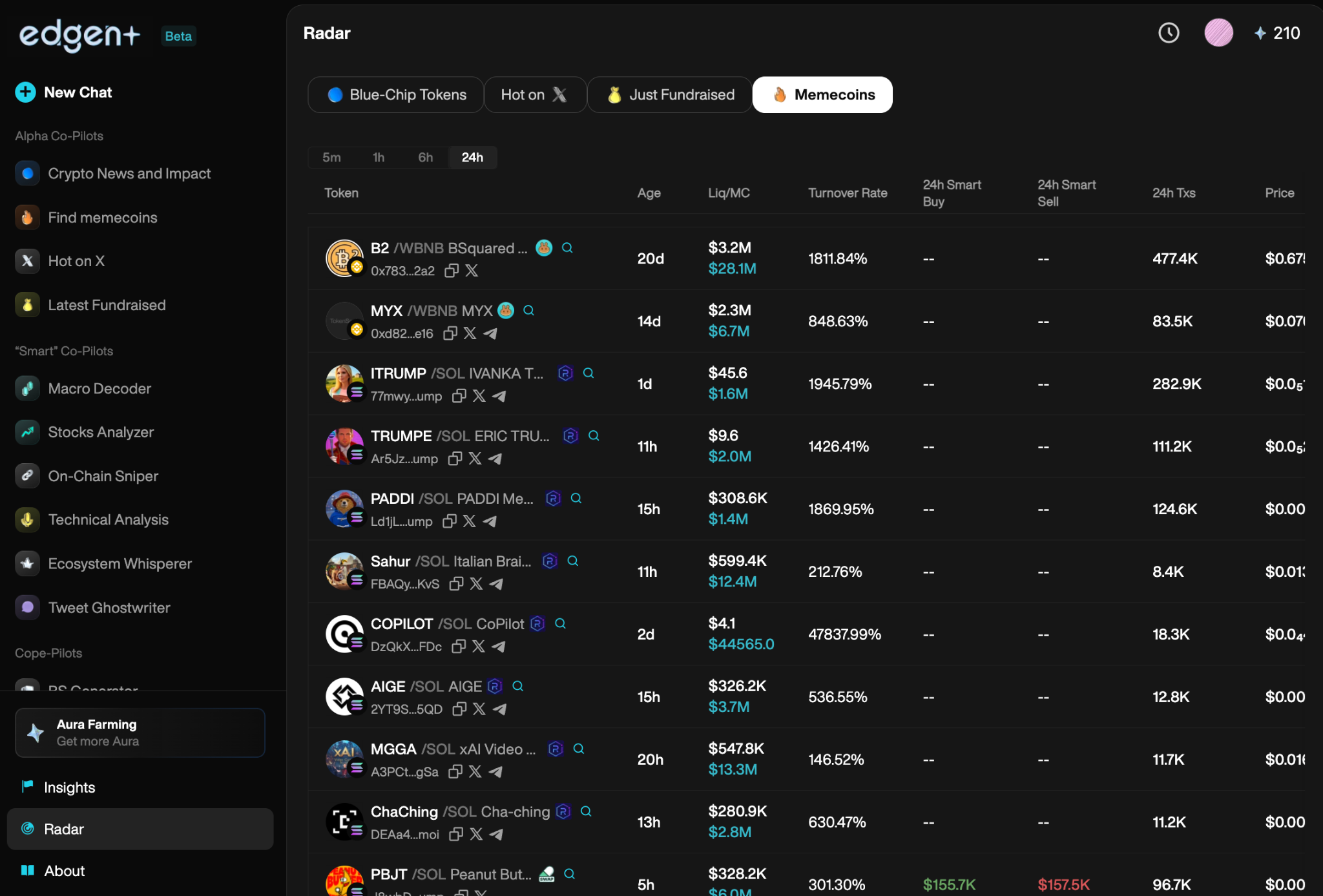
表情币最初是网络玩笑:狗狗币(DOGE)、柴犬币(SHIB)、佩佩币(PEPE)。这些资产缺乏传统金融实力,却因社交媒体的关注和病毒式传播的梗而飙升。

Memecoin价格迅速上涨后又暴跌。Edgen AI跟踪Twitter情绪、社交参与度和意见领袖的动向,在炒作发生前识别出潜在的炒作。

山寨币:不仅仅是比特币的替代品

其他加密货币(Altcoins)指的是除比特币以外的加密货币,包括以太坊(ETH)、Solana(SOL)和专注于人工智能的代币。 Learn more about altcoins, their types, and how they differ from Bitcoin与迷因币不同,替代币(altcoins)通常提供明确的用例、功能或现实世界的价值。

Edgen AI追踪小市值加密货币市场信号、链上钱包变动以及社区情绪变化,以尽早发现交易机会。

股票:传统资产的演变

股票代表苹果、特斯拉和亚马逊等大型公司的股份。虽然传统的投资规则仍然适用,但人工智能正在改变股票市场的投资方式。现在,公司使用人工智能驱动的平台,即时分析财报、新闻标题和投资者情绪,使得人工智能驱动的交易变得至关重要。
人工智能如何定义现代市场趋势

AI即时预测市场情绪

投资者情绪决定资产价格。Edgen AI 检测社交媒体(推特/X)和区块链数据,可在市场情绪发生转变被广泛认知之前识别出这种变化。

  • 即时跟踪影响者和社区的情绪。
  • 预测市场变动前的叙事变化。

用人工智能掌握链上数据

链上分析揭示了如钱包活动、资金流动和智能资金行为等隐藏的市场信号。Edgen AI 清晰地解析区块链数据,在大多数交易者注意到之前提供实时警报。

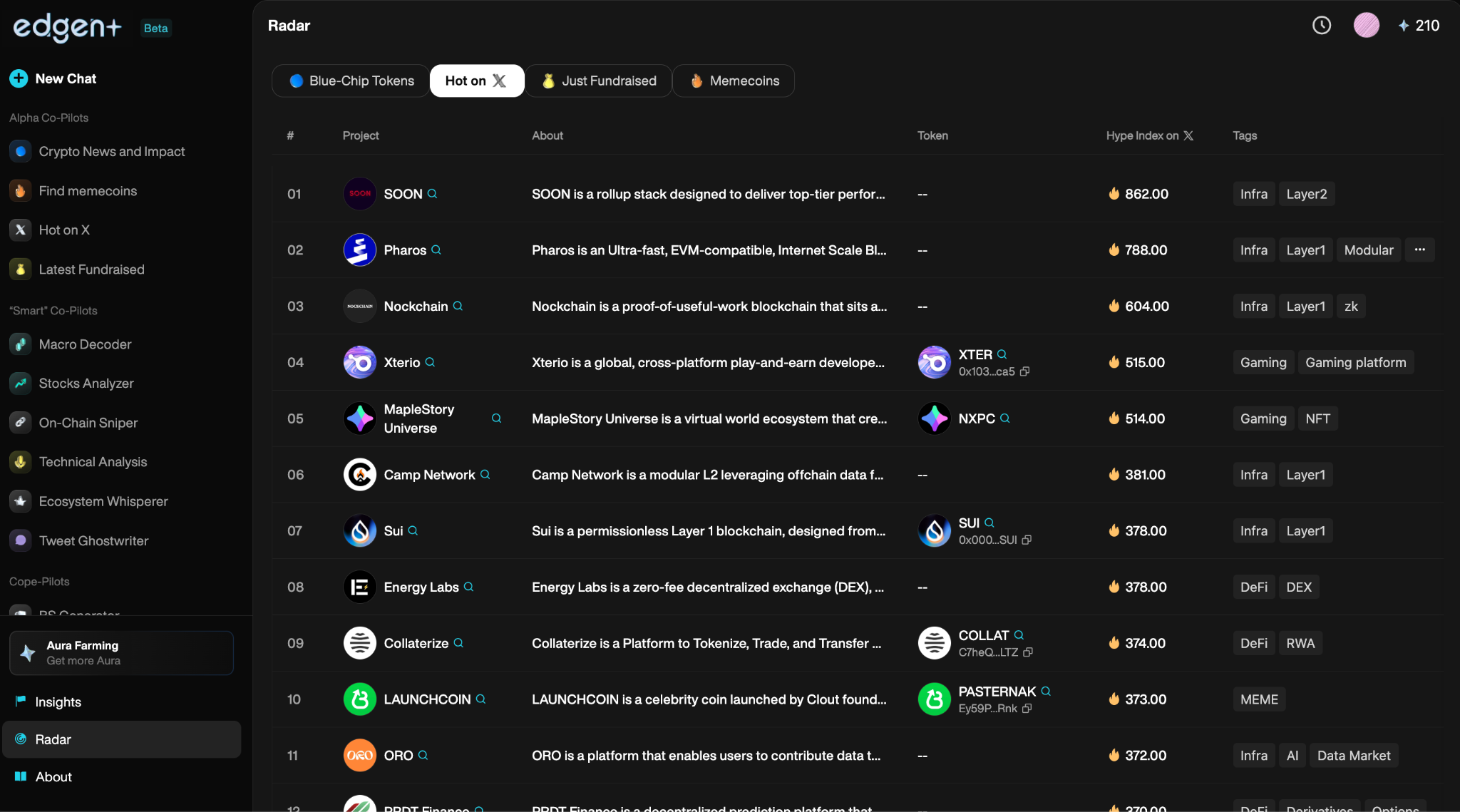
Edgen AI 发现一个主要钱包正在积累一种低市值的替代币。使用 Edgen 的 Radar 的交易者会立即收到警报,从而捕捉早期利润。

阿尔法信号:人工智能的终极优势

Alpha信号突出显示了具有增长潜力的被低估资产。Edgen AI可即时处理大量数据,迅速揭示突破性指标。通过运行实时查询来探索隐藏的Alpha。 Edgen Search交易员的AI驱动搜索引擎。

  • 增加的开发者活动
  • 不断增长的持币者数量
  • 社交媒体提及量上升

AI在价格反映这些机会之前就能识别它们。

Crypto Trading

加密货币和股票中的AI驱动交易算法

AI交易机器人:新标准

人工智能交易更快、更智能,且没有情绪。

AI精准、冷静且以极快的速度进行交易。高频交易(HFT)机器人能在毫秒级别内完成交易,超越人类的反应能力。

Edgen Radar专注于快速交易执行、实时阿尔法识别和全面的市场洞察。

人工智能与社会共识

仅靠技术分析是不够的。Edgen AI 融合了社交情绪和社区叙事,以捕捉市场的集体心态:

  • 智能钱包操作(买入/卖出动作)
  • 关键意见领袖(KOL)活动
  • 推特/X上的热门话题和意见领袖动态

AI比人类更快地检测社会情绪

社会动量、网红趋势和社区参与度在一夜之间推动价格变化。Edgen AI 持续监控并清晰评估这些信号。实时监测市场对话和社区内幕信息。 Edgen Feed

  • 看涨信号:病毒式参与、网红关注度上升、巨鲸囤积。
  • 看跌警告:社会兴趣下降、叙事转变、参与度降低。

AI首先捕捉情感变化,从而在市场反应之前做出果断交易。

人工智能在未来市场趋势中的关键作用

AI + DeFi:下一个市场前沿

DeFi 持续革新金融行业,AI 加速其发展。

Edgen AI演进为完整的买方交易基础设施:

  • 自动化借贷策略。
  • 在DeFi中主动管理风险。
  • 优化收益挖矿以获得最大回报。

仅靠人工分析无法跟上DeFi的规模。AI现在正引领潮流。

区块链与人工智能:一种强大的交易组合

结合人工智能和区块链技术可显著提高市场透明度和效率:

  • AI对智能合约进行审计以发现潜在漏洞。
  • 预测最优的Gas费用和交易时间。
  • 提升去中心化交易所(DEX)分析以实现更好的交易执行。

人工智能和区块链共同构成了一个强大的交易环境。

为什么现在AI对交易员至关重要

AI变得不可或缺,塑造了交易成功的未来。

交易员需要人工智能的原因是:

  • 更快的决策:对数百万个数据点进行即时处理。
  • 更高的准确性:人工智能消除人类情感偏见。
  • 保持持续警觉:AI 提供持续的市场监控。
  • 即时的阿尔法洞察:AI能够清晰追踪实时情绪和链上活动。

没有人工智能的交易会使投资者处于严重不利的地位。

Crypto Trading

聪明交易,否则落后于人

市场已经永久性地发生了变化。表情包币、替代币和股票在很大程度上依赖于AI驱动的洞察、社交叙事和实时分析。

忽视人工智能的交易者会遇到困难。而采用Edge AI等平台的交易者则利用社交情绪、阿尔法检测和区块链分析,从而远远领先。

未来已经到来。人工智能驱动的交易决定了胜负。你的操作定义了你的市场地位。 Learn more about Edgen AI请将以下英文翻译成简体中文。保持结构和技术术语准确。避免过度翻译。

推荐阅读
banner.jpg

What is a money person? The plain-English alternative to a financial advisor

The short version: a money person is a smart, warm friend who happens to be good with money and explains it like a person, not a bank. Practically, it's a second opinion on your whole financial picture — cash, debt, tax exposure, concentration, and the goals you're working toward — that tells you in plain language what to look at first. It's not a traditional advisor managing your portfolio for 1% a year, and it's not a coach cheering you on. It's the honest read a good advisor's first meeting would give you, without the fee or the asset minimum. It's the role Ed Wealth was built to play. Strip away the label and a money person does four concrete things: Just as important is what it doesn't do: it doesn't take custody of your money, it doesn't sell you products for commission, and it doesn't pretend a forecast is a promise. It's a second opinion: it shows you the structure and lets you decide. People reach for four different things when they say "I should talk to someone." They're not
Edgen
·
Jul 10 2026
banner.jpg

Is a financial advisor worth it? Advisor vs robo vs money person

The short version: a financial advisor is worth it when your money has real complexity — a business, concentrated stock, an estate, a divorce, or turning savings into retirement income. There, a fee pays for itself. But most people don't have a complexity problem; they have a clarity one, and paying 1% of your assets a year — about $3,000 on a $300,000 portfolio, every year — is a lot to pay for reassurance. You have three tiers to choose from: a human advisor (~1% of assets), a robo-advisor (~0.25%), and a money person — a flat-fee second opinion that doesn't grow as your savings do. Start with the honest case for paying. A good advisor earns their fee when your situation is genuinely complex: selling a business, a big block of company stock or options, an estate with kids, a divorce, a windfall, or building a retirement-income plan with real moving parts. In those moments, one right call can save you many times the fee, and the job becomes picking a good one (that's how to choose a f
Edgen
·
Jul 10 2026
banner.jpg

Do You Actually Need a Financial Advisor? (An Honest Test)

The short version: you need a financial advisor when your money has genuine complexity — equity comp across several employers, a business sale, an estate with kids involved, a divorce, a sudden windfall, or a retirement-drawdown plan with real moving parts. If your situation is closer to "I earn well but somehow feel behind," that's a clarity problem, not a complexity one, and hiring someone to manage your money for about 1% a year is an expensive way to solve it. Here's how to tell which one you have. Almost everyone reaching for an advisor falls into one of two camps, and confusing them is where money gets wasted. A complexity problem is when there are real moving parts that interact: decisions where a wrong move costs far more than any fee. Selling a company, exercising stock options with a tax bill attached, splitting assets in a divorce, planning how to draw income across a 30-year retirement. Here, a good advisor earns their keep. A clarity problem looks different. Good income, a
Edgen
·
Jul 06 2026
banner.jpg

How to Choose a Financial Advisor in 2026 (and Whether You Even Need One)

The short version: picking a financial advisor isn't about finding the "smartest" one. It comes down to three boring questions that actually predict whether you'll be treated well: are they legally a fiduciary, how do they get paid, and do you even need one yet. Get those right and the rest is noise. Here's how to run the check — and what to do if you want guidance but can't (or don't want to) meet a $250,000 minimum. Before you choose one, ask whether this is the right tool at all. A full-service advisor earns their fee when your situation is genuinely complex — a business sale, equity comp across several companies, estate planning, a divorce, a sudden windfall, or a retirement-income plan with real moving parts. But a lot of people reaching for an advisor don't have a complexity problem. They have a clarity problem: a good income, a few scattered accounts, and a nagging sense of being behind. That doesn't need someone to manage your money for 1% a year. It needs a clear read on where
Edgen
·
Jul 06 2026
Redeem miles for gift cards and each is worth ~1 cent; redeem for long-haul business and they're worth 2.5-4+. With programs now dynamically priced, the one check that decides every redemption.

How to redeem airline miles without wasting them

The single biggest mistake with miles is redeeming them for the easy stuff: gift cards, merchandise, seat upgrades at the gate. Do that and each mile is worth about one cent. Redeem the *same* miles for flights, especially long-haul or premium-cabin flights, and they're often worth two to five cents each, sometimes more. So the real skill isn't earning miles; it's not throwing away their value at the finish line. Here's how to actually use them. A mile has no fixed price; its value depends entirely on what you redeem it for. The way to judge any redemption is simple math: (cash price of the flight) ÷ (miles it costs) = cents per mile. If a flight costs $400 or 20,000 miles, that's 2 cents a mile, a solid deal. If a $90 flight costs 18,000 miles, that's half a cent, which is terrible; pay cash and keep the miles. Run this check before every redemption. It instantly separates a great use from a waste, and it's the one habit that makes miles worth having. As a rule of thumb, most major ai
Edgen
·
Jun 30 2026
Short-term goals (under ~3 years) belong in safe cash; long-term goals (5+ years) can take market risk. The best HYSAs now pay ~4-5% APY. How to sort yours and run both.

Long-term vs short-term financial goals (and how to plan both)

The difference comes down to one thing: time. A short-term goal is money you'll need within roughly three years (an emergency fund, a trip, a wedding, next year's tax bill), so it has to be *safe and reachable*. A long-term goal is five-plus years out (retirement, a house down the road, a kid's education), so it can take market risk, because time smooths the bumps out. Get that match right and you've done most of the work. It's not the size, it's the deadline. A $2,000 goal you need in six months is short-term; a $2,000 goal you won't touch for fifteen years is long-term, and they belong in completely different places. This is the part that actually matters, and where people lose money without realizing it. Short-term money should not be in the stock market. If your emergency fund is in stocks and the market drops 20% the same month your car dies, you're selling at the worst possible time. Short-term goals go somewhere stable and accessible, and a high-yield savings account is the clas
Edgen
·
Jun 30 2026
Mortgages near 6.5%, home prices flat, and the Fed split on rate cuts vs hikes. With timing a coin flip, the 3 questions that actually decide whether to buy now or wait.

Should you buy a house now or wait? How to actually decide

The honest answer: buy when you'll stay put for at least five years and you'll still have an emergency fund left after the down payment. Otherwise, waiting (and renting) is often the smarter money move, not the weaker one. "Rent vs buy" isn't a math problem with one right answer, and it's almost never really about timing the market. It's about your *life*, in three questions. Before the three questions, here's the mid-2026 backdrop — because "now or wait" usually hides a bet on rates and prices, and the data says that bet is a coin flip. The picture: mortgages are still pricey, prices have gone flat (more than half of the 20 big metros saw year-over-year declines in March), and the cheap-money era hasn't returned. So "buy before it runs away" and "wait for the crash" are *both* weak arguments right now. The whole "wait for rates to drop" plan rests on the Fed, and the Fed is split down the middle. In its June 2026 projections, policymakers were divided: 8 expected no change this year,
Edgen
·
Jun 30 2026
Most financial goals fail because they're wishes, not systems. Here's the 3-part anatomy of a goal that sticks (a number, a date, one automatic move), plus why 37% of adults can't cover a $400 surprise.

How to set financial goals you'll actually hit

A financial goal you'll actually hit has three things a vague wish doesn't: a number, a date, and one automatic move that happens whether or not you remember it. "Save more" is a wish. "$6,000 in a separate account by next December, $500 auto-transferred on payday" is a goal. The gap between those two sentences is the reason most goals quietly die, and it has almost nothing to do with willpower. Key Takeaways A real financial goal answers three questions: how much, by when, and what for. Drop any one and it stops working. "Pay off debt" has no number and no date, so there's nothing to aim at or measure, while "$8,000 of card debt cleared in 18 months" tells you exactly whether you're on track and the day you're done. The "what for" matters more than people expect. A goal tied to something real (a buffer so a bad month isn't a crisis, a deposit on a first place) survives the months when motivation dips. In our experience reading how people actually use a money tool, the goals that get
Edgen
·
Jun 30 2026
A big RSU grant just vested — now what? Here's what a modern money tool actually surfaces first, using Ed as a worked example: a reality check, the 22% tax gap most high earners miss, and the concentration risk nobody flags.

Your RSUs Just Vested. Here's What a Money Tool Surfaces First.

You just had a big RSU grant vest. Congratulations — and now the awkward part: a six-figure pile of your own company's stock, a vague sense you should "do something," and no one actually telling you what. An advisor, a spreadsheet, and a piece of software each handle this moment differently. Here's what a modern money tool surfaces in a moment like this — using Ed as a worked example — so you can decide what kind of help actually fits. Key takeaways You connect your brokerage and bank through read-only aggregation, so the tool can read balances but can't move a dollar. Ed's framing is simple: precise about your money, blind to your identity. Instead of sorting your lattes into categories, Ed opens on a single Financial Reality Check — a read on whether your money could survive a bad month. For a lot of high earners, that one number lands harder than any budget, because it answers a question the other apps never ask. (If the Reality Check is the numbers side, your money type is the beha
Edgen
·
Jun 26 2026
A money personality test is more than a quiz if it measures behavior, not just vibes. Here's the science behind money types, how Ed's test works, and how to use your result.

What Is a Money Personality Test? The Science Behind Your Money Type

The short version: a good money personality test should feel like a roast and work like a mirror — fun on the surface, behavioral underneath. The useful ones don't tell you what you know; they show you how you act with money, and the one blind spot worth watching. Key takeaways Here's the uncomfortable backdrop. U.S. financial literacy has been stuck for a decade — adults answer only about 49% of the standard knowledge questions correctly, essentially flat since 2017 (TIAA Institute–GFLEC, 2025) — even as free financial information became infinite. If facts fixed money, they'd have fixed it by now. They don't, because the thing that actually drives your outcomes lives one level below the facts: how you're wired to behave when money is on the line. That's the whole premise of financial fitness — and it's what a money personality test is built to surface. Not what you know. What you do. The idea has real research behind it — money behavior is patterned and measurable, and a few tradition
Edgen
·
Jun 23 2026

投资这事,终于不用一个人了

免费试用 Edgen。不用信用卡,不绑约