
Content
El Mercado Cambió. Para Siempre.
Memecoins, Altcoins y Acciones Explicados
Memecoins: Beneficios serios con bromas
Altcoins: Más que simples alternativas a Bitcoin
Acciones: Activos Tradicionales Evolucionados
Cómo la IA define las tendencias del mercado moderno
AI predice la sentimiento del mercado de forma inmediata
Dominar los datos en cadena con inteligencia artificial
Señales Alpha: La Ventaja Final de la IA
Algoritmos de Trading impulsados por IA en Criptomonedas y Acc...
Bots de Trading con IA: El Nuevo Estándar
La Inteligencia Artificial encuentra el Consenso Social
AI Detecta el Sentimiento Social Más Rápidamente que los Human...
El Rol Esencial de la IA en las Tendencias del Mercado Futuro
AI + DeFi: El Próximo Frente del Mercado
Blockchain y IA: Una poderosa colaboración en el trading
¿Por qué la IA es esencial para los traders ahora?
Negocie con inteligencia o arriesgue quedarse atrás

Markets Confusing? Ask Edgen Search.

Instant answers, zero BS, and trading decisions your future self will thank you for.

Try Search Now

Memecoins, altcoins y acciones: ¿Por qué la IA es clave para las tendencias del mercado
Edgen
· Mar 31 2026
Memecoins, altcoins y acciones: ¿Por qué la IA es clave para las tendencias del mercado

El Mercado Cambió. Para Siempre.

El dinero se mueve rápidamente. Los mercados se mueven más rápido.

La inversión evolucionó más allá de gráficos, estados financieros y fundamentos. Los memecoins, altcoins y acciones ahora siguen la euforia social, el sentimiento de los influencers y la actividad en tiempo real en la cadena de bloques.

La IA es el motor detrás de este cambio, guiando a los traders hacia decisiones más inteligentes, predicciones más claras y movimientos más rápidos.Edgen AIllama a esta nueva fuerza del mercado "Pumpamentals", la intersección de la dinámica social, el poder de los influencers y la acción de precios impulsada por la comunidad.

Negociar sin IA significa perder señales que otros ven claramente. El trading con IA define el éxito en el mercado.

Memecoins, Altcoins y Acciones Explicados

Memecoins: Beneficios serios con bromas

Los memecoins comenzaron como bromas de internet: Dogecoin (DOGE), Shiba Inu (SHIB), Pepe Coin (PEPE). Sin fuerza financiera tradicional, estos activos suben gracias a la atención social y los memes virales.

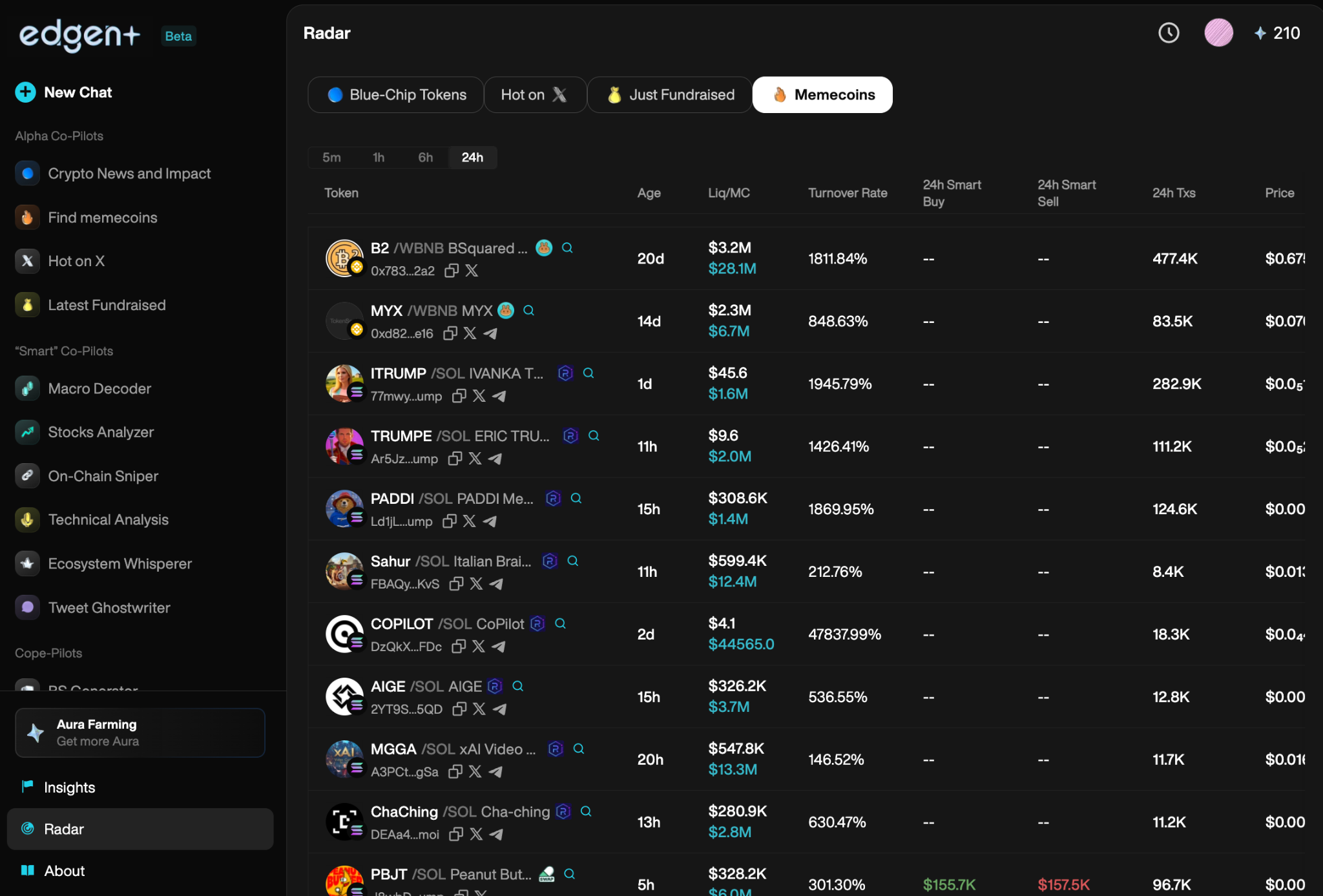
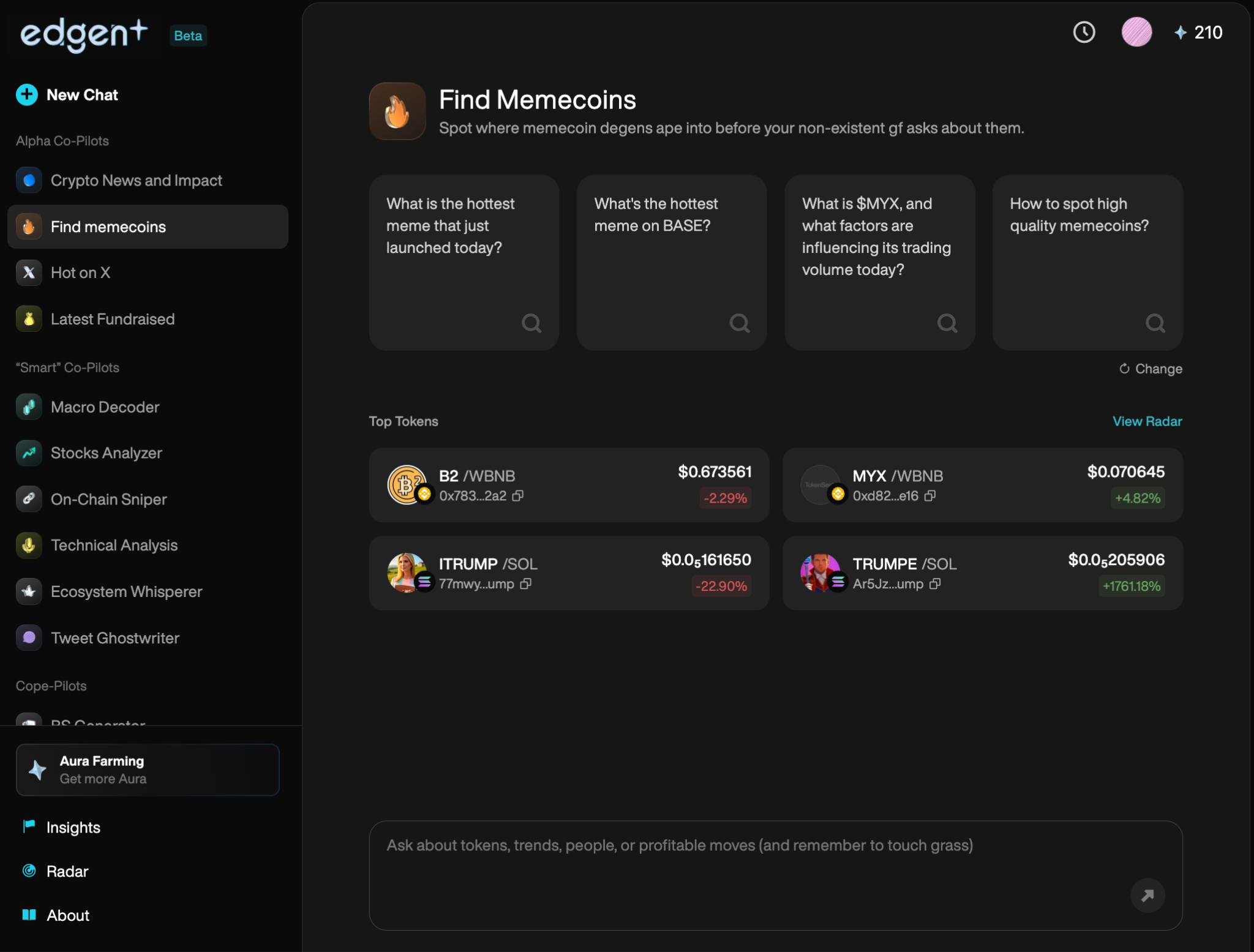
Los precios de los memecoin suben y caen rápidamente.Edgen AIrastrea la sentimiento de Twitter, la participación social y los movimientos de los influencers, identificando las subidas antes de que ocurran.

Altcoins: Más que simples alternativas a Bitcoin

Las altcoins representan criptomonedas distintas de Bitcoin, incluyendo Ethereum (ETH), Solana (SOL) y tokens enfocados en inteligencia artificial. Learn more about altcoins, their types, and how they differ from BitcoinA diferencia de las memecoins, las altcoins suelen ofrecer casos de uso, utilidades o valor real claros.

Edgen AI sigue las señales del mercado de altcoins, los movimientos de billeteras en cadena y los cambios en el sentimiento de la comunidad para identificar oportunidades de trading tempranamente.

Acciones: Activos Tradicionales Evolucionados

Las acciones representan participaciones en empresas principales como Apple, Tesla y Amazon. Aunque las reglas tradicionales de inversión aún aplican, la inteligencia artificial transforma la inversión en el mercado de valores. Las empresas ahora utilizan plataformas impulsadas por inteligencia artificial para analizar instantáneamente informes de ganancias, titulares y sentimiento de los inversores, convirtiendo así el trading con inteligencia artificial en esencial.
Cómo la IA define las tendencias del mercado moderno

AI predice la sentimiento del mercado de forma inmediata

La sentimiento de los inversores determina los precios de los activos. Edgen AI escanea las redes sociales (Twitter/X) y los datos de blockchain, identificando cambios en el estado de ánimo del mercado antes de que sean ampliamente reconocidos.

  • Rastrea instantáneamente el sentimiento de los influencers y la comunidad.
  • Predice cambios en la narrativa antes de los movimientos del mercado.

Dominar los datos en cadena con inteligencia artificial

El análisis en cadena revela señales de mercado ocultas como las actividades de billeteras, los flujos de fondos y las acciones del dinero inteligente. Edgen AI interpreta claramente los datos de blockchain, proporcionando alertas en tiempo real antes de que la mayoría de los traders las noten.

Edgen AI detecta un billetera destacada que acumula una criptomoneda de baja capitalización. Los traders que usan el Radar de Edgen reciben alertas inmediatas, capturando ganancias tempranas.

Señales Alpha: La Ventaja Final de la IA

Las señales Alpha destacan activos subvalorados listos para crecer. Edgen AI procesa grandes volúmenes de datos instantáneamente, revelando indicadores de ruptura con rapidez. Explore el alpha oculto ejecutando consultas en vivo a través de Edgen Searchel motor de búsqueda impulsado por IA para traders.

  • Actividad de desarrolladores incrementada
  • Creciente número de tenedores de tokens
  • Menciones en redes sociales en aumento

La IA identifica estas oportunidades antes de que los precios las reflejen.
Crypto Trading

Algoritmos de Trading impulsados por IA en Criptomonedas y Acciones

Bots de Trading con IA: El Nuevo Estándar

IAnegocia más rápido, más inteligentemente y sin emociones.

El comercio de IA es preciso, sin emociones y a velocidades extraordinarias. Los bots de trading de alta frecuencia (HFT) realizan operaciones en milisegundos, superando la capacidad humana.

Edgen Radarse especializa en ejecución rápida de operaciones, identificación en tiempo real de alpha y perspectivas completas del mercado.

La Inteligencia Artificial encuentra el Consenso Social

El análisis técnico en sí mismo es insuficiente. Edgen AI integra el sentimiento social y las narrativas de la comunidad para capturar la mentalidad colectiva del mercado:

  • Movimientos de billetera inteligente (acciones de compra/venta)
  • Actividades de Líder de Opinión Clave (KOL)
  • Temas en tendencia y dinámicas de influencers en Twitter/X

AI Detecta el Sentimiento Social Más Rápidamente que los Humanos

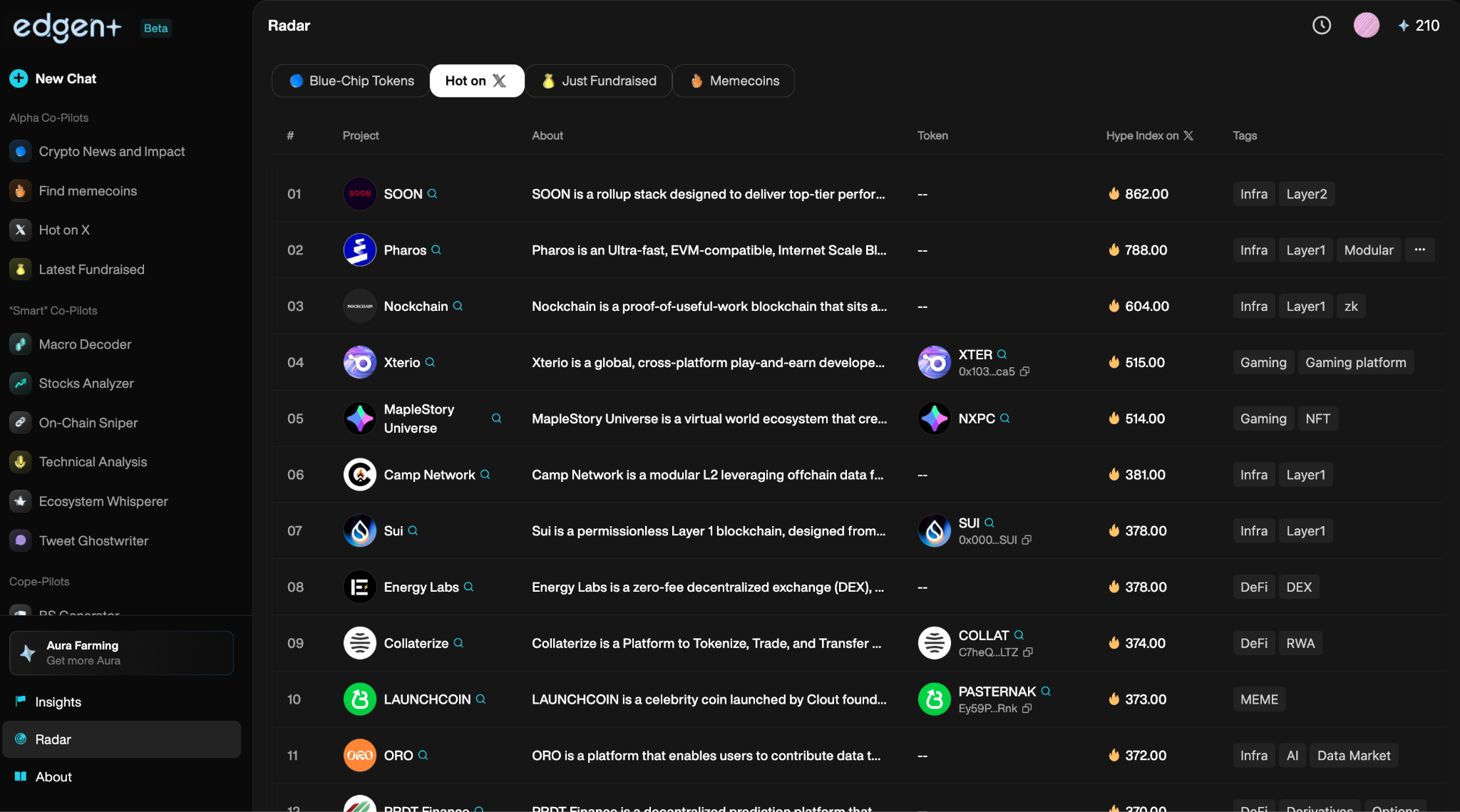
El impulso social, las tendencias de los influencers y la participación de la comunidad impulsan los precios durante la noche. Edgen AI monitorea y evalúa continuamente estas señales con claridad. Supervisa las conversaciones del mercado en vivo y el alpha de la comunidad en la Edgen Feed:

  • Señales alcistas: engagement viral, aumento de la atención de los influencers, acumulación de whales.
  • Advertencias bajistas: disminución del interés social, narrativas en cambio y menor participación.

La IA detecta los cambios de sentimiento primero, permitiendo operaciones decisivas antes de las reacciones del mercado.

El Rol Esencial de la IA en las Tendencias del Mercado Futuro

AI + DeFi: El Próximo Frente del Mercado

DeFi continúa revolucionando las finanzas y la IA acelera su crecimiento.

La inteligencia artificial Edgen se convierte en infraestructura completa de negociación del lado comprador:

  • Automatizar estrategias de préstamo y préstamo.
  • Gestionar el riesgo de forma proactiva en DeFi.
  • Optimizar la agricultura de rendimiento para obtener mayores retornos.

El análisis humano en solo no puede igualar la escala de DeFi. La IA ahora lidera la carga.

Blockchain y IA: Una poderosa colaboración en el trading

Combinar la inteligencia artificial y la tecnología blockchain mejora drásticamente la transparencia y la eficiencia del mercado:

  • Auditoría de contratos inteligentes por parte de la IA en busca de vulnerabilidades potenciales.
  • Predecir las tarifas de gas óptimas y el momento de las transacciones.
  • Mejorar el análisis de DEX para una ejecución de intercambios más eficiente.

La inteligencia artificial y el blockchain forman juntos un entorno de trading potente.

¿Por qué la IA es esencial para los traders ahora?

La IA se convirtió en un elemento fundamental, moldeando el futuro del éxito en el trading.

Los comerciantes necesitan IA porque:

  • Toma de decisiones más rápida: Procesamiento inmediato de millones de puntos de datos.
  • Mayor precisión: la IA elimina los sesgos emocionales humanos.
  • Vigilancia constante: la IA ofrece un monitoreo continuo del mercado.
  • Insights in tiempo real de alpha: la IA rastrea claramente el sentimiento en tiempo real y las actividades en cadena.

Negociar sin IA coloca a los inversores en una grave desventaja.
Crypto Trading

Negocie con inteligencia o arriesgue quedarse atrás

Los mercados cambiaron permanentemente. Las memecoins, altcoins y acciones dependen en gran medida de análisis impulsados por IA, narrativas sociales y analíticas en tiempo real.

Los comerciantes que ignoran la IA tienen dificultades. Aquellos que adoptan plataformas como Edgen AI aprovechan el sentimiento social, la detección de alpha y el análisis de blockchain, manteniéndose muy por delante.

El futuro ha llegado. El comercio impulsado por IA determina ganadores y perdedores. Tu movimiento define tu posición en el mercado. Learn more about Edgen AIPor favor, traduzca el siguiente inglés al español. Mantenga la estructura y los términos técnicos precisos. Evite la sobretraducción.


Recommend
banner.jpg

What is a money person? The plain-English alternative to a financial advisor

The short version: a money person is a smart, warm friend who happens to be good with money and explains it like a person, not a bank. Practically, it's a second opinion on your whole financial picture — cash, debt, tax exposure, concentration, and the goals you're working toward — that tells you in plain language what to look at first. It's not a traditional advisor managing your portfolio for 1% a year, and it's not a coach cheering you on. It's the honest read a good advisor's first meeting would give you, without the fee or the asset minimum. It's the role Ed Wealth was built to play. Strip away the label and a money person does four concrete things: Just as important is what it doesn't do: it doesn't take custody of your money, it doesn't sell you products for commission, and it doesn't pretend a forecast is a promise. It's a second opinion: it shows you the structure and lets you decide. People reach for four different things when they say "I should talk to someone." They're not
Edgen
·
Jul 10 2026
banner.jpg

Is a financial advisor worth it? Advisor vs robo vs money person

The short version: a financial advisor is worth it when your money has real complexity — a business, concentrated stock, an estate, a divorce, or turning savings into retirement income. There, a fee pays for itself. But most people don't have a complexity problem; they have a clarity one, and paying 1% of your assets a year — about $3,000 on a $300,000 portfolio, every year — is a lot to pay for reassurance. You have three tiers to choose from: a human advisor (~1% of assets), a robo-advisor (~0.25%), and a money person — a flat-fee second opinion that doesn't grow as your savings do. Start with the honest case for paying. A good advisor earns their fee when your situation is genuinely complex: selling a business, a big block of company stock or options, an estate with kids, a divorce, a windfall, or building a retirement-income plan with real moving parts. In those moments, one right call can save you many times the fee, and the job becomes picking a good one (that's how to choose a f
Edgen
·
Jul 10 2026
banner.jpg

Do You Actually Need a Financial Advisor? (An Honest Test)

The short version: you need a financial advisor when your money has genuine complexity — equity comp across several employers, a business sale, an estate with kids involved, a divorce, a sudden windfall, or a retirement-drawdown plan with real moving parts. If your situation is closer to "I earn well but somehow feel behind," that's a clarity problem, not a complexity one, and hiring someone to manage your money for about 1% a year is an expensive way to solve it. Here's how to tell which one you have. Almost everyone reaching for an advisor falls into one of two camps, and confusing them is where money gets wasted. A complexity problem is when there are real moving parts that interact: decisions where a wrong move costs far more than any fee. Selling a company, exercising stock options with a tax bill attached, splitting assets in a divorce, planning how to draw income across a 30-year retirement. Here, a good advisor earns their keep. A clarity problem looks different. Good income, a
Edgen
·
Jul 06 2026
banner.jpg

How to Choose a Financial Advisor in 2026 (and Whether You Even Need One)

The short version: picking a financial advisor isn't about finding the "smartest" one. It comes down to three boring questions that actually predict whether you'll be treated well: are they legally a fiduciary, how do they get paid, and do you even need one yet. Get those right and the rest is noise. Here's how to run the check — and what to do if you want guidance but can't (or don't want to) meet a $250,000 minimum. Before you choose one, ask whether this is the right tool at all. A full-service advisor earns their fee when your situation is genuinely complex — a business sale, equity comp across several companies, estate planning, a divorce, a sudden windfall, or a retirement-income plan with real moving parts. But a lot of people reaching for an advisor don't have a complexity problem. They have a clarity problem: a good income, a few scattered accounts, and a nagging sense of being behind. That doesn't need someone to manage your money for 1% a year. It needs a clear read on where
Edgen
·
Jul 06 2026
Redeem miles for gift cards and each is worth ~1 cent; redeem for long-haul business and they're worth 2.5-4+. With programs now dynamically priced, the one check that decides every redemption.

How to redeem airline miles without wasting them

The single biggest mistake with miles is redeeming them for the easy stuff: gift cards, merchandise, seat upgrades at the gate. Do that and each mile is worth about one cent. Redeem the *same* miles for flights, especially long-haul or premium-cabin flights, and they're often worth two to five cents each, sometimes more. So the real skill isn't earning miles; it's not throwing away their value at the finish line. Here's how to actually use them. A mile has no fixed price; its value depends entirely on what you redeem it for. The way to judge any redemption is simple math: (cash price of the flight) ÷ (miles it costs) = cents per mile. If a flight costs $400 or 20,000 miles, that's 2 cents a mile, a solid deal. If a $90 flight costs 18,000 miles, that's half a cent, which is terrible; pay cash and keep the miles. Run this check before every redemption. It instantly separates a great use from a waste, and it's the one habit that makes miles worth having. As a rule of thumb, most major ai
Edgen
·
Jun 30 2026
Short-term goals (under ~3 years) belong in safe cash; long-term goals (5+ years) can take market risk. The best HYSAs now pay ~4-5% APY. How to sort yours and run both.

Long-term vs short-term financial goals (and how to plan both)

The difference comes down to one thing: time. A short-term goal is money you'll need within roughly three years (an emergency fund, a trip, a wedding, next year's tax bill), so it has to be *safe and reachable*. A long-term goal is five-plus years out (retirement, a house down the road, a kid's education), so it can take market risk, because time smooths the bumps out. Get that match right and you've done most of the work. It's not the size, it's the deadline. A $2,000 goal you need in six months is short-term; a $2,000 goal you won't touch for fifteen years is long-term, and they belong in completely different places. This is the part that actually matters, and where people lose money without realizing it. Short-term money should not be in the stock market. If your emergency fund is in stocks and the market drops 20% the same month your car dies, you're selling at the worst possible time. Short-term goals go somewhere stable and accessible, and a high-yield savings account is the clas
Edgen
·
Jun 30 2026
Mortgages near 6.5%, home prices flat, and the Fed split on rate cuts vs hikes. With timing a coin flip, the 3 questions that actually decide whether to buy now or wait.

Should you buy a house now or wait? How to actually decide

The honest answer: buy when you'll stay put for at least five years and you'll still have an emergency fund left after the down payment. Otherwise, waiting (and renting) is often the smarter money move, not the weaker one. "Rent vs buy" isn't a math problem with one right answer, and it's almost never really about timing the market. It's about your *life*, in three questions. Before the three questions, here's the mid-2026 backdrop — because "now or wait" usually hides a bet on rates and prices, and the data says that bet is a coin flip. The picture: mortgages are still pricey, prices have gone flat (more than half of the 20 big metros saw year-over-year declines in March), and the cheap-money era hasn't returned. So "buy before it runs away" and "wait for the crash" are *both* weak arguments right now. The whole "wait for rates to drop" plan rests on the Fed, and the Fed is split down the middle. In its June 2026 projections, policymakers were divided: 8 expected no change this year,
Edgen
·
Jun 30 2026
Most financial goals fail because they're wishes, not systems. Here's the 3-part anatomy of a goal that sticks (a number, a date, one automatic move), plus why 37% of adults can't cover a $400 surprise.

How to set financial goals you'll actually hit

A financial goal you'll actually hit has three things a vague wish doesn't: a number, a date, and one automatic move that happens whether or not you remember it. "Save more" is a wish. "$6,000 in a separate account by next December, $500 auto-transferred on payday" is a goal. The gap between those two sentences is the reason most goals quietly die, and it has almost nothing to do with willpower. Key Takeaways A real financial goal answers three questions: how much, by when, and what for. Drop any one and it stops working. "Pay off debt" has no number and no date, so there's nothing to aim at or measure, while "$8,000 of card debt cleared in 18 months" tells you exactly whether you're on track and the day you're done. The "what for" matters more than people expect. A goal tied to something real (a buffer so a bad month isn't a crisis, a deposit on a first place) survives the months when motivation dips. In our experience reading how people actually use a money tool, the goals that get
Edgen
·
Jun 30 2026
A big RSU grant just vested — now what? Here's what a modern money tool actually surfaces first, using Ed as a worked example: a reality check, the 22% tax gap most high earners miss, and the concentration risk nobody flags.

Your RSUs Just Vested. Here's What a Money Tool Surfaces First.

You just had a big RSU grant vest. Congratulations — and now the awkward part: a six-figure pile of your own company's stock, a vague sense you should "do something," and no one actually telling you what. An advisor, a spreadsheet, and a piece of software each handle this moment differently. Here's what a modern money tool surfaces in a moment like this — using Ed as a worked example — so you can decide what kind of help actually fits. Key takeaways You connect your brokerage and bank through read-only aggregation, so the tool can read balances but can't move a dollar. Ed's framing is simple: precise about your money, blind to your identity. Instead of sorting your lattes into categories, Ed opens on a single Financial Reality Check — a read on whether your money could survive a bad month. For a lot of high earners, that one number lands harder than any budget, because it answers a question the other apps never ask. (If the Reality Check is the numbers side, your money type is the beha
Edgen
·
Jun 26 2026
A money personality test is more than a quiz if it measures behavior, not just vibes. Here's the science behind money types, how Ed's test works, and how to use your result.

What Is a Money Personality Test? The Science Behind Your Money Type

The short version: a good money personality test should feel like a roast and work like a mirror — fun on the surface, behavioral underneath. The useful ones don't tell you what you know; they show you how you act with money, and the one blind spot worth watching. Key takeaways Here's the uncomfortable backdrop. U.S. financial literacy has been stuck for a decade — adults answer only about 49% of the standard knowledge questions correctly, essentially flat since 2017 (TIAA Institute–GFLEC, 2025) — even as free financial information became infinite. If facts fixed money, they'd have fixed it by now. They don't, because the thing that actually drives your outcomes lives one level below the facts: how you're wired to behave when money is on the line. That's the whole premise of financial fitness — and it's what a money personality test is built to surface. Not what you know. What you do. The idea has real research behind it — money behavior is patterned and measurable, and a few tradition
Edgen
·
Jun 23 2026

Invertir, por fin, ya no es cosa de uno solo.

Prueba Edgen gratis. Sin tarjeta, sin compromiso.