Content
Le trading de cryptomonnaies a changé : suivez-vous le rythme ...
1. Le trading traditionnel de cryptomonnaies : L'approche clas...
Limites humaines en trading :
2. Qu'est-ce qui distingue Edgen AI ?
Les avantages uniques d'Edgen AI :
3. Comment Edgen AI donne aux traders un avantage concurrentie...
Recherche Edgen : Votre Analyste du Marché Personnel
Radar Edgen : Visibilité en temps réel du marché
Edgen Insights : Alpha vérifié des traders experts
4. Comment l'intelligence artificielle va-t-elle changer à jam...
5. L'intelligence artificielle peut-elle remplacer entièrement...
6. Devriez-vous adopter le trading avec l'intelligence artific...
L'avenir appartient aux humains et à l'intelligence artificiel...

Markets Confusing? Ask Edgen Search.

Instant answers, zero BS, and trading decisions your future self will thank you for.

Try Search Now

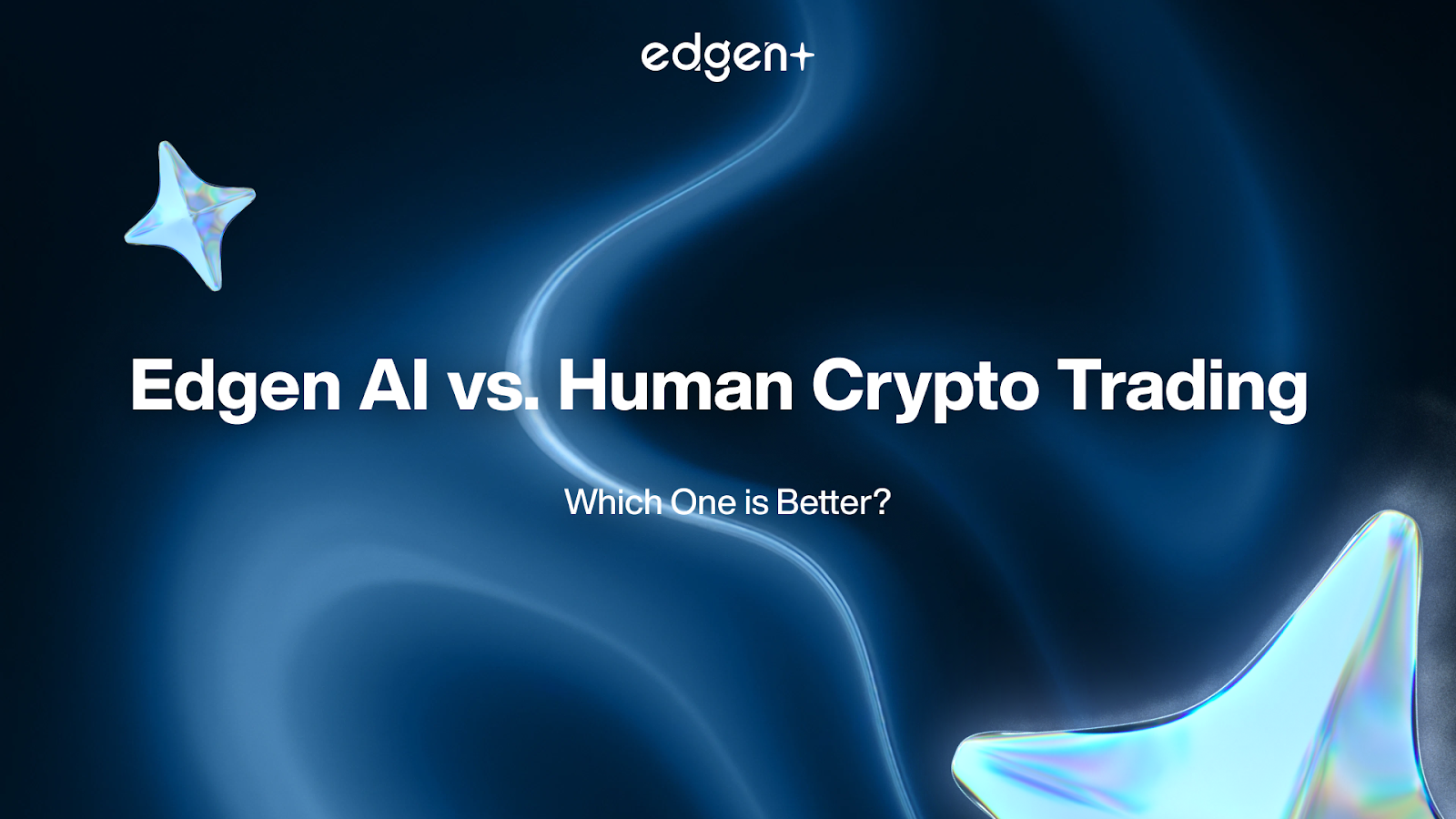
Edgen AI vs. Trading Crypto Humain : Lequel est Mejieur ?

Edgen
· Mar 31 2026
Edgen AI vs. Trading Crypto Humain : Lequel est Mejieur ?

Le trading de cryptomonnaies a changé : suivez-vous le rythme ?

Ce sont les jours où l'analyse manuelle des graphiques, les opérations basées sur le flair et la poursuite de la dernière tendance sur Crypto Twitter appartiennent au passé. Des plateformes alimentées par l'intelligence artificielle, en particulierEdgen AI,réformer le mode de participation des traders aux marchés.

Mais l'IA dépasse-t-elle réellement les traders humains, ou s'agit-il d'une autre mode technologique passagère ?

Ci-dessous, découvrez les vraies différences entre le trading traditionnel et les stratégies pilotées par Edgen AI, comment l'IA transforme les marchés, et si l'expertise humaine reste essentielle.

1. Le trading traditionnel de cryptomonnaies : L'approche classique

Avant que l'intelligence artificielle ne devienne courante, le trading crypto réussi reposait fortement sur l'intuition personnelle et une recherche approfondie :

  • Analyse technique : Interprétation manuelle des graphiques de prix.
  • Analyse fondamentale : Suivre les actualités avec soin.
  • Analyse de sentiment : Évaluer constamment l'excitation provenant de Crypto Twitter et des communautés en ligne.

Les traders ont passé des centaines d'heures à trier les fuites de Discord, les mouvements des portefeuilles de whales et les discussions des influenceurs pour rester en avance.

Limites humaines en trading :

  • Surcharge d'information : il est impossible de suivre manuellement des milliers de cryptomonnaies.
  • Le trading émotionnel : la peur et la cupidité provoquent des achats impulsifs et des ventes motivées par la panique.
  • Courses sans arrêt : Les traders dorment, les marchés non — les portefeuilles peuvent perdre de la valeur pendant la nuit.

C'est pourquoi Edgen AI est devenu crucial.

2. Qu'est-ce qui distingue Edgen AI ?

Edgen AIva bien au-delà des bots de trading traditionnels. Il intègre des données en temps réel sur la blockchain, une analyse de l'émotion sociale et des perspectives prédictives alimentées par l'intelligence artificielle, offrant ainsi une intelligence marchée complète.

Cette approche s'aligne sur les tendances plus larges du secteur, où l'intelligence artificielle est de plus en plus utilisée pour accompagner les investisseurs individuels et démocratiser l'accès aux outils financiers, comme l'a souligné leWorld Economic Forum.

Les avantages uniques d'Edgen AI :

  • Analyse sur la chaîne : suit instantanément l'activité des portefeuilles de whales, les mouvements des capitaux de risque et les interactions avec les contrats intelligents.
  • Signaux Alpha : Identifie les cryptomonnaies sous-évaluées, les tendances émergentes et les joyaux cachés avant la prise de conscience générale.
  • Gestion avancée des risques : ajuste automatiquement les positions en fonction de la volatilité du marché, éliminant ainsi le biais émotionnel.
  • Suivi de l'opinion publique : Évalue les récits animés par la communauté en analysant Twitter et d'autres plateformes, anticipant les changements du marché.

Edgen AI prédit et positionne les traders en avant du marché.

3. Comment Edgen AI donne aux traders un avantage concurrentiel

Edgen AI résout le plus grand défi du marché cryptographique : gérer efficacement les flux d'informations écrasants.

Recherche Edgen : Votre Analyste du Marché Personnel

A jamais souhaité avoir un moteur de recherche spécifique aux cryptomonnaies qui comprenne réellement le contexte du marché ?

Edgen Searchlivre exactement cela.

  • Agglomère instantanément l'activité blockchain, le sentiment social et les analyses d'actualité.
  • Révèle des opportunités alpha cachées en avance sur les tendances du marché général.
  • Résume clairement les risques et les opportunités, permettant des prises de décision rapides.

Veuillez traduire la phrase suivante en français. Conservez la structure et les termes techniques précis. Évitez la surtraduction.

Exemple :
Vous interrogez « Meilleurs jetons d'IA à faible capitalisation », et Edgen fournit immédiatement des informations exploitables – pas de suppositions, seulement des données du marché vérifiées.

Radar Edgen : Visibilité en temps réel du marché

Arrêtez de défiler sans fin les fils d'actualité de Twitter.

Edgen Radarrassemble les informations essentielles de manière claire sur un seul tableau de bord :

  • Les moniteurs surveillent les achats et les ventes intelligents en temps réel.
  • Souligner les jetons émergents avant la prise de conscience du marché plus large.
  • Offre des données en temps réel sur la liquidité du marché, les entrées, les sorties et les indicateurs clés du marché.

Veuillez traduire la phrase suivante en français. Conservez la structure et les termes techniques précis. Évitez la surtraduction.

Exemple :
Si un portefeuille influent accumule un token discrètement, Edgen Radar vous alerte avant que la communauté plus large ne s'en rende compte.

Edgen Insights : Alpha vérifié des traders experts

Les réseaux sociaux cryptés sont bruyants.Edgen Insightsle nettoie :

  • Collecte des informations en temps réel sur le marché provenant de traders et d'analystes de confiance.
  • Appels de repères temporels pour suivre la précision de manière transparente.
  • Utilise un filtrage par IA pour éliminer les fausses informations et les discussions motivées par la hype.

Veuillez traduire la phrase suivante en français. Conservez la structure et les termes techniques précis. Évitez la surtraduction.

Exemple :
Un négociant respecté partage un appel de marché prometteur. Edgen Insights le valide immédiatement grâce aux données sur la chaîne et au sentiment social, confirmant ainsi sa fiabilité.

4. Comment l'intelligence artificielle va-t-elle changer à jamais le trading de cryptomonnaies

L'IA redéfinit rapidement les marchés. Voici comment le trading évoluera :

  • Trading émotionnel réduit : l'IA limite les pertes en éliminant les décisions impulsives et les biais émotionnels.
  • Détection Instantanée de l'Alpha : Les jours de recherche manuelle deviennent inutiles : l'IA identifie les opportunités immédiatement.
  • Régulation entrante : Les régulateurs peuvent surveiller de près les pratiques de trading par IA, redéfinissant ainsi la dynamique du marché.

Si vous ignorez l'intelligence artificielle, vous risquez de vous retrouver rapidement en retard.

5. L'intelligence artificielle peut-elle remplacer entièrement les traders humains ?

Réponse courte : Pas entièrement.

Les forces de l'IA :

  • Traiter rapidement de grandes quantités de données.
  • Automatise la gestion des risques et l'exécution.
  • Négocie plus rapidement et plus efficacement que les humains.

Les avantages humains restent :

  • Comprendre les tendances culturelles telles que les pièces de monnaie de mode, les NFT et les nouveaux récits.
  • Identifier les histoires des marchés émergents que l'intelligence artificielle pourrait ignorer initialement.
  • Négocier les perturbations du marché imprévues et les événements "cygne noir" de manière créative.

Le trading optimal combine la puissance d'analyse de l'intelligence artificielle avec l'intuition et la stratégie humaines.

6. Devriez-vous adopter le trading avec l'intelligence artificielle ?

Si vous :

  • Fréquemment manquer des tendances rentables → l'IA surveille les marchés 24/7.
  • Lutte avec les décisions émotionnelles → Les IA négocient de manière objective.
  • Manque de temps pour des recherches approfondies → L'IA fournit des informations immédiates.

Ensuite, intégrer un AI comme Edgen devient votre prochaine étape claire.

L'avenir appartient aux humains et à l'intelligence artificielle, ensemble

Les marchés cryptographiques évoluent constamment. Les traders qui ne font pas usage de plateformes d'IA comme Edgen sont à un net désavantage.

  • Le commerce traditionnel fonctionne, mais lentement.
  • Le trading par IA est puissant, mais en constante amélioration.
  • Les humains plus l'IA représentent le principal avantage en trading.

Les traders les plus rentables combinent les capacités avancées d'Edgen AI avec des connaissances personnelles du marché, obtenant ainsi des résultats sans précédent.

Prêt à obtenir votre avantage en trading alimenté par l'IA ? EssayezEdgen AIpour améliorer votre trading !

Recommend
Redeem miles for gift cards and each is worth ~1 cent; redeem for long-haul business and they're worth 2.5-4+. With programs now dynamically priced, the one check that decides every redemption.

How to redeem airline miles without wasting them

The single biggest mistake with miles is redeeming them for the easy stuff: gift cards, merchandise, seat upgrades at the gate. Do that and each mile is worth about one cent. Redeem the *same* miles for flights, especially long-haul or premium-cabin flights, and they're often worth two to five cents each, sometimes more. So the real skill isn't earning miles; it's not throwing away their value at the finish line. Here's how to actually use them. A mile has no fixed price; its value depends entirely on what you redeem it for. The way to judge any redemption is simple math: (cash price of the flight) ÷ (miles it costs) = cents per mile. If a flight costs $400 or 20,000 miles, that's 2 cents a mile, a solid deal. If a $90 flight costs 18,000 miles, that's half a cent, which is terrible; pay cash and keep the miles. Run this check before every redemption. It instantly separates a great use from a waste, and it's the one habit that makes miles worth having. As a rule of thumb, most major ai
Edgen
·
Jun 30 2026
Short-term goals (under ~3 years) belong in safe cash; long-term goals (5+ years) can take market risk. The best HYSAs now pay ~4-5% APY. How to sort yours and run both.

Long-term vs short-term financial goals (and how to plan both)

The difference comes down to one thing: time. A short-term goal is money you'll need within roughly three years (an emergency fund, a trip, a wedding, next year's tax bill), so it has to be *safe and reachable*. A long-term goal is five-plus years out (retirement, a house down the road, a kid's education), so it can take market risk, because time smooths the bumps out. Get that match right and you've done most of the work. It's not the size, it's the deadline. A $2,000 goal you need in six months is short-term; a $2,000 goal you won't touch for fifteen years is long-term, and they belong in completely different places. This is the part that actually matters, and where people lose money without realizing it. Short-term money should not be in the stock market. If your emergency fund is in stocks and the market drops 20% the same month your car dies, you're selling at the worst possible time. Short-term goals go somewhere stable and accessible, and a high-yield savings account is the clas
Edgen
·
Jun 30 2026
Mortgages near 6.5%, home prices flat, and the Fed split on rate cuts vs hikes. With timing a coin flip, the 3 questions that actually decide whether to buy now or wait.

Should you buy a house now or wait? How to actually decide

The honest answer: buy when you'll stay put for at least five years and you'll still have an emergency fund left after the down payment. Otherwise, waiting (and renting) is often the smarter money move, not the weaker one. "Rent vs buy" isn't a math problem with one right answer, and it's almost never really about timing the market. It's about your *life*, in three questions. Before the three questions, here's the mid-2026 backdrop — because "now or wait" usually hides a bet on rates and prices, and the data says that bet is a coin flip. The picture: mortgages are still pricey, prices have gone flat (more than half of the 20 big metros saw year-over-year declines in March), and the cheap-money era hasn't returned. So "buy before it runs away" and "wait for the crash" are *both* weak arguments right now. The whole "wait for rates to drop" plan rests on the Fed, and the Fed is split down the middle. In its June 2026 projections, policymakers were divided: 8 expected no change this year,
Edgen
·
Jun 30 2026
Most financial goals fail because they're wishes, not systems. Here's the 3-part anatomy of a goal that sticks (a number, a date, one automatic move), plus why 37% of adults can't cover a $400 surprise.

How to set financial goals you'll actually hit

A financial goal you'll actually hit has three things a vague wish doesn't: a number, a date, and one automatic move that happens whether or not you remember it. "Save more" is a wish. "$6,000 in a separate account by next December, $500 auto-transferred on payday" is a goal. The gap between those two sentences is the reason most goals quietly die, and it has almost nothing to do with willpower. Key Takeaways A real financial goal answers three questions: how much, by when, and what for. Drop any one and it stops working. "Pay off debt" has no number and no date, so there's nothing to aim at or measure, while "$8,000 of card debt cleared in 18 months" tells you exactly whether you're on track and the day you're done. The "what for" matters more than people expect. A goal tied to something real (a buffer so a bad month isn't a crisis, a deposit on a first place) survives the months when motivation dips. In our experience reading how people actually use a money tool, the goals that get
Edgen
·
Jun 30 2026
A big RSU grant just vested — now what? Here's what a modern money tool actually surfaces first, using Ed as a worked example: a reality check, the 22% tax gap most high earners miss, and the concentration risk nobody flags.

Your RSUs Just Vested. Here's What a Money Tool Surfaces First.

You just had a big RSU grant vest. Congratulations — and now the awkward part: a six-figure pile of your own company's stock, a vague sense you should "do something," and no one actually telling you what. An advisor, a spreadsheet, and a piece of software each handle this moment differently. Here's what a modern money tool surfaces in a moment like this — using Ed as a worked example — so you can decide what kind of help actually fits. Key takeaways You connect your brokerage and bank through read-only aggregation, so the tool can read balances but can't move a dollar. Ed's framing is simple: precise about your money, blind to your identity. Instead of sorting your lattes into categories, Ed opens on a single Financial Reality Check — a read on whether your money could survive a bad month. For a lot of high earners, that one number lands harder than any budget, because it answers a question the other apps never ask. (If the Reality Check is the numbers side, your money type is the beha
Edgen
·
Jun 26 2026
A money personality test is more than a quiz if it measures behavior, not just vibes. Here's the science behind money types, how Ed's test works, and how to use your result.

What Is a Money Personality Test? The Science Behind Your Money Type

The short version: a good money personality test should feel like a roast and work like a mirror — fun on the surface, behavioral underneath. The useful ones don't tell you what you know; they show you how you act with money, and the one blind spot worth watching. Key takeaways Here's the uncomfortable backdrop. U.S. financial literacy has been stuck for a decade — adults answer only about 49% of the standard knowledge questions correctly, essentially flat since 2017 (TIAA Institute–GFLEC, 2025) — even as free financial information became infinite. If facts fixed money, they'd have fixed it by now. They don't, because the thing that actually drives your outcomes lives one level below the facts: how you're wired to behave when money is on the line. That's the whole premise of financial fitness — and it's what a money personality test is built to surface. Not what you know. What you do. The idea has real research behind it — money behavior is patterned and measurable, and a few tradition
Edgen
·
Jun 23 2026
A financial reality check scores where you actually stand across safety, control, progress, upside, and Mental Load. Here's why a money score matters, how Ed's checkup works, and what to do with your weakest area.

What Is a Financial Reality Check? Why Your Credit Score Isn't Enough

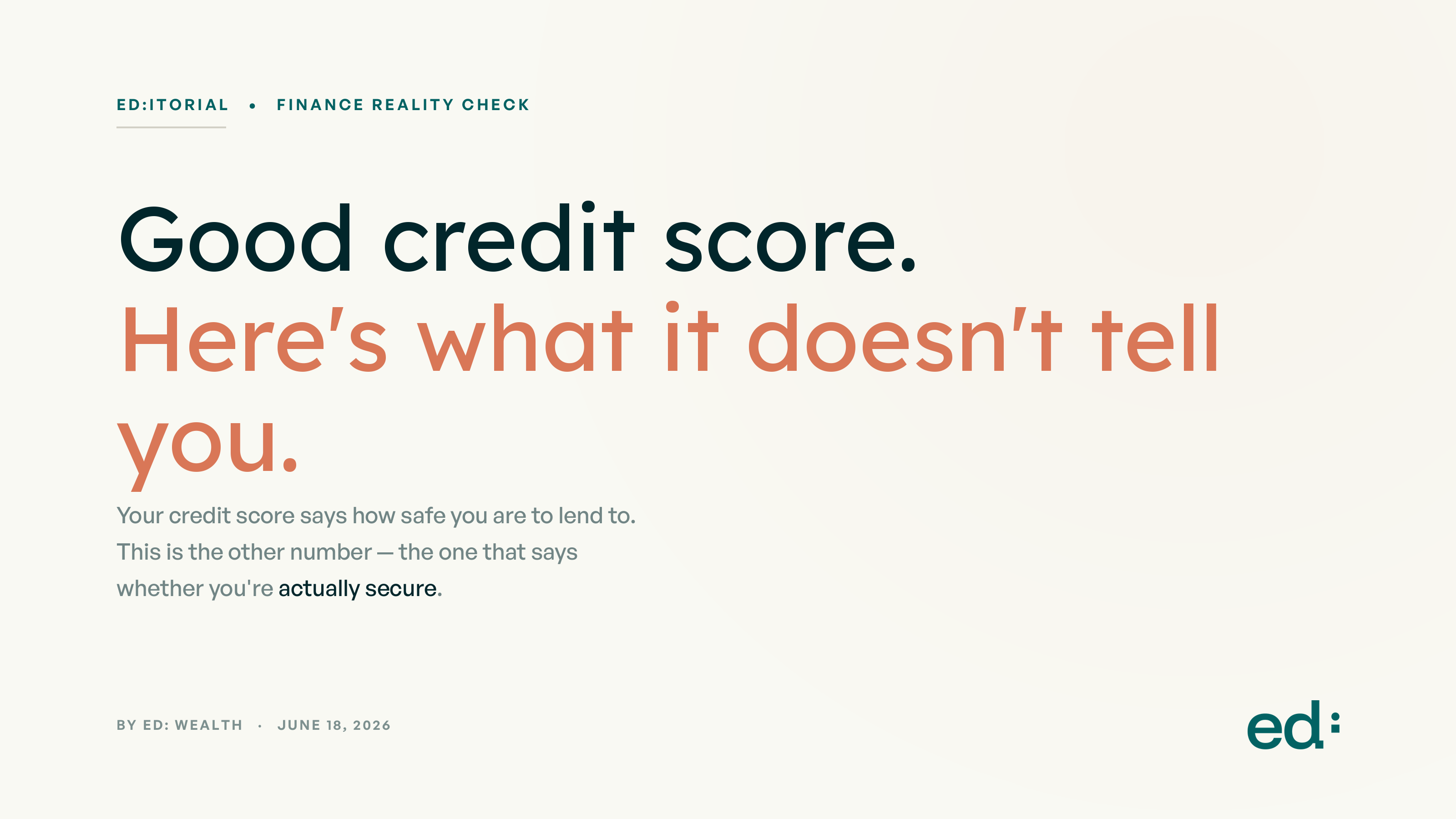
The short version: your credit score measures how safe you are to lend to. Almost nobody has ever seen the number that measures whether you are actually secure. A financial reality check is that second number. Key takeaways Ask people for their credit score and many can recite it. Ask whether they could survive three months without income, or where their money quietly leaks each month, and you get a shrug. That's the gap. A credit score answers a lender's question — how risky is it to extend this person debt? It can be high while your life is fragile, or low while you're genuinely fine, because it was never built to measure you. A financial reality check answers the question the credit score ignores: are you safe, clear, progressing, building, and at ease? Here's the simple version, with the research behind each axis.
Edgen
·
Jun 23 2026
SpaceX opens Thursday at a $1.77 trillion valuation — the largest IPO ever. Only 4.2% of stock actually trades. Musk is locked up for 366 days. The next 366 days run on an unusually clean calendar of supply releases. Here are the 13 dates worth watching.

SpaceX goes public Thursday with a possible $5 trillion hit. Here's the calendar that actually matters.

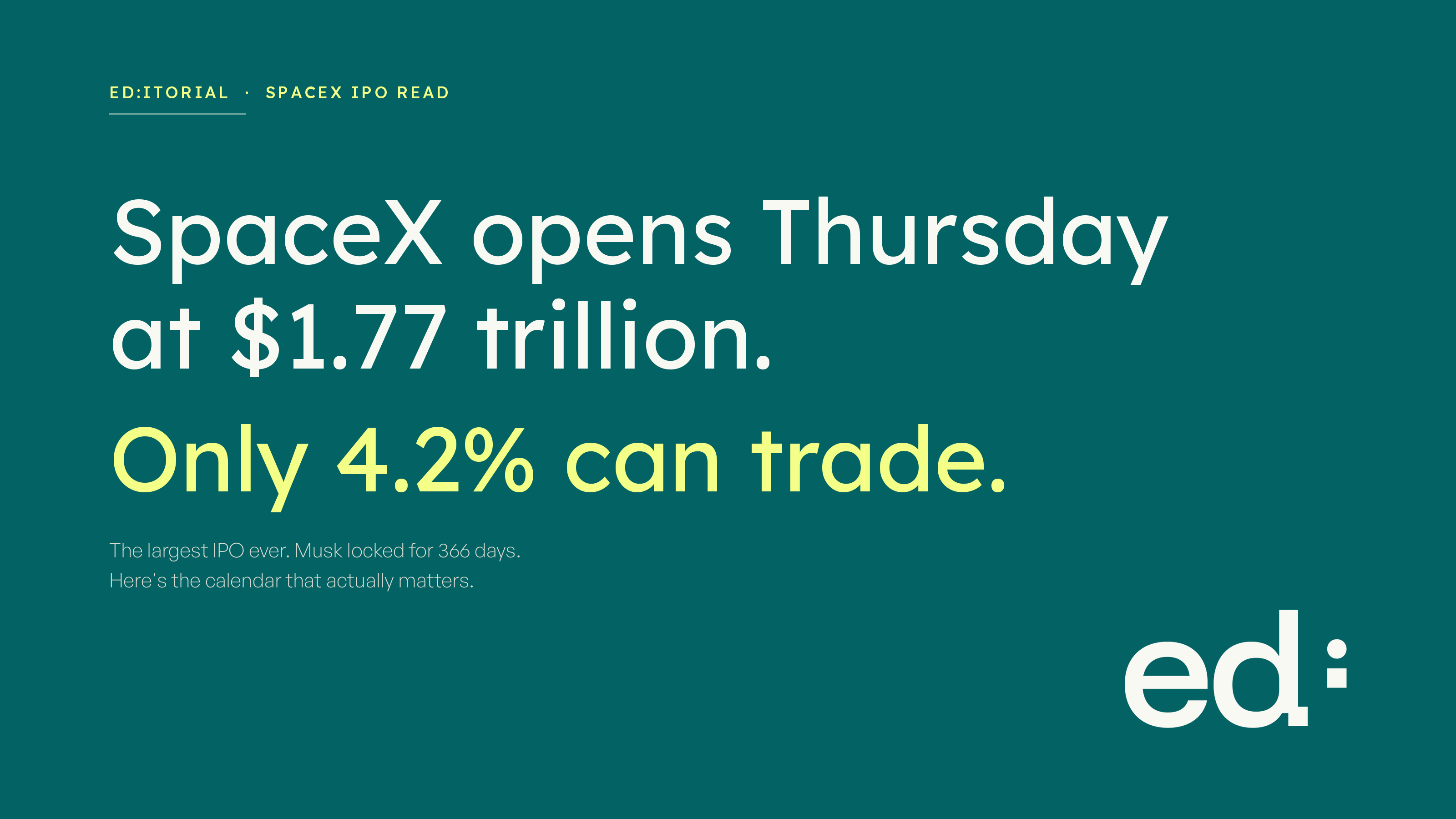
SpaceX prices Wednesday night and opens Thursday on Nasdaq at $135 per share — a $1.77 trillion valuation, the largest IPO ever. Most coverage will frame what comes next as a sentiment trade, an Elon story, or a race to Goldman's $5 trillion bull case. The reality is more grounded and more useful: the next 366 days are governed by an unusually clean calendar of supply releases — when 95.8% of the company can or cannot trade, when index funds add weight, when the lock-up cliff arrives, when Musk himself becomes a potential seller for the first time. Read the calendar and you've already understood the structure most market commentary will spend the next quarter trying to explain. Here are the 13 dates worth watching. Two things keep showing up in headlines that don't survive a careful read. The first is the idea that index funds are about to be forced into a massive single-event SpaceX buy. They aren't. Nasdaq did create a fast-track inclusion rule that lets SpaceX join the Nasdaq 100 wi
Edgen
·
Jun 10 2026

Investir, enfin, tu n'es plus seul.

Essaie Ed gratuitement. Sans carte, sans engagement.