Content
L'avenir du trading de cryptomonnaies : comment l'intelligence...
1. Pourquoi l'IA est-elle essentielle pour le trading de crypt...
Comment l'intelligence artificielle améliore vos décisions de ...
2. Stratégies d'IA puissantes pour des échanges de crypto rent...
1. Analyse des sentiments : Profiter de la hype du marché
2. Informations sur les données en chaîne : Lecture de l'activ...
3. Analyse technique et fondamentale : Des insights alimentés ...
3. Alpha Trading expliqué : Comment l'intelligence artificiell...
Qu'est-ce que l'Alpha exactement ?
Comment Edgen AI identifie les signaux alpha :
4. Mise en route avec Edgen AI dans le trading de cryptomonnai...
Le point crucial : L'IA est l'avenir du trading de cryptomonna...

Markets Confusing? Ask Edgen Search.

Instant answers, zero BS, and trading decisions your future self will thank you for.

Try Search Now

Comment utiliser l'IA pour identifier des opportunités de trading crypto rentables avec Edgen Radar
Edgen
· Mar 31 2026
Comment utiliser l'IA pour identifier des opportunités de trading crypto rentables avec Edgen Radar

L'avenir du trading de cryptomonnaies : comment l'intelligence artificielle transforme le jeu

Le trading de cryptomonnaies se déroule à une vitesse supraluminale, et les méthodes traditionnelles ne peuvent pas suivre le rythme.

Entrez en IA : votre meilleur allié pour battre le marché. Des plateformes commeEdgen Radarexploiter l'intelligence artificielle pour identifier rapidement des opportunités de trading cryptographique rentables, en combinant les données sur la chaîne, le sentiment social et l'analyse pilotée par l'intelligence artificielle dans une interface fluide.

Cet article vous guidera à travers la manière dont l'intelligence artificielle révolutionne les stratégies de trading en cryptomonnaies, et plus spécifiquement, comment Edgen AIéquipe les traders en leur fournissant des signaux Alpha en temps réel, des perspectives exploitables issues des tendances de la blockchain et une analyse précise des crypto-monnaies socialesles fondamentaux de la pompe.

1. Pourquoi l'IA est-elle essentielle pour le trading de cryptomonnaies
Crypto Chatgpt

Le crypto jamaisles lits :Les prix fluctuent en un clin d'œil, et il est impossible de suivre chaque mouvement individuel manuellement. C'est pourquoi l'utilisation de l'intelligence artificielle est un véritable changement de jeu.

Comment l'intelligence artificielle améliore vos décisions de trading :

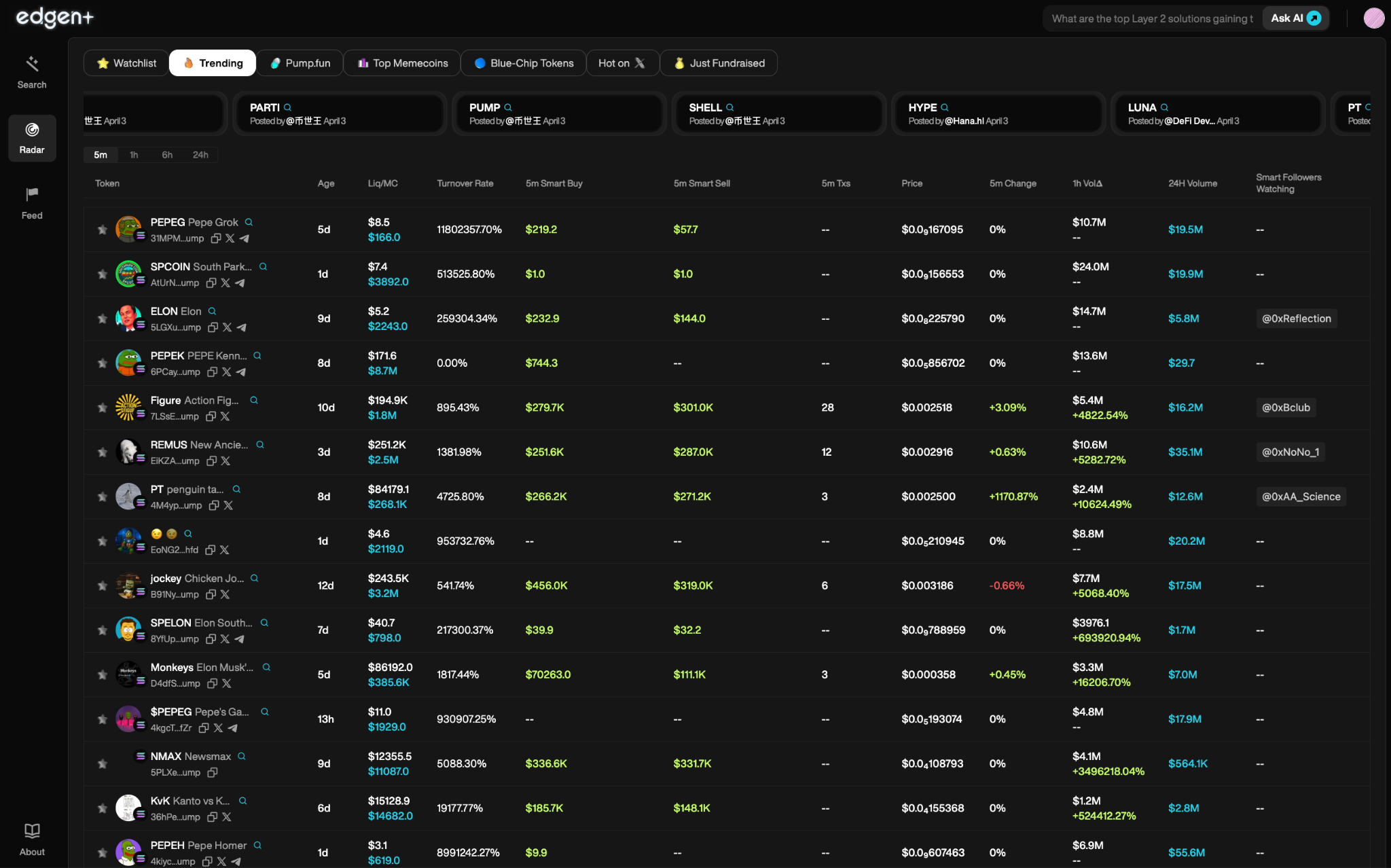
  • AI-based sentiment analysis for crypto:Scanne instantanément Crypto Twitter (X) et les actualités, identifiant les jetons en tendance et la communauté.sentiment...
  • Real-Time On-Chain Monitoring:Repérez les transactions de baleine, les déplacements de liquidité et les activités des portefeuilles intelligents avant qu'ils n'affectent les prix des jetons.
  • Crypto Alpha Signal powered by Edgen AI:Repère les actifs sous-évalués avec un momentum prometteur, vous alertant sur des opérations avant que les autres ne les remarquent.

Edgen va encore plus loin en combinant de manière unique l'analyse crypto, l'intelligence artificielle et les informations provenant des réseaux sociaux, assurant ainsi l'absence de points aveugles.
Crypto Trades

2. Stratégies d'IA puissantes pour des échanges de crypto rentables

La puissance de l'intelligence artificielle réside dans sa capacité à trier rapidement de grands ensembles de données, à reconnaître des motifs et à élaborer des stratégies avec précision et en temps réel, dépassant largement les capacités humaines. Voici comment l'IA accélère vos performances en trading de cryptomonnaies :

1. Analyse des sentiments : Profiter de la hype du marché

Les marchés cryptographiques évoluent principalement en fonction de la hype et de la spéculation. L'analyse de sentiment alimentée par l'intelligence artificielle détecte les tendances haussières ou baissières en analysant :

  • Mentions de jetonà travers les plateformes comme Twitter (X)
  • Indicateurs d'engagementpar exemple des retweets, des commentaires et des abonnements provenant de comptes intelligents.
  • Le sentiment des influenceursauprès des influenceurs clés (KOL).

Edgen Radarsignale instantanément les jetons qui gagnent en popularité sociale, vous permettant de vous positionner tôt pour des mouvements rentables.

2. Informations sur les données en chaîne : Lecture de l'activité des portefeuilles intelligents

Des analyses sur la chaîne de blocs pilotées par l'IA d'Edgen aident les traders en mettant en évidence les changements importants sur le marché :

  • Activité des baleines :Les grands mouvements des portefeuilles intelligents annoncent souvent des changements importants de prix.
  • Flux de liquidité :Suivre les mouvements des jetons sur les échanges centralisés (CEX) et les échanges décentralisés (DEX).
  • Signaux de Portefeuille Intelligent :Suivre les activités au sein des protocoles DeFi, les comportements de mise en garantie et les indicateurs d'utilité des tokens.

Le tableau de bord complet d'Edgen offre des informations claires et en temps réel sur la blockchain, éliminant ainsi les suppositions.

3. Analyse technique et fondamentale : Des insights alimentés par l'IA, de manière globale

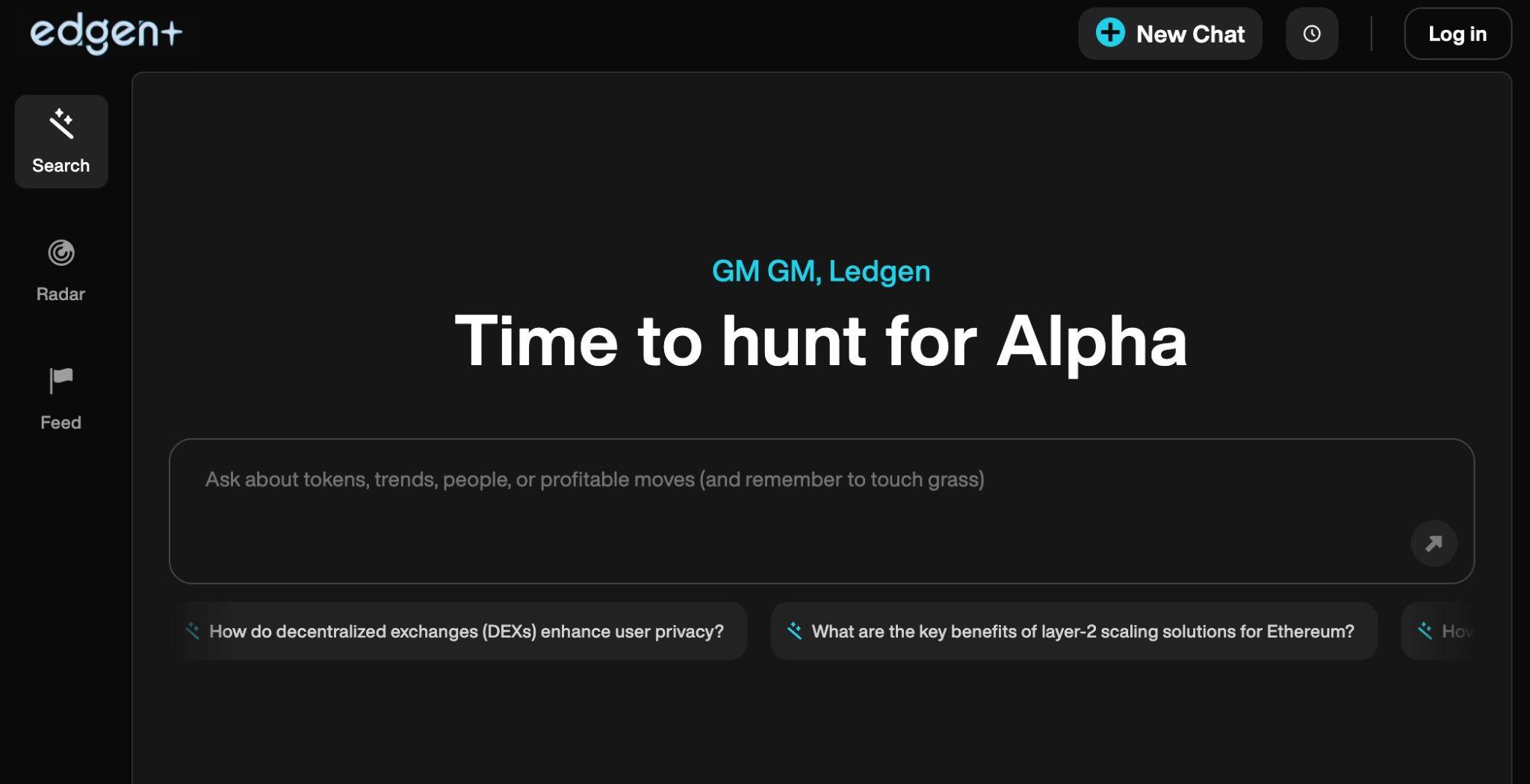
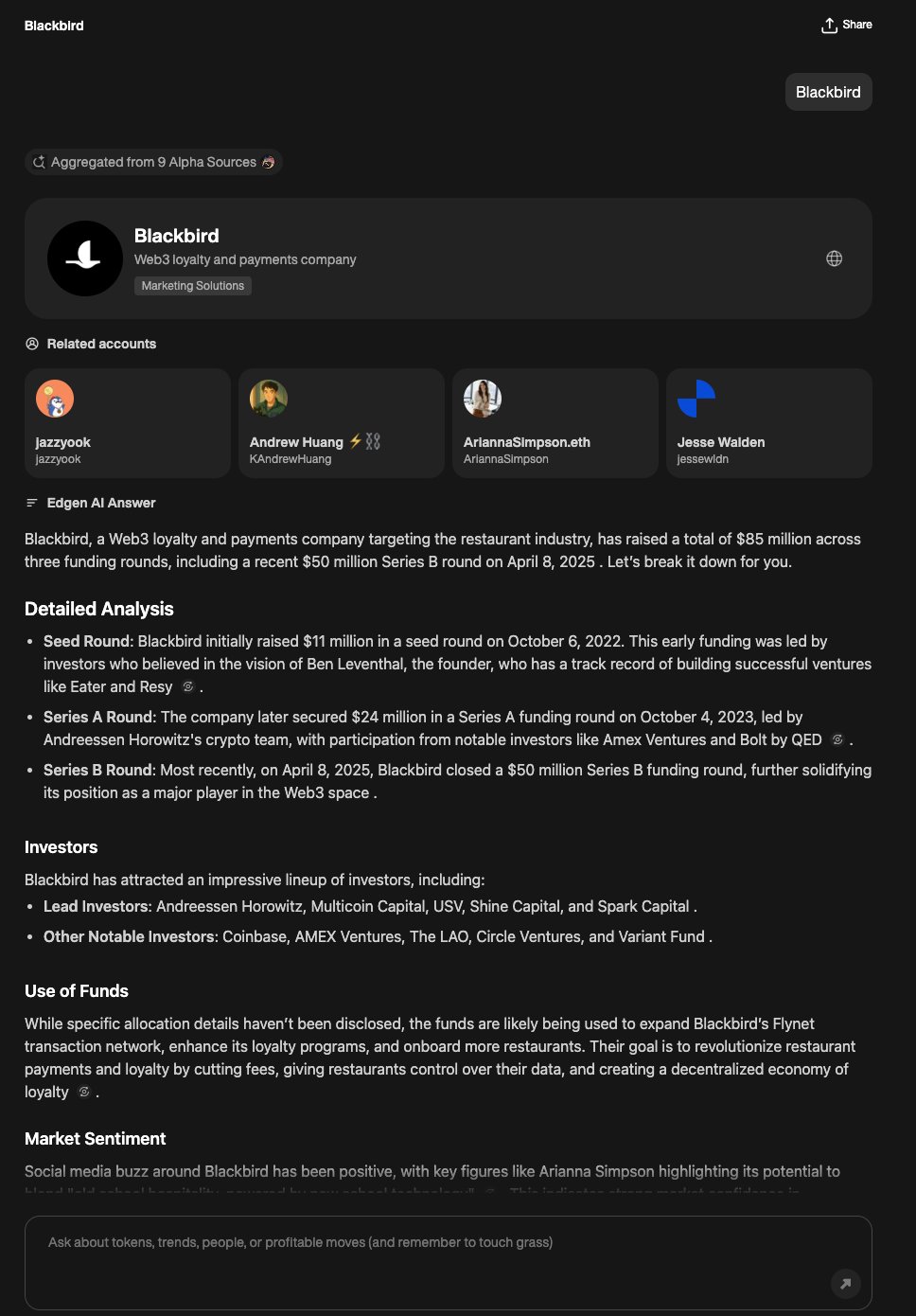
En combinant les modèles techniques de graphiques, les données sur la chaîne et les indicateurs de sentiment social, les algorithmes intelligents d'Edgen AI mettent automatiquement en évidence des opportunités de trading très pertinentes. Plutôt que de perdre du temps à trier manuellement des données de marché bruyantes et fragmentées, les traders peuvent s'appuyer sur Edgen Search’s AI-powered crypto trading enginepour fournir des analyses rapides, précises et basées sur les données en quelques secondes. La technologie LLM (Large Language Model) de la plateforme permet une fonction de recherche intuitive, permettant aux utilisateurs d'entrer des questions comme « Quels tokens attirent l'intérêt des whales ? » ou « Quels tokens DeFi sont en tendance aujourd'hui ? », et d'obtenir immédiatement des réponses détaillées. C'est le moyen plus intelligent de trader : conçu pour la vitesse, l'échelle et la précision.
3. Alpha Trading expliqué : Comment l'intelligence artificielle découvre des opportunités cachées

Qu'est-ce que l'Alpha exactement ?

Alpha désigne le fait de battre de manière constante le benchmark du marché en découvrant des opportunités de trading peu connues avant qu'elles ne deviennent largement visibles.

Comment Edgen AI identifie les signaux alpha :

  • Suivi des mouvements importants des portefeuilles intelligents et des whales.
  • Souligne les configurations de trading à faible risque et fort rendement.
  • Synthétise les fondamentaux sur la chaîne avec le "social-driven"les fondamentaux de la pompe.

En outre,Edgenintroduit un système unique d'incitation appelé "Aura", qui encourage les utilisateurs à former l'IA d'Edgen en partageant leurs propres connaissances, en récompensant les contributions actives et en améliorant continuellement la précision prédictive de la plateforme.
4. Mise en route avec Edgen AI dans le trading de cryptomonnaies

Prêt à accélérer votre trading de cryptomonnaies avec l'intelligence artificielle ? Voici comment commencer :

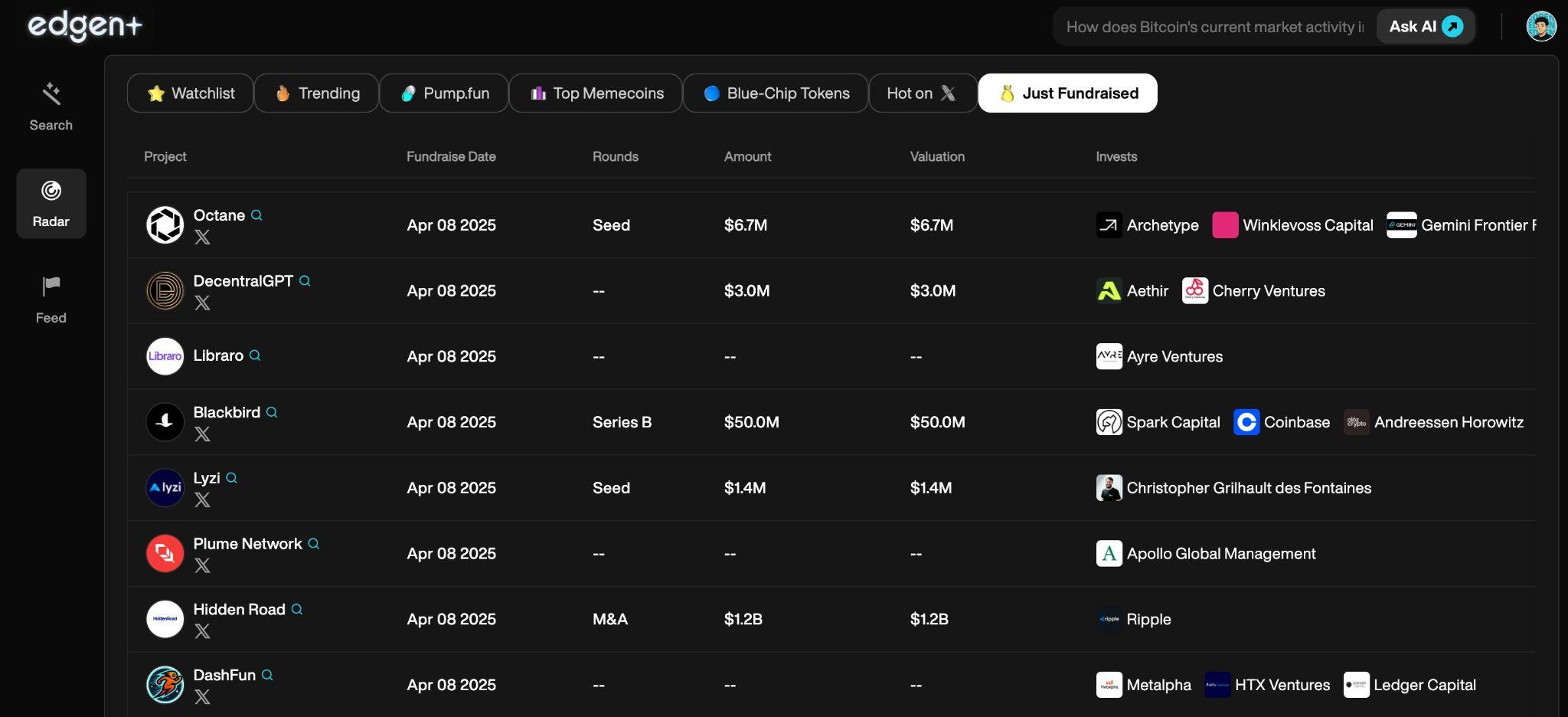
  1. Inscription :Rejoignez des plateformes commeEdgen Radaret accéder à l'intelligence marchée alimentée par l'IA.
  2. Surveiller les données en temps réel :Restez informé des tendances en chaîne évoluant et de l'actualité sociale naissante directement depuis le Radar.
  3. BacktestStratégies :Simulez et optimisez vos stratégies à l'aide d'une analyse historique du marché alimentée par l'intelligence artificielle.
  4. Gestion des risques :Maintenez toujours une discipline en matière de risque en fixant des stops-loss et en diversifiant votre portefeuille.

Souvenez-vous, l'IA renforce votre stratégie, mais elle ne remplace pas les principes du trading discipliné. L'IA est puissante, mais elle nécessite une surveillance humaine intelligente. Edgenaide en intégrant une surveillance continue, en temps réel, sur la chaîne et sociale, permettant des décisions d'achat et de vente plus sécurisées et plus intelligentes.

Le point crucial : L'IA est l'avenir du trading de cryptomonnaies

Dans le monde en constante évolution des crypto-monnaies, l'IA n'est pas seulement utile, c'est une obligation. Avec Edgen’s AI crypto toolsvous obtenez une bordure nette : des signaux alpha précis, des données en temps réel et une intelligence sociale qui vous aide à trader plus intelligemment et en avance sur la courbe.

Si vous souhaitez approfondir l'avenir des blockchain, des écosystèmes cryptographiques et comment les technologies comme l'intelligence artificielle s'intersectent avec l'innovation financière, le MIT Digital Currency Initiativefournit des recherches de pointe et un leadership en matière de réflexion provenant l'une des institutions académiques les plus prestigieuses au monde.

Prêt à trader plus intelligemment et à gagner plus souvent ? Start using Edgen today.

Recommend
Redeem miles for gift cards and each is worth ~1 cent; redeem for long-haul business and they're worth 2.5-4+. With programs now dynamically priced, the one check that decides every redemption.

How to redeem airline miles without wasting them

The single biggest mistake with miles is redeeming them for the easy stuff: gift cards, merchandise, seat upgrades at the gate. Do that and each mile is worth about one cent. Redeem the *same* miles for flights, especially long-haul or premium-cabin flights, and they're often worth two to five cents each, sometimes more. So the real skill isn't earning miles; it's not throwing away their value at the finish line. Here's how to actually use them. A mile has no fixed price; its value depends entirely on what you redeem it for. The way to judge any redemption is simple math: (cash price of the flight) ÷ (miles it costs) = cents per mile. If a flight costs $400 or 20,000 miles, that's 2 cents a mile, a solid deal. If a $90 flight costs 18,000 miles, that's half a cent, which is terrible; pay cash and keep the miles. Run this check before every redemption. It instantly separates a great use from a waste, and it's the one habit that makes miles worth having. As a rule of thumb, most major ai
Edgen
·
Jun 30 2026
Short-term goals (under ~3 years) belong in safe cash; long-term goals (5+ years) can take market risk. The best HYSAs now pay ~4-5% APY. How to sort yours and run both.

Long-term vs short-term financial goals (and how to plan both)

The difference comes down to one thing: time. A short-term goal is money you'll need within roughly three years (an emergency fund, a trip, a wedding, next year's tax bill), so it has to be *safe and reachable*. A long-term goal is five-plus years out (retirement, a house down the road, a kid's education), so it can take market risk, because time smooths the bumps out. Get that match right and you've done most of the work. It's not the size, it's the deadline. A $2,000 goal you need in six months is short-term; a $2,000 goal you won't touch for fifteen years is long-term, and they belong in completely different places. This is the part that actually matters, and where people lose money without realizing it. Short-term money should not be in the stock market. If your emergency fund is in stocks and the market drops 20% the same month your car dies, you're selling at the worst possible time. Short-term goals go somewhere stable and accessible, and a high-yield savings account is the clas
Edgen
·
Jun 30 2026
Mortgages near 6.5%, home prices flat, and the Fed split on rate cuts vs hikes. With timing a coin flip, the 3 questions that actually decide whether to buy now or wait.

Should you buy a house now or wait? How to actually decide

The honest answer: buy when you'll stay put for at least five years and you'll still have an emergency fund left after the down payment. Otherwise, waiting (and renting) is often the smarter money move, not the weaker one. "Rent vs buy" isn't a math problem with one right answer, and it's almost never really about timing the market. It's about your *life*, in three questions. Before the three questions, here's the mid-2026 backdrop — because "now or wait" usually hides a bet on rates and prices, and the data says that bet is a coin flip. The picture: mortgages are still pricey, prices have gone flat (more than half of the 20 big metros saw year-over-year declines in March), and the cheap-money era hasn't returned. So "buy before it runs away" and "wait for the crash" are *both* weak arguments right now. The whole "wait for rates to drop" plan rests on the Fed, and the Fed is split down the middle. In its June 2026 projections, policymakers were divided: 8 expected no change this year,
Edgen
·
Jun 30 2026
Most financial goals fail because they're wishes, not systems. Here's the 3-part anatomy of a goal that sticks (a number, a date, one automatic move), plus why 37% of adults can't cover a $400 surprise.

How to set financial goals you'll actually hit

A financial goal you'll actually hit has three things a vague wish doesn't: a number, a date, and one automatic move that happens whether or not you remember it. "Save more" is a wish. "$6,000 in a separate account by next December, $500 auto-transferred on payday" is a goal. The gap between those two sentences is the reason most goals quietly die, and it has almost nothing to do with willpower. Key Takeaways A real financial goal answers three questions: how much, by when, and what for. Drop any one and it stops working. "Pay off debt" has no number and no date, so there's nothing to aim at or measure, while "$8,000 of card debt cleared in 18 months" tells you exactly whether you're on track and the day you're done. The "what for" matters more than people expect. A goal tied to something real (a buffer so a bad month isn't a crisis, a deposit on a first place) survives the months when motivation dips. In our experience reading how people actually use a money tool, the goals that get
Edgen
·
Jun 30 2026
A big RSU grant just vested — now what? Here's what a modern money tool actually surfaces first, using Ed as a worked example: a reality check, the 22% tax gap most high earners miss, and the concentration risk nobody flags.

Your RSUs Just Vested. Here's What a Money Tool Surfaces First.

You just had a big RSU grant vest. Congratulations — and now the awkward part: a six-figure pile of your own company's stock, a vague sense you should "do something," and no one actually telling you what. An advisor, a spreadsheet, and a piece of software each handle this moment differently. Here's what a modern money tool surfaces in a moment like this — using Ed as a worked example — so you can decide what kind of help actually fits. Key takeaways You connect your brokerage and bank through read-only aggregation, so the tool can read balances but can't move a dollar. Ed's framing is simple: precise about your money, blind to your identity. Instead of sorting your lattes into categories, Ed opens on a single Financial Reality Check — a read on whether your money could survive a bad month. For a lot of high earners, that one number lands harder than any budget, because it answers a question the other apps never ask. (If the Reality Check is the numbers side, your money type is the beha
Edgen
·
Jun 26 2026
A money personality test is more than a quiz if it measures behavior, not just vibes. Here's the science behind money types, how Ed's test works, and how to use your result.

What Is a Money Personality Test? The Science Behind Your Money Type

The short version: a good money personality test should feel like a roast and work like a mirror — fun on the surface, behavioral underneath. The useful ones don't tell you what you know; they show you how you act with money, and the one blind spot worth watching. Key takeaways Here's the uncomfortable backdrop. U.S. financial literacy has been stuck for a decade — adults answer only about 49% of the standard knowledge questions correctly, essentially flat since 2017 (TIAA Institute–GFLEC, 2025) — even as free financial information became infinite. If facts fixed money, they'd have fixed it by now. They don't, because the thing that actually drives your outcomes lives one level below the facts: how you're wired to behave when money is on the line. That's the whole premise of financial fitness — and it's what a money personality test is built to surface. Not what you know. What you do. The idea has real research behind it — money behavior is patterned and measurable, and a few tradition
Edgen
·
Jun 23 2026
A financial reality check scores where you actually stand across safety, control, progress, upside, and Mental Load. Here's why a money score matters, how Ed's checkup works, and what to do with your weakest area.

What Is a Financial Reality Check? Why Your Credit Score Isn't Enough

The short version: your credit score measures how safe you are to lend to. Almost nobody has ever seen the number that measures whether you are actually secure. A financial reality check is that second number. Key takeaways Ask people for their credit score and many can recite it. Ask whether they could survive three months without income, or where their money quietly leaks each month, and you get a shrug. That's the gap. A credit score answers a lender's question — how risky is it to extend this person debt? It can be high while your life is fragile, or low while you're genuinely fine, because it was never built to measure you. A financial reality check answers the question the credit score ignores: are you safe, clear, progressing, building, and at ease? Here's the simple version, with the research behind each axis.
Edgen
·
Jun 23 2026
SpaceX opens Thursday at a $1.77 trillion valuation — the largest IPO ever. Only 4.2% of stock actually trades. Musk is locked up for 366 days. The next 366 days run on an unusually clean calendar of supply releases. Here are the 13 dates worth watching.

SpaceX goes public Thursday with a possible $5 trillion hit. Here's the calendar that actually matters.

SpaceX prices Wednesday night and opens Thursday on Nasdaq at $135 per share — a $1.77 trillion valuation, the largest IPO ever. Most coverage will frame what comes next as a sentiment trade, an Elon story, or a race to Goldman's $5 trillion bull case. The reality is more grounded and more useful: the next 366 days are governed by an unusually clean calendar of supply releases — when 95.8% of the company can or cannot trade, when index funds add weight, when the lock-up cliff arrives, when Musk himself becomes a potential seller for the first time. Read the calendar and you've already understood the structure most market commentary will spend the next quarter trying to explain. Here are the 13 dates worth watching. Two things keep showing up in headlines that don't survive a careful read. The first is the idea that index funds are about to be forced into a massive single-event SpaceX buy. They aren't. Nasdaq did create a fast-track inclusion rule that lets SpaceX join the Nasdaq 100 wi
Edgen
·
Jun 10 2026

Investir, enfin, tu n'es plus seul.

Essaie Ed gratuitement. Sans carte, sans engagement.