
Content
What Exactly is Edgen Search for Crypto Trading?
How AI Transforms Your Crypto Trading Experience
The AI Power Behind Edgen Search for Crypto Trading
How AI Makes Crypto Trading Smarter and Safer
Real-Time Data Processing
Advanced Pattern Recognition
Smart Risk Assessment
Why Traders Love Using Edgen Search
Faster Decision-Making
Reduced Emotional Bias
24/7 Trading Surveillance
Is AI the Future of Crypto Trading?
Next-Level Automation
Enhanced Risk Management
Personalized Trading Strategies
Powerful Market Intelligence
Expanding Beyond Crypto
FAQs: Your Edgen Search & AI Trading Questions Answered
What exactly is Edgen Search for crypto trading?
Can AI genuinely boost my crypto trading success?
Are there risks involved in AI crypto trading?
Is Edgen Search beginner-friendly?
How do I choose the best AI tool?
Final Thoughts: Time to Trade Smarter with Edgen AI
Ready to trade smarter — not harder?

Markets Confusing? Ask Edgen Search.

Instant answers, zero BS, and trading decisions your future self will thank you for.

Try Search Now

Edgen Search for Crypto Trading: Can AI Help You Trade Smarter?
Edgen
· Apr 02 2026
Edgen Search for Crypto Trading: Can AI Help You Trade Smarter?

Crypto trading can be wild. One second, prices are shooting to the moon, and the next, they're diving faster than you can say "rug pull." Most traders rely on gut feelings or chase the latest hype on Crypto Twitter, often leading to costly mistakes. But what if there was a smarter, faster way to trade crypto?

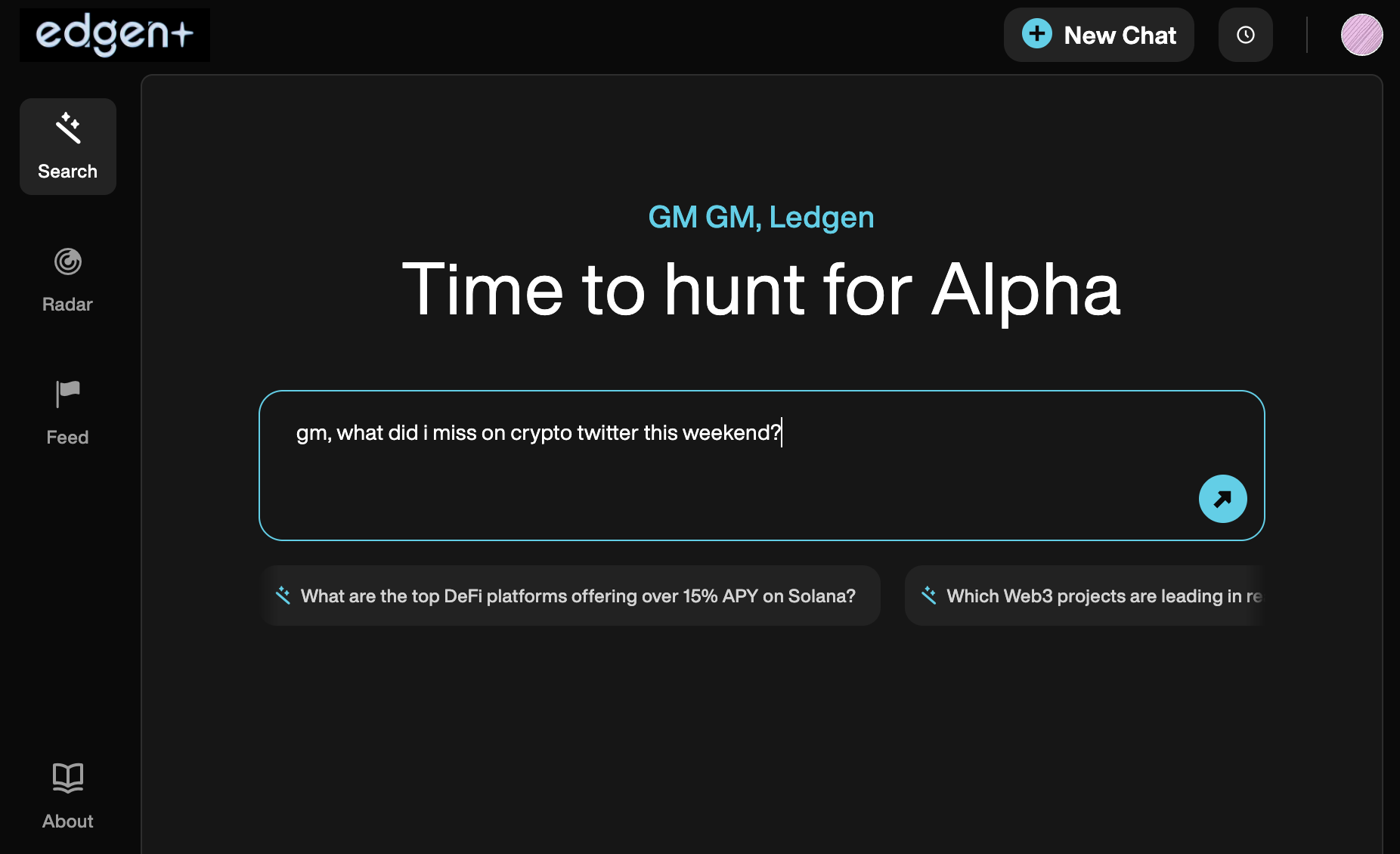
Meet Edgen Search: your AI-powered trading sidekick designed to navigate the chaotic crypto market. Edgen Search scans millions of data points from blockchain transactions, market sentiment, influencer tweets, and smart wallets instantly, so you don't have to.

In this guide, we'll explore how Edgen Search uses AI to make crypto trading easier, faster, and significantly smarter.

What Exactly is Edgen Search for Crypto Trading?

Think of Edgen Search as your personal crypto assistant… except smarter, faster, and awake 24/7. It instantly analyzes real-time on-chain activities, social trends, and market signals to spot profitable opportunities before most traders even notice them.

No more endless scrolling, no more emotional trades. Edgen Search helps you cut through market noise, reduce your risk, and boost your trading efficiency. It's like having a trading genius whispering alpha straight into your ear.

How AI Transforms Your Crypto Trading Experience

Crypto markets never sleep, but humans do. AI fills the gap perfectly by delivering:

  • Instant Market Analysis: Processes real-time blockchain and social media data at lightning speed.
  • Better Predictions: Spots patterns and trends invisible to human eyes.
  • Emotion-Free Trading: Trades based on logic and data, not panic or hype.
  • Continuous Operation: Runs tirelessly around the clock, ensuring no trade opportunity slips away.

In short, tools like Edgen Search empower traders to move faster and smarter, without stress or guesswork.

The AI Power Behind Edgen Search for Crypto Trading
Crypto Trading

Edgen Search isn't magic, but it sure feels like it. Its advanced algorithms quickly analyze market trends, social sentiment ("pumpamentals"), influencer activity, and whale wallet movements. Unlike humans, it doesn't get distracted or emotional, meaning its predictions remain sharp, accurate, and actionable.

Traders receive real-time insights and alerts, enabling swift, informed decisions without the constant stress of manual monitoring.

How AI Makes Crypto Trading Smarter and Safer

Crypto trading can feel like a rollercoaster. Here's how Edgen's AI smooths out the ride:

Real-Time Data Processing

Crypto moves fast. Edgen's AI processes thousands of trades per second, instantly spotting price movements, volume shifts, and emerging trends. This means you can jump into trades confidently, without guesswork or delays.

Advanced Pattern Recognition

AI excels at identifying market patterns, helping traders anticipate market moves before they become obvious. By analyzing historical trends and real-time signals, Edgen Search transforms trading from guesswork into strategy.

Smart Risk Assessment

Market volatility can crush portfolios overnight. Edgen Search proactively identifies risks like sudden liquidity shifts, suspicious whale activity, or scam patterns, giving traders timely warnings to avoid costly pitfalls.

Trading crypto manually feels outdated once you experience Edgen Search. Here’s why traders keep coming back for more:

Faster Decision-Making

Crypto markets reward speed. Edgen AI instantly analyzes vast amounts of data: prices, volume, influencer posts, smart wallet moves. So you’re always first to the trade, never the last.

Reduced Emotional Bias

Fear and greed lead to trading disasters. AI removes emotion from your trading decisions, relying strictly on market data, trends, and precise analysis. Less panic, more profit.

24/7 Trading Surveillance

You can sleep while Edgen watches the charts. It keeps an eye on the market round-the-clock, alerting you only when it matters. You can even personalize your content feed using the Edgen Feed to stay laser-focused on what matters most.

Is AI the Future of Crypto Trading?

Absolutely! The shift is already well underway.

AI is reshaping how traders analyze markets, manage risk, and make faster decisions with greater confidence. In fact, the International Monetary Fund (IMF) highlights how artificial intelligence is increasingly influencing financial markets and financial stability, reinforcing the idea that AI isn’t just a crypto trend — it’s redefining the future of finance itself.

Here’s what that means for Edgen AI:

Next-Level Automation

Edgen AI’s integrates on-chain fundamentals and social signals to pinpoint opportunities other tools miss completely.

Enhanced Risk Management

AI-driven insights will continue to evolve, providing deeper market analytics, sharper risk assessments, and clearer signals around whale activities and pump-and-dump scenarios.

Personalized Trading Strategies

Edgen AI learns from you. It adapts trading insights to match your risk profile, trading style, and asset preferences, powered by Edgen’s innovative "Aura" system.

Powerful Market Intelligence

With Edgen’s upcoming AI search enhancements, you'll instantly access precise, clutter-free answers to critical market questions. No information overload, just actionable alpha.

Expanding Beyond Crypto

While optimized for memecoins and altcoins, Edgen AI also covers traditional assets, bringing advanced AI-powered trading to every market imaginable.

FAQs: Your Edgen Search & AI Trading Questions Answered

What exactly is Edgen Search for crypto trading?

Answer:

Edgen Search is an AI tool that analyzes real-time crypto market data, on-chain activity, and social sentiment to help traders make smarter, quicker, and less risky trading decisions.

Can AI genuinely boost my crypto trading success?

Answer:

Yes. AI significantly enhances crypto trading by providing instant market insights, identifying hidden trends, and automating trades based on accurate data rather than emotions.

Are there risks involved in AI crypto trading?

Answer:

AI is smarter, but it isn't foolproof. Unexpected market events, poor-quality data, and external factors (like regulatory changes or hacks) can still impact predictions. Always combine AI insights with your own analysis.

Is Edgen Search beginner-friendly?

Answer:

Absolutely. Edgen Search simplifies complex market analysis and presents clear insights suitable for beginners. But it's beneficial to understand basic trading concepts and risk management.

How do I choose the best AI tool?

Answer:

Prioritize features like real-time insights, automation, ease of use, reliability, and risk management. Edgen Search checks all these boxes, offering both simplicity and powerful analysis.

Final Thoughts: Time to Trade Smarter with Edgen AI

Let’s be honest — crypto isn’t getting any easier to follow. But with the right AI in your corner, you don’t have to keep guessing.

With Edgen Search, you gain:

  • Instant market signals and smart alerts
  • Emotionless, data-driven trading insights
  • Always-on scanning of on-chain and social trends
  • Real-time tools that help you move first — not last

Whether you're deep into altcoins or just starting out, Edgen helps you navigate the chaos with clarity and confidence.

Ready to trade smarter — not harder?

Start now with Edgen and experience next-gen trading powered by real-time AI.
Looking for the vision behind the product? Learn what drives Edgen and how we’re reshaping the future of intelligent markets.


Recommend
banner.jpg

What is a money person? The plain-English alternative to a financial advisor

The short version: a money person is a smart, warm friend who happens to be good with money and explains it like a person, not a bank. Practically, it's a second opinion on your whole financial picture — cash, debt, tax exposure, concentration, and the goals you're working toward — that tells you in plain language what to look at first. It's not a traditional advisor managing your portfolio for 1% a year, and it's not a coach cheering you on. It's the honest read a good advisor's first meeting would give you, without the fee or the asset minimum. It's the role Ed Wealth was built to play. Strip away the label and a money person does four concrete things: Just as important is what it doesn't do: it doesn't take custody of your money, it doesn't sell you products for commission, and it doesn't pretend a forecast is a promise. It's a second opinion: it shows you the structure and lets you decide. People reach for four different things when they say "I should talk to someone." They're not
Edgen
·
Jul 10 2026
banner.jpg

Is a financial advisor worth it? Advisor vs robo vs money person

The short version: a financial advisor is worth it when your money has real complexity — a business, concentrated stock, an estate, a divorce, or turning savings into retirement income. There, a fee pays for itself. But most people don't have a complexity problem; they have a clarity one, and paying 1% of your assets a year — about $3,000 on a $300,000 portfolio, every year — is a lot to pay for reassurance. You have three tiers to choose from: a human advisor (~1% of assets), a robo-advisor (~0.25%), and a money person — a flat-fee second opinion that doesn't grow as your savings do. Start with the honest case for paying. A good advisor earns their fee when your situation is genuinely complex: selling a business, a big block of company stock or options, an estate with kids, a divorce, a windfall, or building a retirement-income plan with real moving parts. In those moments, one right call can save you many times the fee, and the job becomes picking a good one (that's how to choose a f
Edgen
·
Jul 10 2026
banner.jpg

Do You Actually Need a Financial Advisor? (An Honest Test)

The short version: you need a financial advisor when your money has genuine complexity — equity comp across several employers, a business sale, an estate with kids involved, a divorce, a sudden windfall, or a retirement-drawdown plan with real moving parts. If your situation is closer to "I earn well but somehow feel behind," that's a clarity problem, not a complexity one, and hiring someone to manage your money for about 1% a year is an expensive way to solve it. Here's how to tell which one you have. Almost everyone reaching for an advisor falls into one of two camps, and confusing them is where money gets wasted. A complexity problem is when there are real moving parts that interact: decisions where a wrong move costs far more than any fee. Selling a company, exercising stock options with a tax bill attached, splitting assets in a divorce, planning how to draw income across a 30-year retirement. Here, a good advisor earns their keep. A clarity problem looks different. Good income, a
Edgen
·
Jul 06 2026
banner.jpg

How to Choose a Financial Advisor in 2026 (and Whether You Even Need One)

The short version: picking a financial advisor isn't about finding the "smartest" one. It comes down to three boring questions that actually predict whether you'll be treated well: are they legally a fiduciary, how do they get paid, and do you even need one yet. Get those right and the rest is noise. Here's how to run the check — and what to do if you want guidance but can't (or don't want to) meet a $250,000 minimum. Before you choose one, ask whether this is the right tool at all. A full-service advisor earns their fee when your situation is genuinely complex — a business sale, equity comp across several companies, estate planning, a divorce, a sudden windfall, or a retirement-income plan with real moving parts. But a lot of people reaching for an advisor don't have a complexity problem. They have a clarity problem: a good income, a few scattered accounts, and a nagging sense of being behind. That doesn't need someone to manage your money for 1% a year. It needs a clear read on where
Edgen
·
Jul 06 2026
Redeem miles for gift cards and each is worth ~1 cent; redeem for long-haul business and they're worth 2.5-4+. With programs now dynamically priced, the one check that decides every redemption.

How to redeem airline miles without wasting them

The single biggest mistake with miles is redeeming them for the easy stuff: gift cards, merchandise, seat upgrades at the gate. Do that and each mile is worth about one cent. Redeem the *same* miles for flights, especially long-haul or premium-cabin flights, and they're often worth two to five cents each, sometimes more. So the real skill isn't earning miles; it's not throwing away their value at the finish line. Here's how to actually use them. A mile has no fixed price; its value depends entirely on what you redeem it for. The way to judge any redemption is simple math: (cash price of the flight) ÷ (miles it costs) = cents per mile. If a flight costs $400 or 20,000 miles, that's 2 cents a mile, a solid deal. If a $90 flight costs 18,000 miles, that's half a cent, which is terrible; pay cash and keep the miles. Run this check before every redemption. It instantly separates a great use from a waste, and it's the one habit that makes miles worth having. As a rule of thumb, most major ai
Edgen
·
Jun 30 2026
Short-term goals (under ~3 years) belong in safe cash; long-term goals (5+ years) can take market risk. The best HYSAs now pay ~4-5% APY. How to sort yours and run both.

Long-term vs short-term financial goals (and how to plan both)

The difference comes down to one thing: time. A short-term goal is money you'll need within roughly three years (an emergency fund, a trip, a wedding, next year's tax bill), so it has to be *safe and reachable*. A long-term goal is five-plus years out (retirement, a house down the road, a kid's education), so it can take market risk, because time smooths the bumps out. Get that match right and you've done most of the work. It's not the size, it's the deadline. A $2,000 goal you need in six months is short-term; a $2,000 goal you won't touch for fifteen years is long-term, and they belong in completely different places. This is the part that actually matters, and where people lose money without realizing it. Short-term money should not be in the stock market. If your emergency fund is in stocks and the market drops 20% the same month your car dies, you're selling at the worst possible time. Short-term goals go somewhere stable and accessible, and a high-yield savings account is the clas
Edgen
·
Jun 30 2026
Mortgages near 6.5%, home prices flat, and the Fed split on rate cuts vs hikes. With timing a coin flip, the 3 questions that actually decide whether to buy now or wait.

Should you buy a house now or wait? How to actually decide

The honest answer: buy when you'll stay put for at least five years and you'll still have an emergency fund left after the down payment. Otherwise, waiting (and renting) is often the smarter money move, not the weaker one. "Rent vs buy" isn't a math problem with one right answer, and it's almost never really about timing the market. It's about your *life*, in three questions. Before the three questions, here's the mid-2026 backdrop — because "now or wait" usually hides a bet on rates and prices, and the data says that bet is a coin flip. The picture: mortgages are still pricey, prices have gone flat (more than half of the 20 big metros saw year-over-year declines in March), and the cheap-money era hasn't returned. So "buy before it runs away" and "wait for the crash" are *both* weak arguments right now. The whole "wait for rates to drop" plan rests on the Fed, and the Fed is split down the middle. In its June 2026 projections, policymakers were divided: 8 expected no change this year,
Edgen
·
Jun 30 2026
Most financial goals fail because they're wishes, not systems. Here's the 3-part anatomy of a goal that sticks (a number, a date, one automatic move), plus why 37% of adults can't cover a $400 surprise.

How to set financial goals you'll actually hit

A financial goal you'll actually hit has three things a vague wish doesn't: a number, a date, and one automatic move that happens whether or not you remember it. "Save more" is a wish. "$6,000 in a separate account by next December, $500 auto-transferred on payday" is a goal. The gap between those two sentences is the reason most goals quietly die, and it has almost nothing to do with willpower. Key Takeaways A real financial goal answers three questions: how much, by when, and what for. Drop any one and it stops working. "Pay off debt" has no number and no date, so there's nothing to aim at or measure, while "$8,000 of card debt cleared in 18 months" tells you exactly whether you're on track and the day you're done. The "what for" matters more than people expect. A goal tied to something real (a buffer so a bad month isn't a crisis, a deposit on a first place) survives the months when motivation dips. In our experience reading how people actually use a money tool, the goals that get
Edgen
·
Jun 30 2026
A big RSU grant just vested — now what? Here's what a modern money tool actually surfaces first, using Ed as a worked example: a reality check, the 22% tax gap most high earners miss, and the concentration risk nobody flags.

Your RSUs Just Vested. Here's What a Money Tool Surfaces First.

You just had a big RSU grant vest. Congratulations — and now the awkward part: a six-figure pile of your own company's stock, a vague sense you should "do something," and no one actually telling you what. An advisor, a spreadsheet, and a piece of software each handle this moment differently. Here's what a modern money tool surfaces in a moment like this — using Ed as a worked example — so you can decide what kind of help actually fits. Key takeaways You connect your brokerage and bank through read-only aggregation, so the tool can read balances but can't move a dollar. Ed's framing is simple: precise about your money, blind to your identity. Instead of sorting your lattes into categories, Ed opens on a single Financial Reality Check — a read on whether your money could survive a bad month. For a lot of high earners, that one number lands harder than any budget, because it answers a question the other apps never ask. (If the Reality Check is the numbers side, your money type is the beha
Edgen
·
Jun 26 2026
A money personality test is more than a quiz if it measures behavior, not just vibes. Here's the science behind money types, how Ed's test works, and how to use your result.

What Is a Money Personality Test? The Science Behind Your Money Type

The short version: a good money personality test should feel like a roast and work like a mirror — fun on the surface, behavioral underneath. The useful ones don't tell you what you know; they show you how you act with money, and the one blind spot worth watching. Key takeaways Here's the uncomfortable backdrop. U.S. financial literacy has been stuck for a decade — adults answer only about 49% of the standard knowledge questions correctly, essentially flat since 2017 (TIAA Institute–GFLEC, 2025) — even as free financial information became infinite. If facts fixed money, they'd have fixed it by now. They don't, because the thing that actually drives your outcomes lives one level below the facts: how you're wired to behave when money is on the line. That's the whole premise of financial fitness — and it's what a money personality test is built to surface. Not what you know. What you do. The idea has real research behind it — money behavior is patterned and measurable, and a few tradition
Edgen
·
Jun 23 2026

Your money person, finally.

Try Edgen free. No credit card. No commitment.