
A bundle of aluminum-coated glass fibers first used against radar in World War II is emerging as a critical tool for protecting Ukraine's long-range drones.
A bundle of aluminum-coated glass fibers first used against radar in World War II is emerging as a critical tool for protecting Ukraine's long-range drones.
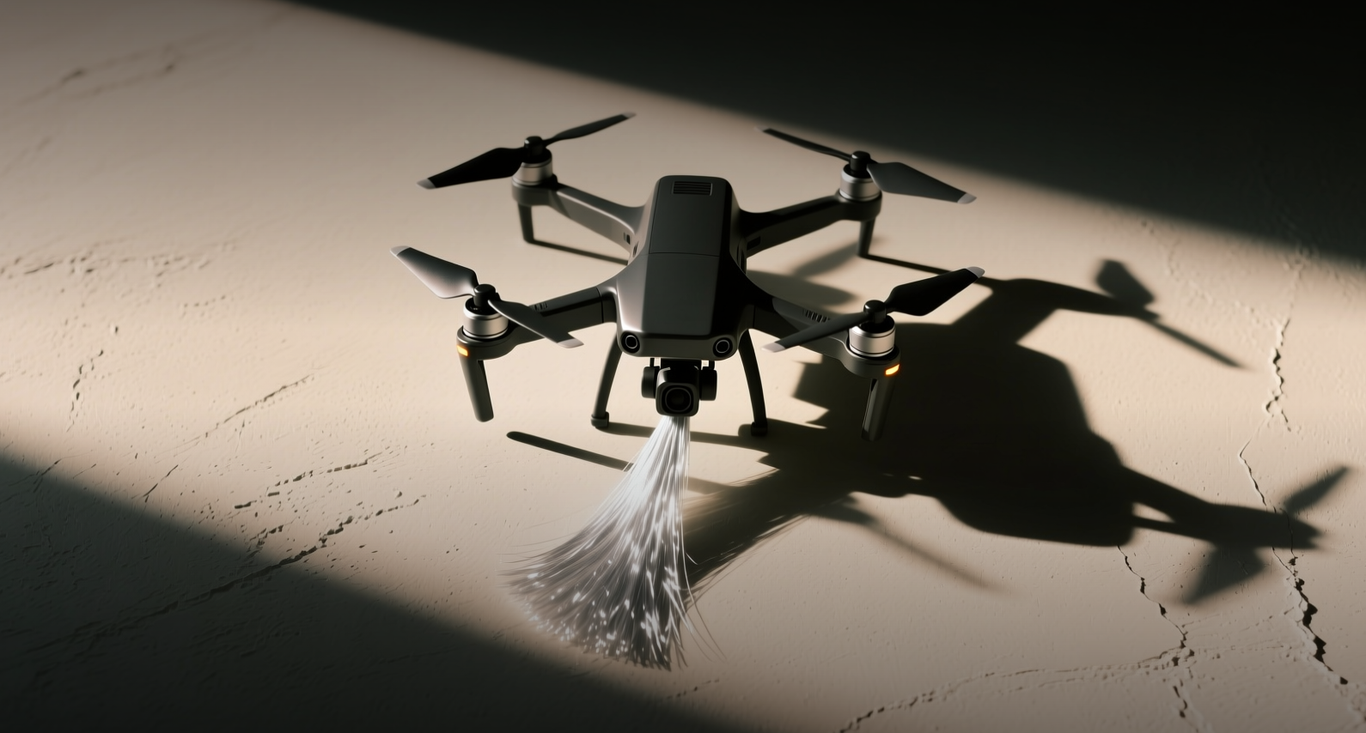
When Ukrainian drones struck Russia's Omsk refinery in July, they flew through undefended airspace — a luxury that will not last as Moscow densifies its radar networks, making chaff an increasingly vital countermeasure.
"Chaff creates uncertainty across radar systems and complicates decision-making, forcing defenders to waste expensive interceptor missiles," said Robert Brüll, chief executive officer of FibreCoat, a company developing compact chaff systems for drones.
The Omsk refinery, Russia's largest, had no air-defense coverage because Moscow considered the Siberian city beyond Ukraine's reach. The July strike knocked out its only primary refining unit. Chaff — tiny aluminum-coated glass fibers engineered to resonate at specific radar frequencies — has been used on military aircraft and warships since World War II but is only now being adapted for drone-scale deployment.
Ukraine's deep-strike capability depends on getting drones through increasingly dense air-defense networks. Without countermeasures like chaff, each long-range mission becomes a high-risk gamble. With it, Ukraine can disguise the direction, size and makeup of an attack, splitting defenders' attention and improving the odds that strike packages reach their targets.
The drone war in Ukraine shifted in 2023 with the mass adoption of first-person-view drones for tactical strikes a few kilometers beyond the front line. Now, long-range systems can hit targets hundreds of kilometers away — logistics hubs, ammunition depots, aircraft on the ground and defense-industrial facilities. But range alone is not enough. The utility of these drones depends on their ability to penetrate defended airspace.
Chaff addresses this problem at a fraction of the cost of the missiles it confuses. When ejected from a drone, the fibers form a reflective cloud that produces radar returns strong enough to mask other aircraft or trick radar-guided missiles into locking onto the wrong target. Ukrainian deep-strike units already combine strike drones with unarmed decoys, but chaff offers a more scalable solution — one drone can release chaff to hide another, and a swarm can use the technique to confuse defenders about the attack's true direction.
The Economics of Countermeasures
The cost asymmetry is central to chaff's appeal. Radar-guided interceptor missiles can cost hundreds of thousands of dollars each, while chaff is cheap to produce and requires no sophisticated guidance systems. For Russia, defending against chaff-equipped drones means either investing in more expensive counter-countermeasure technology or accepting higher intercept failure rates — both unfavorable outcomes.
The next step, according to Brüll, is making the countermeasure practical at drone scale. His company is among those developing compact chaff systems small and light enough for long-range unmanned aircraft, a capability once limited to manned jets and warships.
The broader strategic context favors Ukraine's adaptation. Major General Mykhailo Drapatyi took over as Ukraine's commander-in-chief on July 21, bringing one of the military's most battle-tested commanders to its top post. On the diplomatic front, President Donald Trump promised during a July meeting in Ankara with President Volodymyr Zelensky to license Patriot missile production to Kyiv, addressing Ukraine's critically low interceptor stocks.
The last time a low-cost countermeasure reshaped a conflict was the proliferation of man-portable air-defense systems in the 1980s, which forced a fundamental shift in how air forces operated. Chaff, if successfully scaled for drones, could have a similar effect on the economics of modern air defense — making it far more expensive for the defender than the attacker.
This article is for informational purposes only and does not constitute investment advice.
