

The AI trade is no longer about earnings growth — it is about who bears the credit risk when the financing chain breaks.
The AI trade is no longer about earnings growth — it is about who bears the credit risk when the financing chain breaks.
The AI trade is no longer about earnings growth — it is about who bears the credit risk when the financing chain breaks.
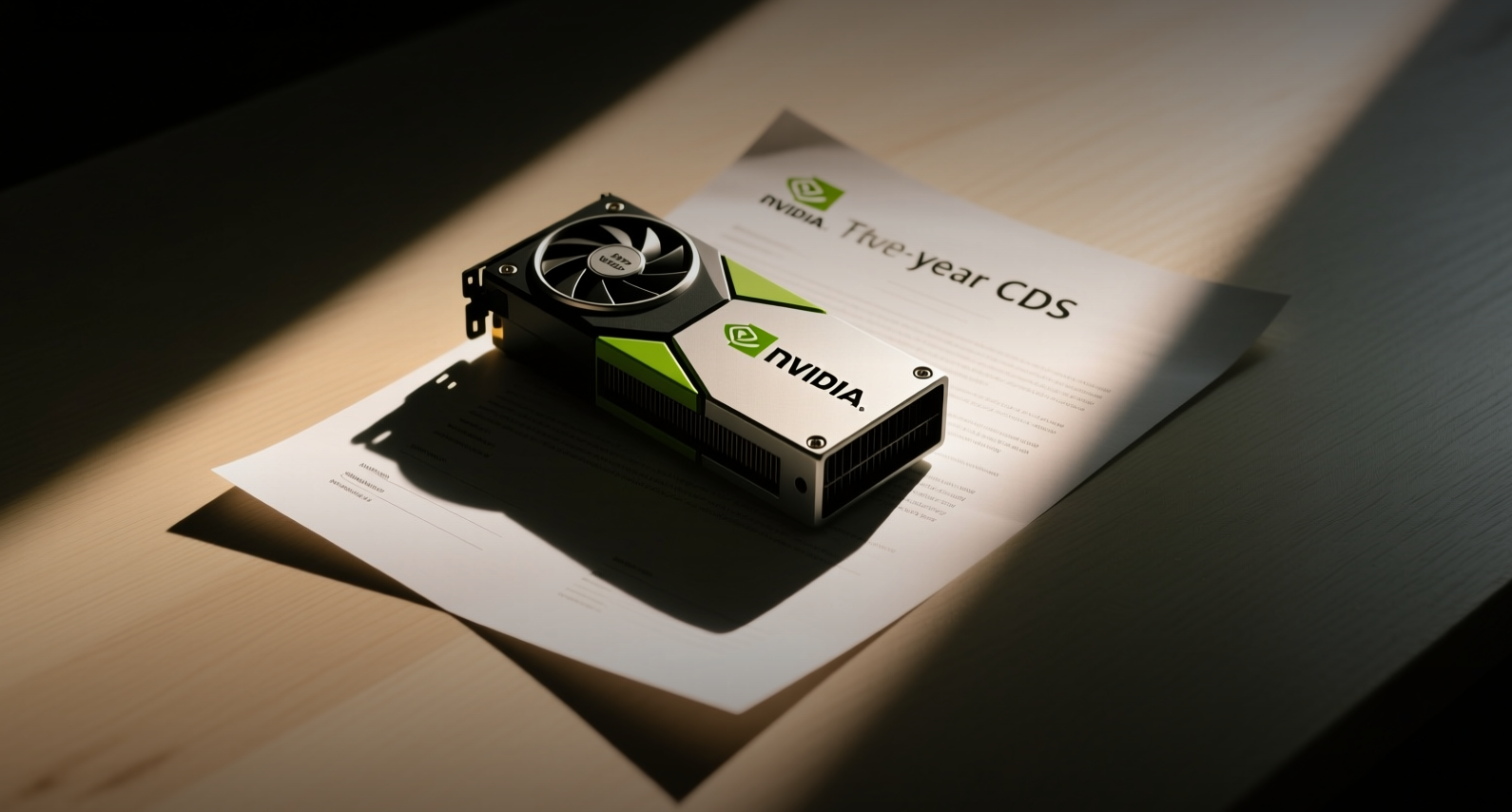
Nvidia Corp.'s five-year credit default swaps surged 14 basis points to 82 on July 27, the largest single-day move since the contract listed in November, as investors repriced the credit risk embedded in the company's circular AI financing structure.
"We have reached the stage of this cycle where Nvidia must guarantee two-thirds of the cost of chips it sells to data centers," Jim Chanos, founder of Chanos & Co., said on X. "This is not a demand problem — it is a financing structure problem."
The CDS spike erased $250 billion from Nvidia's market capitalization in a single session, pushing Apple Inc. back to the world's most valuable company at $4.93 trillion. The trigger was Nvidia's own announcements: a $500 billion-plus AI infrastructure partnership with South Korea's SK Group and discussions to provide up to $250 billion in financing guarantees for OpenAI to lease a 10-gigawatt data center in southern Ohio being developed by SoftBank Group Corp.'s SBEnergy unit. The total project could exceed $500 billion, with Nvidia separately discussing a chip purchase financing package valued at up to $350 billion, bringing its total exposure to a single customer to as much as $600 billion — nearly three times Nvidia's annual revenue of $216 billion.
The circular structure — Nvidia guarantees financing, SoftBank builds the data center, OpenAI leases the compute, OpenAI uses Nvidia-guaranteed money to buy Nvidia chips — means risk is concentrated on a single credit chain. If any link breaks, all four dominoes fall together. The question the CDS market is now pricing: what happens if OpenAI's $13 billion in annual revenue cannot support $1.4 trillion in spending commitments?
Credit Contagion Spreads Beyond Nvidia
The repricing is not confined to Nvidia. Oracle Corp.'s CDS has surged to 203 basis points from 144 at the start of the year after S&P Global Ratings cut its credit rating to BBB-, one notch above junk, citing AI capital spending that pushed free cash flow deep into negative territory. Among the largest hyperscalers, average CDS spreads have doubled since January to about 49 basis points — the highest since 2018 — with Meta Platforms Inc. at 65, Amazon.com Inc. at 58, Alphabet Inc. at 48 and Microsoft Corp. at 42.
The debt acceleration behind these numbers is unprecedented. Amazon, Google, Nvidia, Meta, Oracle and SpaceX have issued $182 billion in investment-grade bonds since the start of 2026, a 1,300 percent increase from the same period a year earlier and roughly 15 percent of all US corporate bond issuance. Morgan Stanley estimates hyperscaler leverage ratios have doubled to 1.8 times in just two quarters. Moody's Investors Service puts the top five technology companies' off-balance-sheet lease-related commitments at $662 billion, while a Nikkei survey found total off-balance-sheet obligations among major hyperscalers reached about $1.65 trillion — an eightfold increase in four years.
SoftBank's $40 Billion Bridge Loan
SoftBank has accumulated more than $60 billion in total investments in OpenAI, including a $40 billion bridge loan — the largest of its kind in Asian history — due in March 2027. S&P has cut SoftBank's credit outlook to negative, saying OpenAI "is one of its weakest credit quality investments." A separate plan to borrow $10 billion using OpenAI shares as collateral was reduced to $6 billion and then shelved entirely after lenders struggled to value a private company with no public market pricing.
OpenAI has confidentially filed for an initial public offering with Goldman Sachs Group Inc. and Morgan Stanley as lead underwriters. The IPO would provide a market-clearing price for SoftBank's collateral and distribute the concentrated credit risk across public equity markets. Any delay would send pressure back through the guarantee chain.
Three Thresholds to Watch
Nvidia's CDS breaking above 100 basis points would be the first signal of deepening distress — still well below the 200-plus threshold typical for investment-grade companies, but the slope from 35 to 82 in eight months is the metric to watch. The timing of OpenAI's IPO is the second: a 2026 listing would give SoftBank an exit for its $40 billion bridge loan. The third is SK Hynix Inc., whose American depositary receipts have fallen 38 percent from a June high to $143.02, reflecting the same credit chain concerns in the memory supply link.
The AI industry's $1.45 trillion in hyperscaler contract backlog confirms that demand is real. The question is whether the financing structure built to serve that demand can withstand the scrutiny the CDS market is now applying.
This article is for informational purposes only and does not constitute investment advice.
