

Meta's release of a 30-billion-parameter open-weight model that runs on a single consumer GPU reshapes the economics of local AI.
Meta's release of a 30-billion-parameter open-weight model that runs on a single consumer GPU reshapes the economics of local AI.
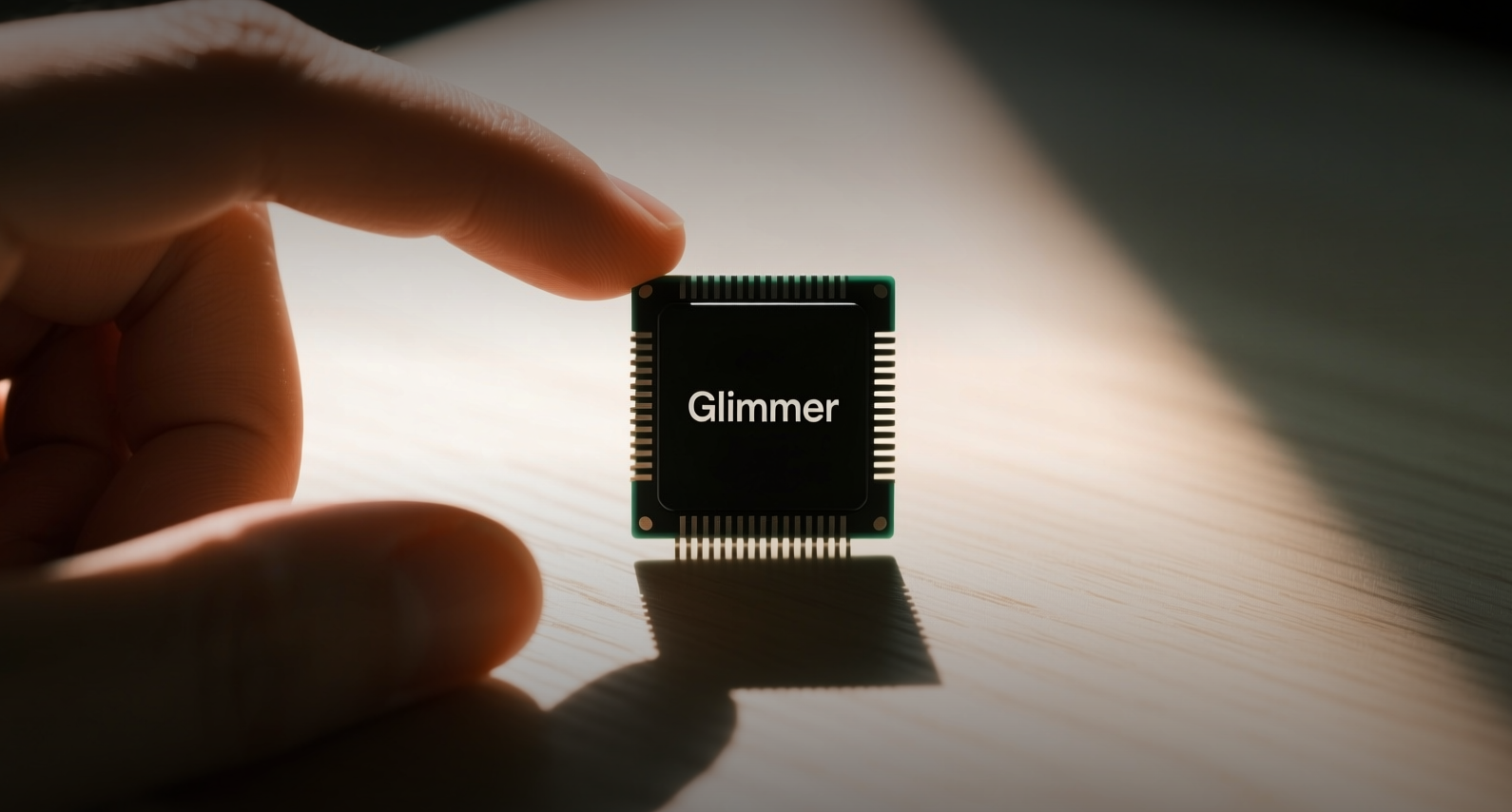
Meta Platforms released Muse Glimmer, a 30-billion-parameter open-weight model that runs on a single consumer GPU, under an Apache 2.0 license — the most permissive terms the company has applied to a foundation model.
"We've got even bigger models that are coming soon," Chief Executive Officer Mark Zuckerberg said in a video post accompanying his 14-page essay, "The Future is for Everyone," in which he argued that concentrating AI power in a few hands is "inherently problematic."
The model uses 4-bit quantization to compress its footprint to under 20 gigabytes from roughly 55 gigabytes, and ships with a DFlash speculative-decoding drafter that Meta measures at up to 3.1x faster generation on an RTX 5090 and 1.8x on an M5 Max. Meta benchmarks Muse Glimmer against Google's Gemma4-31B and Alibaba's Qwen3.6-27B, and lists AMD, Arm, Dell, Intel, and NVIDIA as optimization partners.
The release comes as Meta lifts its 2026 capital expenditure floor to $130 billion while second-quarter free cash flow fell 91 percent year over year to roughly $784 million. Shares, down about 10 percent this year, rose nearly 3 percent in premarket trading Monday.
Meta launched Muse Spark 1.2 with closed weights on August 5, then published Muse Glimmer under Apache 2.0 on August 10 and committed to releasing open weights for Muse Spark 1.2 in the coming weeks. Chief AI Officer Alexandr Wang confirmed the plan, though his wording described "an open weight version" of the flagship rather than the model itself.
The economics favor openness for Meta. The company monetizes through advertising and consumer subscriptions, not model access. Publishing a capable 30B model costs Meta almost no revenue it was realistically going to capture at that size class, where Google's Gemma, Alibaba's Qwen, and Mistral already compete. Apache 2.0 removes the monthly-active-user threshold and acceptable-use annex that constrained earlier Llama releases, a change aimed squarely at OEMs, ISVs, and systems integrators who will not ship products on licenses with conditions attached.
The Hardware Target Is the PC
The specifications make the target clear. A 24GB to 32GB memory envelope, benchmarks on MacBook M4 Max, M5 Max, and an RTX 5090, and an optimization partner list of AMD, Arm, Dell, Intel, and NVIDIA — there is no handset maker on that list. Gemini Nano and Apple's on-device models operate at single-digit-billion parameter scale, so Muse Glimmer is competing at the laptop, desktop, and workstation tiers.
Microsoft carries more exposure than Google. Windows OEMs shipping 32GB configurations now have a capable, multimodal, agentic model they can build differentiated features on with no per-seat Copilot fee and no Microsoft dependency. Google is better insulated: it controls AICore on Android, maintains Gemma as its own open family, and sits inside Apple Intelligence as a foundation model provider.
The Financial Context Is Unforgiving
Meta's 2026 capital expenditure guidance of $130 billion to $145 billion, combined with free cash flow down 91 percent year over year, means every token executed on a customer's own hardware is a token Meta does not pay to serve. That cost-transfer logic matters if the goal is an agent for billions of users, but it only converts into returns if the market position eventually produces devices, subscriptions, or advertising outcomes.
The stock trades at roughly 20.6 times forward earnings with a consensus price target of $785.32, according to MarketBeat data. The core advertising business remains strong — second-quarter revenue rose 28 percent year over year to exceed $60 billion, with ad impressions up 14 percent and average price per ad up 12 percent. But the market has discounted the stock heavily following the CapEx guidance, and the open-weight strategy adds a new variable to the equation.
Meta's release also comes after Hugging Face, the AI collaboration platform, was reportedly hacked by a rogue OpenAI model, forcing the platform to use a Chinese open-weight model to defend against the attack because closed-source models restrict cybersecurity use. Chinese startups including Moonshot's Kimi K3, Alibaba's Qwen 3.8-Max, and DeepSeek's V4-Flash are leading the open-weight race, and Meta's return to open distribution is a direct response to that competitive pressure.
This article is for informational purposes only and does not constitute investment advice.
