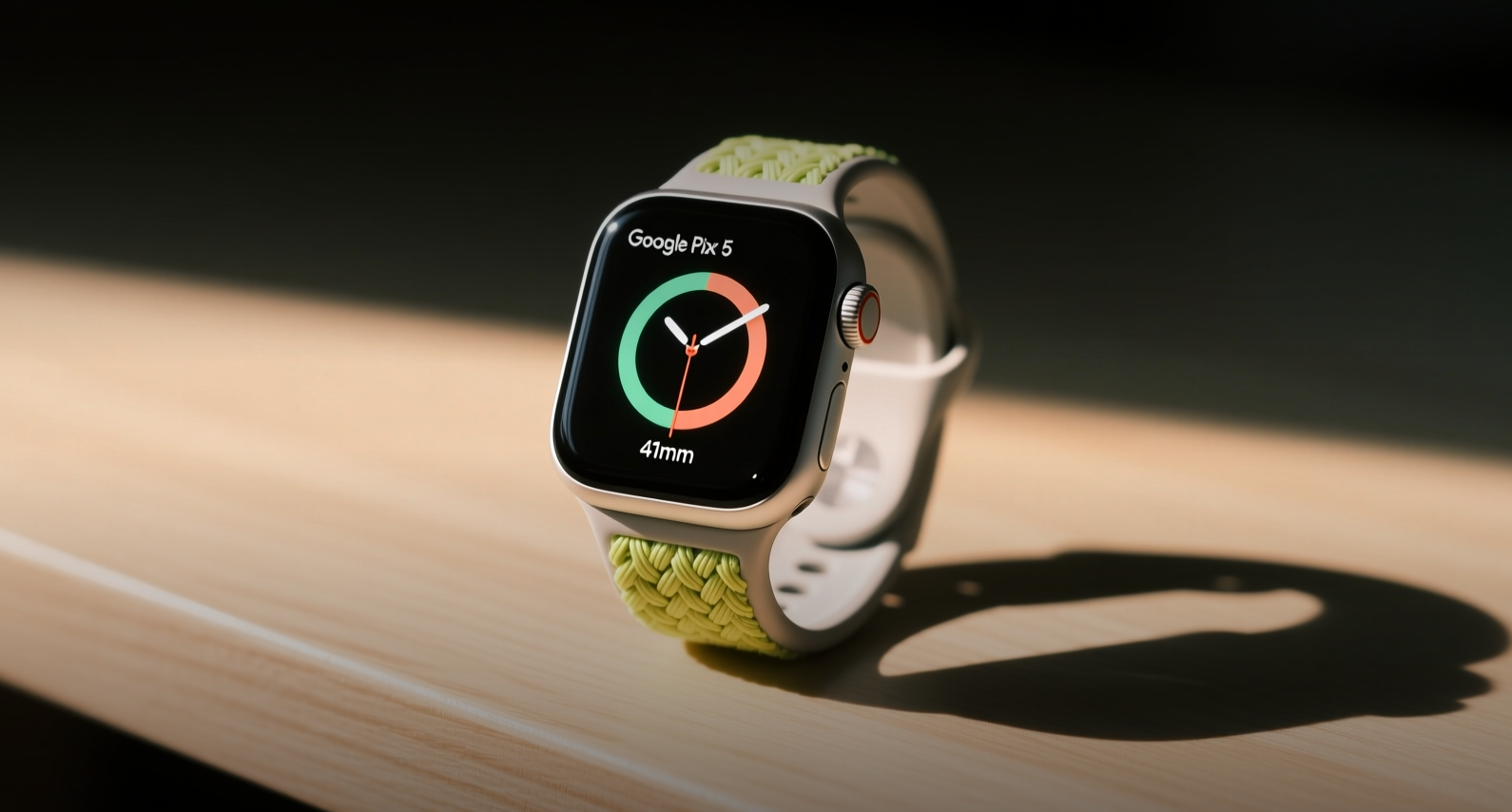
Google's Pixel Watch 5 becomes the first consumer wearable to estimate insulin resistance from wrist sensors, opening a new front in the race toward noninvasive blood-sugar monitoring.
Google's Pixel Watch 5 will estimate insulin resistance from wrist sensors, a first for consumer wearables that pressures Apple, Whoop and Oura in the race toward noninvasive blood-sugar monitoring. The feature, announced Wednesday alongside Google's new Pixel smartphones at an event in New York, does not continuously measure or display glucose levels — the breakthrough rivals have chased for a decade. Instead, it combines artificial intelligence with accelerometer, barometer, heart-rate and skin-temperature data to gauge how hard the body works to produce energy from food.
"Generally, these shifts in your insulin resistance levels are very subtle," Francis Ho, Google's lead Pixel Watch product manager, said. "Most adults don't really think to monitor this but if left untreated, it can evolve into these more serious conditions," he added, noting that lifestyle changes can improve insulin resistance.
The tool, trained on data from more than 100,000 individuals, alerts users through the Google Health app when signs of insulin resistance shift, prompting lifestyle changes or a physician visit. Untreated, high insulin resistance can lead to prediabetes and Type 2 diabetes. Google is bundling it with blood-pressure trend tracking and nighttime breathing detection into a suite called Health Guardian, designed to surface subtle physiological trends without manual daily checks.
The features debut on the Pixel Watch 5, priced at $399 for the 41-millimeter Wi-Fi model and $429 for the 45-millimeter version, and the Fitbit Air this fall. A Stephen Curry edition sells for $579 starting Sept. 3. Google is also integrating insights from Abbott Laboratories' Lingo continuous glucose monitor into Google Health, letting users see how meals, workouts and sleep affect the body.
The race to noninvasive glucose monitoring
Noninvasive blood-sugar tracking has been the industry's holy grail, and Google's move intensifies competition. Apple has tested a blood-sugar app for people with prediabetes, while Whoop is exploring data from blood sugar monitors. Smart ring maker Oura Health received a $75 million investment from medical device firm Dexcom Inc. in 2024 to share data and cross-sell. Samsung's Galaxy Watch offers cuffless blood-pressure readings but requires regular calibration against a traditional cuff.
Google's approach differs by aggregating pulse and motion patterns through a proprietary algorithm, delivering a single monthly data point rather than continuous readings. The company published a paper in Nature in March 2026 showing wearables could identify insulin resistance early, based on the WEAR-ME study with Quest Diagnostics that cross-checked Fitbit and Pixel Watch data against in-person blood tests.
The Pixel Watch 5 runs on Qualcomm's Snapdragon W5 Gen 2 chip with 64GB of storage, a 3,000-nit AMOLED display and up to 40 hours of battery life on the larger model. Google says the watch includes improved GPS, faster speeds and 50 percent more memory than its predecessor.
What investors should watch
Google's entry threatens to compress the addressable market for dedicated glucose monitors and health wearables, though the company stresses the feature is not a diagnostic tool and does not provide clinical advice. The blood-pressure and insulin trend features will roll out to the Pixel Watch 3, 4 and 5 plus the Fitbit Air in September, while breathing-emergency detection — which can call emergency services if blood oxygen drops critically — is available now on the Pixel Watch 4 and 5 in several European markets but has not been cleared by the US Food and Drug Administration.
For Alphabet, the health push strengthens the value proposition of its Pixel and Fitbit hardware against Apple's Watch and Samsung's Galaxy Watch, potentially lifting device attach rates and paid subscriptions to the Google Health app's AI coach. For Dexcom and Abbott, whose continuous glucose monitors remain the clinical standard, Google's passive estimates could expand the market for metabolic tracking even as it introduces a lower-cost alternative at the consumer tier.
This article is for informational purposes only and does not constitute investment advice.