
Key Takeaways: Beijing is betting on six emerging pillar industries and six future sectors to drive economic growth through 2030.
Key Takeaways: Beijing is betting on six emerging pillar industries and six future sectors to drive economic growth through 2030.
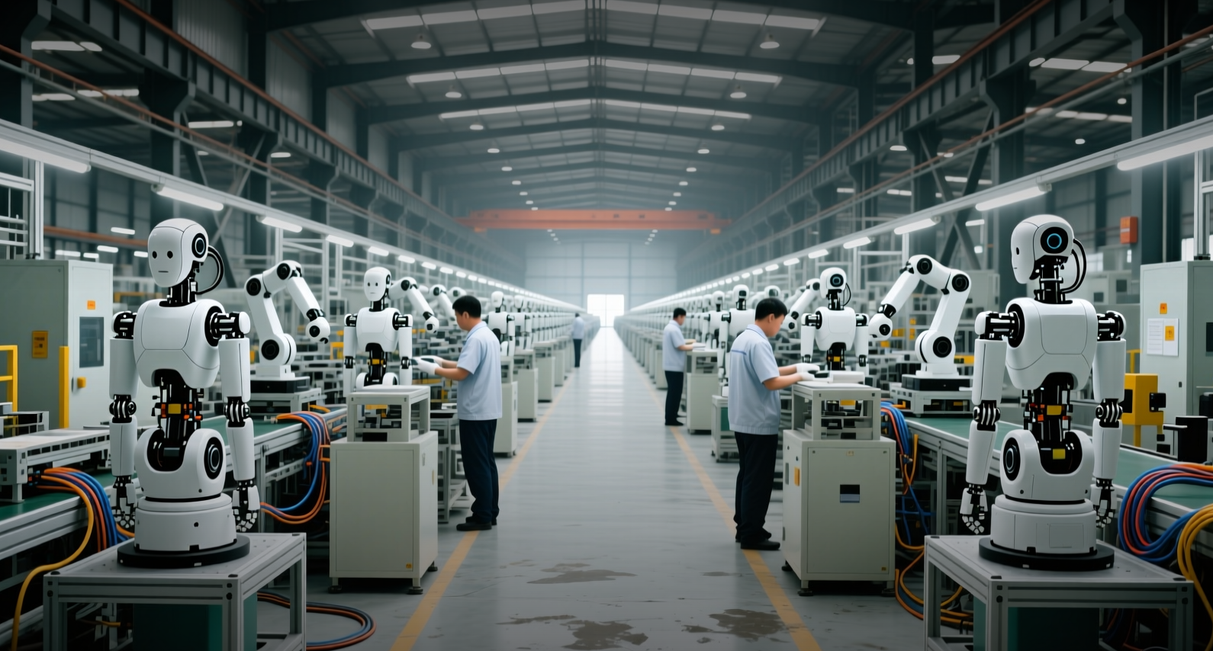
China's Ministry of Industry and Information Technology will accelerate six emerging pillar industries — integrated circuits, aerospace, biopharmaceuticals, low-altitude economy, new energy storage and intelligent robotics — under the 15th Five-Year Plan through 2030.
"We will accelerate the development of emerging pillar industries and promote future industries to become new economic growth points," an MIIT official said at a State Council Information Office press conference in Beijing, according to CCTV.
The plan designates six future industries for frontier development: quantum technology, bio-manufacturing, hydrogen and nuclear fusion energy, brain-computer interfaces, embodied AI and sixth-generation mobile communications. The 15th Five-Year Plan, approved in March 2026, has already designated quantum as the first of seven "future industries" with a specific legal and budgetary classification, according to China Briefing.
The policy signals Beijing's push to shift from scale-driven growth to technology-led industrialization as traditional sectors face headwinds. China's quantum computing sector income reached 11.56 billion yuan ($1.61 billion) in 2025 with annual growth above 30 percent, while the National Venture Guidance Fund has allocated 121.8 billion yuan ($17.5 billion) across three regional quantum-focused funds, according to the Quantum Economic Development Consortium.
The robotics sector illustrates the scale of China's industrial ambitions. China was the source of nearly 90 percent of all humanoid robots sold in 2025, according to Foreign Policy. Unitree, a leading humanoid robot maker, raised 6.1 billion yuan in a heavily oversubscribed IPO on Shanghai's STAR Market this month, becoming the first humanoid robot maker to list in mainland China. The company reported first-half net profit of 274 million yuan, turning from a 32-million-yuan loss a year earlier.
Semiconductor companies are already showing the earnings impact of state-directed industrial policy. Advanced Micro-Fabrication Equipment reported first-half net profit surged fourfold to 2.8 billion yuan on a 35 percent increase in revenue, while GigaDevice Semiconductor posted an 11-fold increase in first-half profit to 6.9 billion yuan as memory chip prices rose. Fudan Microelectronics Group posted a 338 percent gain in first-half net profit to 849 million yuan.
The 15th Five-Year Plan's designation of quantum as a "future industry" carries specific legal and budgetary implications, separating it from ordinary strategic sectors. China's quantum investment in the first quarter of 2026 alone was close to its total 2025 investments, according to Moomoo. The country's quantum companies grew from 93 in 2023 to 153 in 2024, according to China Briefing.
The policy framework also extends to low-altitude economy and new energy storage, sectors where Chinese companies are already scaling. Pony.ai, an autonomous driving company, reported first-half revenue climbed about 99 percent to US$70.5 million, with robotaxi services jumping 534 percent. The company aims to grow its active fleet to 4,000 vehicles and establish operations in more than 20 global cities by year-end.
The plan's emphasis on embodied AI and 6G suggests Beijing is preparing for the next wave of technology competition with the United States. Washington has imposed export controls on advanced robotics and quantum computing, but these measures have accelerated China's domestic supply chain development — within two years of U.S. controls, China began producing in-country dilution refrigerators for quantum systems, according to Forbes. The 15th Five-Year Plan's industrial strategy is expected to provide sustained policy tailwinds for A-share sectors including semiconductors, robotics and new energy through 2030.
This article is for informational purposes only and does not constitute investment advice.
