Content
EN RESUMEN
Qué es Somnia
I. Análisis fundamental y estratégico
1) Visión y alineación de inversores
2) Equipo y destreza de ejecución
3) Capital y avales
4) Oportunidad y adecuación al mercado
5) Posición competitiva y diferenciadores
II. Ecosistema previo al lanzamiento y estrategia de comercial...
1) Comunidad y momentum narrativo
2) Huella en cadena
3) Asociaciones y preparación
4) Tokenómica y acumulación de valor (hoy)
III. Análisis prospectivo (Catalizadores y oportunidades)
IV. Análisis de escenario de valoración (FDV de TGE)
Panorama de la competencia (ángulo del token en/cerca del TGE)
Conclusión final

Markets Confusing? Ask Edgen Search.

Instant answers, zero BS, and trading decisions your future self will thank you for.

Try Search Now

Somnia L1: La computadora de ensueño para mundos en cadena

· Mar 31 2026
Somnia L1: La computadora de ensueño para mundos en cadena

Una perspectiva sobre el L1 especializado de Somnia para el metaverso y los juegos, que abarca estrategia, socios, modelo de token, catalizadores y valoración. Para una guía sencilla para nuevos usuarios, haga clic aquí

EN RESUMEN

  • L1 especializada para aplicaciones en tiempo real: La arquitectura (Consenso MultiStream, Ejecución Secuencial Acelerada, IceDB) se dirige a cargas de trabajo de "estado caliente" con las que otras cadenas tienen dificultades.
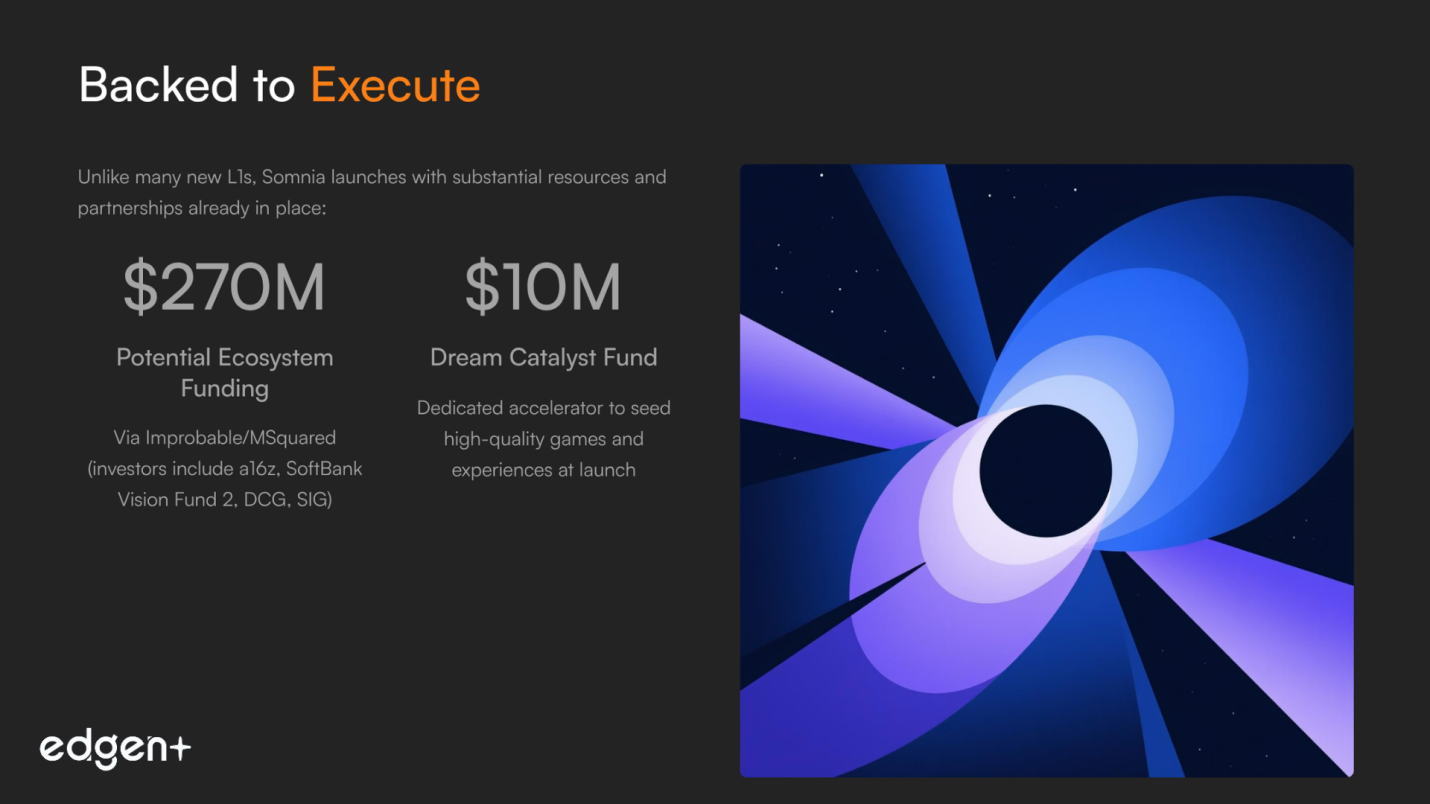
  • Apoyado para ejecutar: Hasta 270 millones de dólares en financiación del ecosistema a través de Improbable/MSquared, validador/infraestructura de Google Cloud, y un Dream Catalyst de 10 millones de dólares para sembrar juegos, posicionando a Somnia para convertir la narrativa en productos enviados.

Qué es Somnia

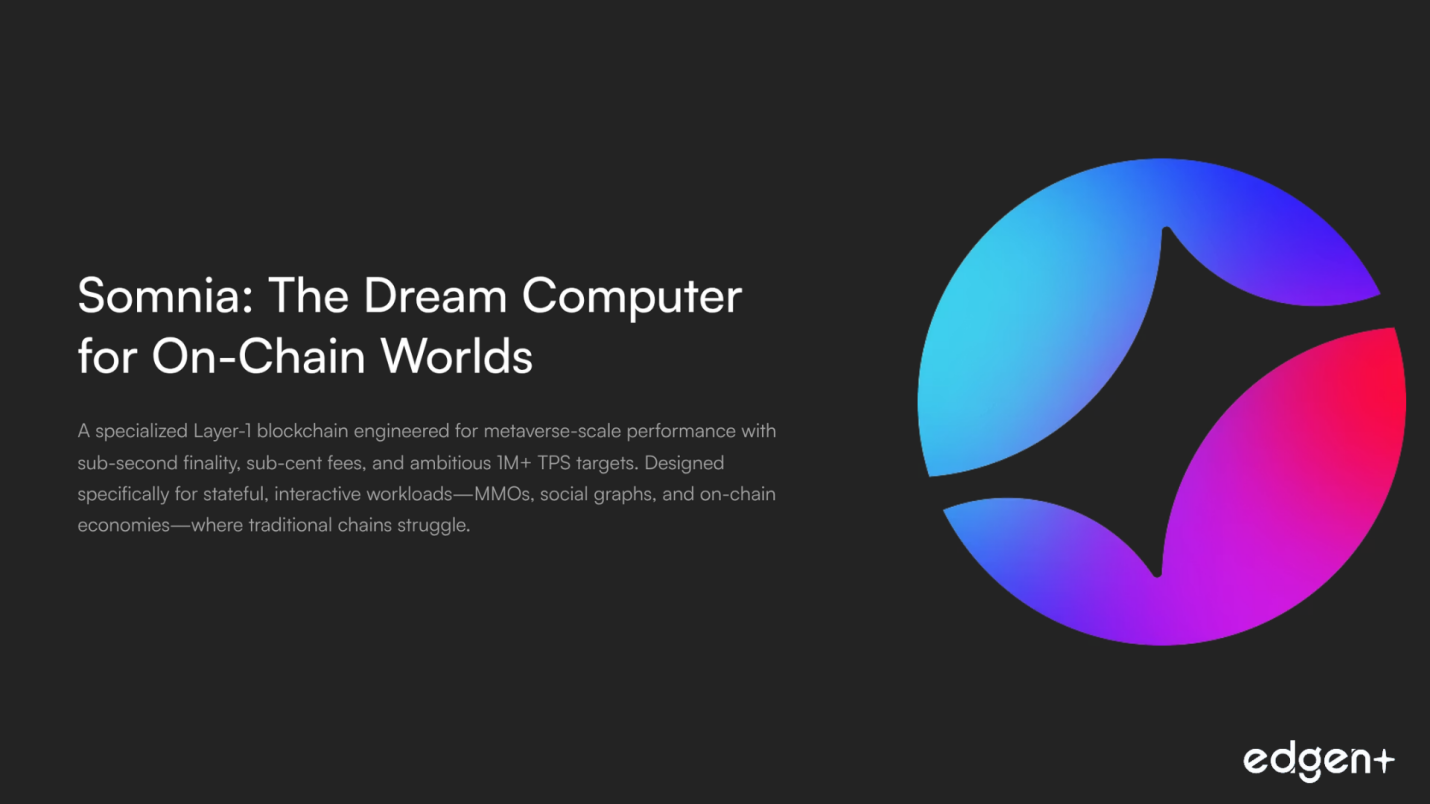
Somnia es una Layer-1 compatible con EVM diseñada para un rendimiento a escala del metaverso: finalidad en sub-segundos, tarifas por debajo del centavo y objetivos de más de 1 millón de TPS. En lugar de perseguir el rendimiento general de DeFi, Somnia está optimizada para cargas de trabajo interactivas y con estado —MMO, grafos sociales, economías en cadena— utilizando un diseño que acelera la ejecución de un solo núcleo para contención caliente mientras aprovecha el paralelismo del hardware. Su Consenso MultiStream separa la disponibilidad de datos del consenso, e IceDB apunta a lecturas/escrituras deterministas a nivel de nanosegundos.

Con el respaldo de la profunda experiencia de Improbable/MSquared en mundos virtuales, Somnia alinea la infraestructura con la realidad del desarrollador: herramientas EVM familiares, una pila de constructores de bajo código (a través de socios) y un acelerador bien financiado para aportar contenido desde el primer día. Con Google Cloud apoyando la validación y los servicios de seguridad de IA/datos, y estudios como Realm (Variance) preparándose para construir, la propuesta de Somnia es clara: una "computadora de ensueño" donde las experiencias Web3 se sienten instantáneas y componibles, listas para los usuarios principales.
I. Análisis fundamental y estratégico

1) Visión y alineación de inversores

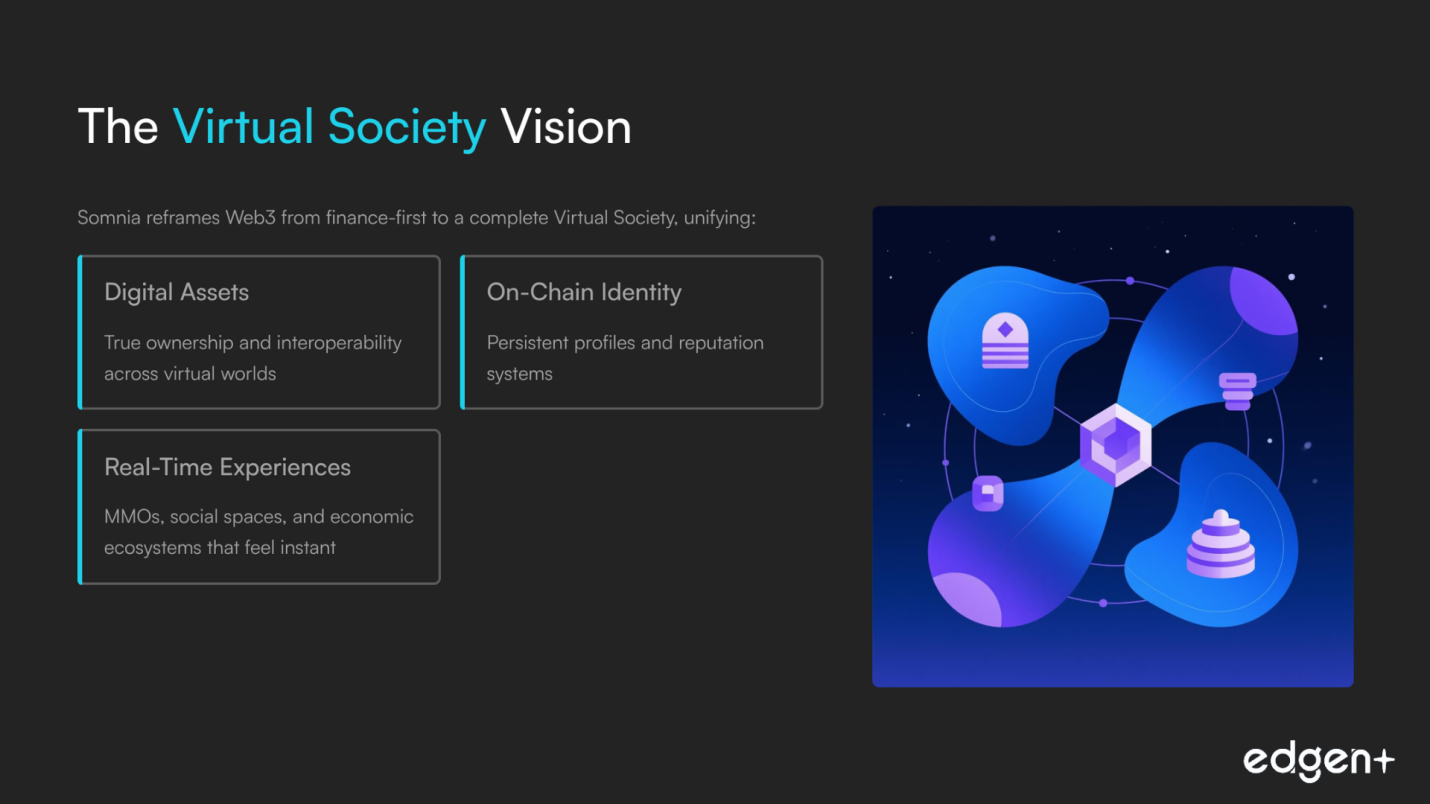
La tesis de Somnia se enfoca en: convertirse en la L1 especializada para metaversos/redes sociales/juegos, donde el rendimiento, la latencia y el costo deciden los ganadores. La estrategia reformula Web3 de financiero primero a Sociedad Virtual, unificando activos, identidad y experiencias. Las asociaciones (por ejemplo, alineación con Yuga Labs) y un acelerador de 10 millones de dólares señalan un compromiso a largo plazo con el contenido y el éxito de los desarrolladores.
2) Equipo y destreza de ejecución

El fundador Paul Thomas (Improbable) aporta una rara profundidad en sistemas distribuidos; Michelle Kang añade experiencia en crecimiento de L1/L2. La combinación de rigor en la infraestructura y conocimientos de GTM (Go-to-Market) apoya la entrega de protocolos complejos y la incorporación del ecosistema, lo cual es muy prometedor para una nueva L1.

3) Capital y avales

En lugar de rondas convencionales, Somnia se beneficia de una financiación del ecosistema de hasta 270 millones de dólares a través de Improbable/MSquared (los inversores incluyen a16z, SoftBank Vision Fund 2, DCG, SIG). Google Cloud valida a nivel empresarial (validador + IA/datos/seguridad), mientras que Sequence y Rarible aceleran la preparación de desarrolladores y del mercado.

4) Oportunidad y adecuación al mercado

Los juegos/metaversos en cadena son un mercado grande y en expansión. Somnia sirve a los desarrolladores que necesitan un rendimiento fiable y de alta contención con la familiaridad de EVM, además de subvenciones, SDKs y distribución, reduciendo así los costos de cambio tanto técnicos como financieros.

5) Posición competitiva y diferenciadores

Compite con cadenas EVM centradas en juegos (Ronin, Immutable zkEVM, GalaChain) y L1 de alto rendimiento (Solana, Aptos). Diferenciación: enfoque en la ejecución de estado caliente, EVM completo, una ambiciosa narrativa de "Sociedad Virtual" y un pedigrí auténtico de mundo virtual de Improbable.
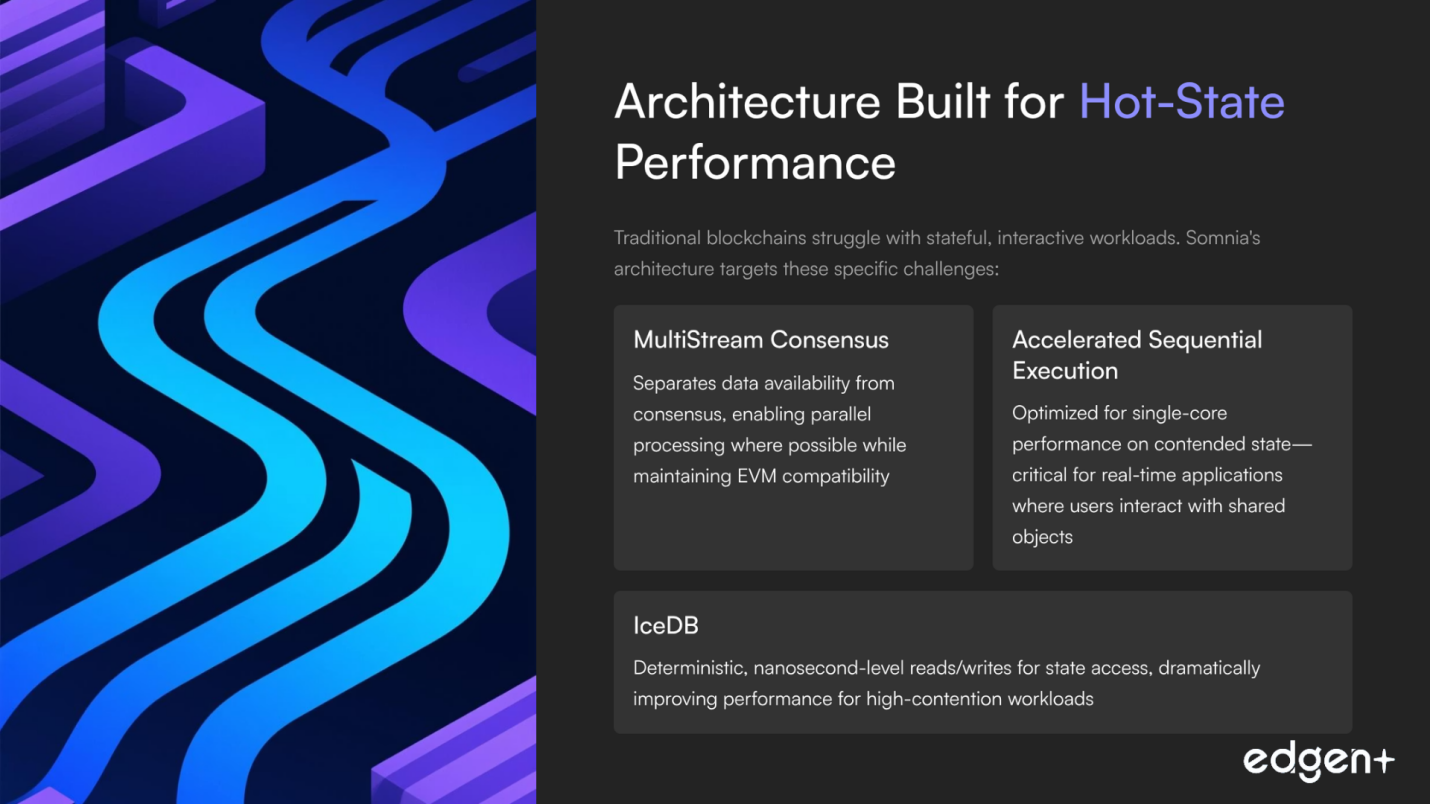
Conclusión fundamental: Notable fortaleza fundamental con capital alineado, socios creíbles y un diseño específicamente creado para mundos en cadena en tiempo real.

II. Ecosistema previo al lanzamiento y estrategia de comercialización

1) Comunidad y momentum narrativo

El crecimiento en la parte superior del embudo es masivo, impulsado por la testnet y los incentivos. La oportunidad ahora es convertir la amplitud en profundidad, institucionalizar las comunicaciones, destacar las dApps enviadas y canalizar la energía de la comunidad hacia el uso de la red principal.

2) Huella en cadena

La actividad de la red de pruebas ha sido a escala de estrés, un campo de pruebas útil para los sistemas. El KPI clave después del TGE es el uso de calidad (DAU, carteras retenidas, dApps en vivo), no las transacciones en bruto.

3) Asociaciones y preparación

  • Google Cloud: validador + integración de IA/datos/seguridad para desarrolladores.
  • Sequence: carteras inteligentes, SDK de Unity/Unreal, pila de mercado para Somnia Builder.
  • Uprising Labs: Dream Catalyst de 10 millones de dólares para sembrar juegos de alta calidad.
    Juntos, estos elementos reducen la fricción desde el código hasta los usuarios y ayudan a asegurar contenido desde el primer día.

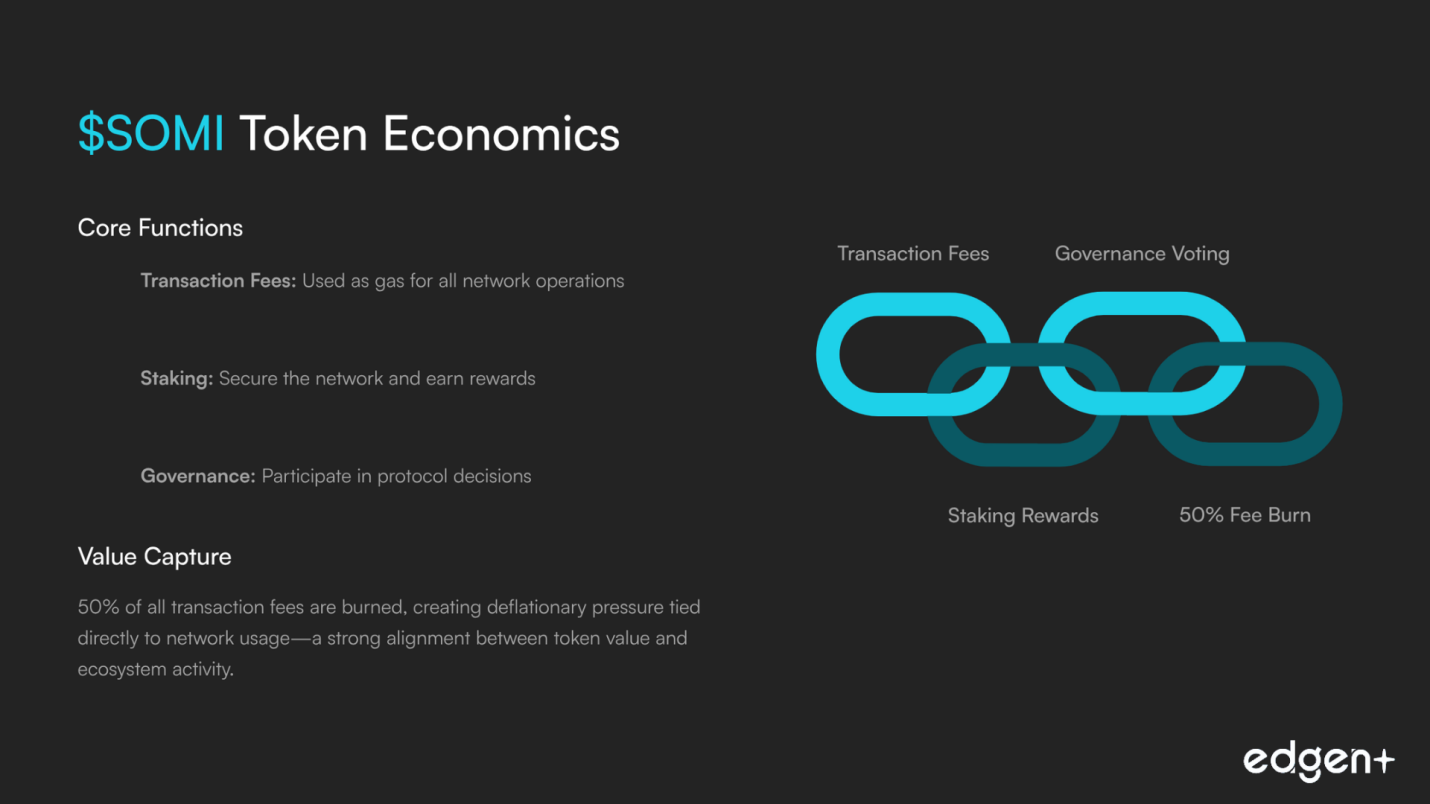
4) Tokenómica y acumulación de valor (hoy)

$SOMI: gas, staking, gobernanza. La quema del 50% de las tarifas alinea el valor con el uso. El Airdrop (5% del suministro) se distribuye a través de misiones semanales en la red principal (20% líquido en TGE; ~80% restringido por actividad durante ~60 días) para fomentar una participación real desde el principio.
Conclusión del GTM: Muy prometedor. La pila tecnológica, los programas y los socios apuntan a una fuerte velocidad de los desarrolladores; las operaciones de lanzamiento (custodia/MM/comunicaciones de liquidez) deben aclararse para maximizar la confianza el primer día.

III. Análisis prospectivo (Catalizadores y oportunidades)

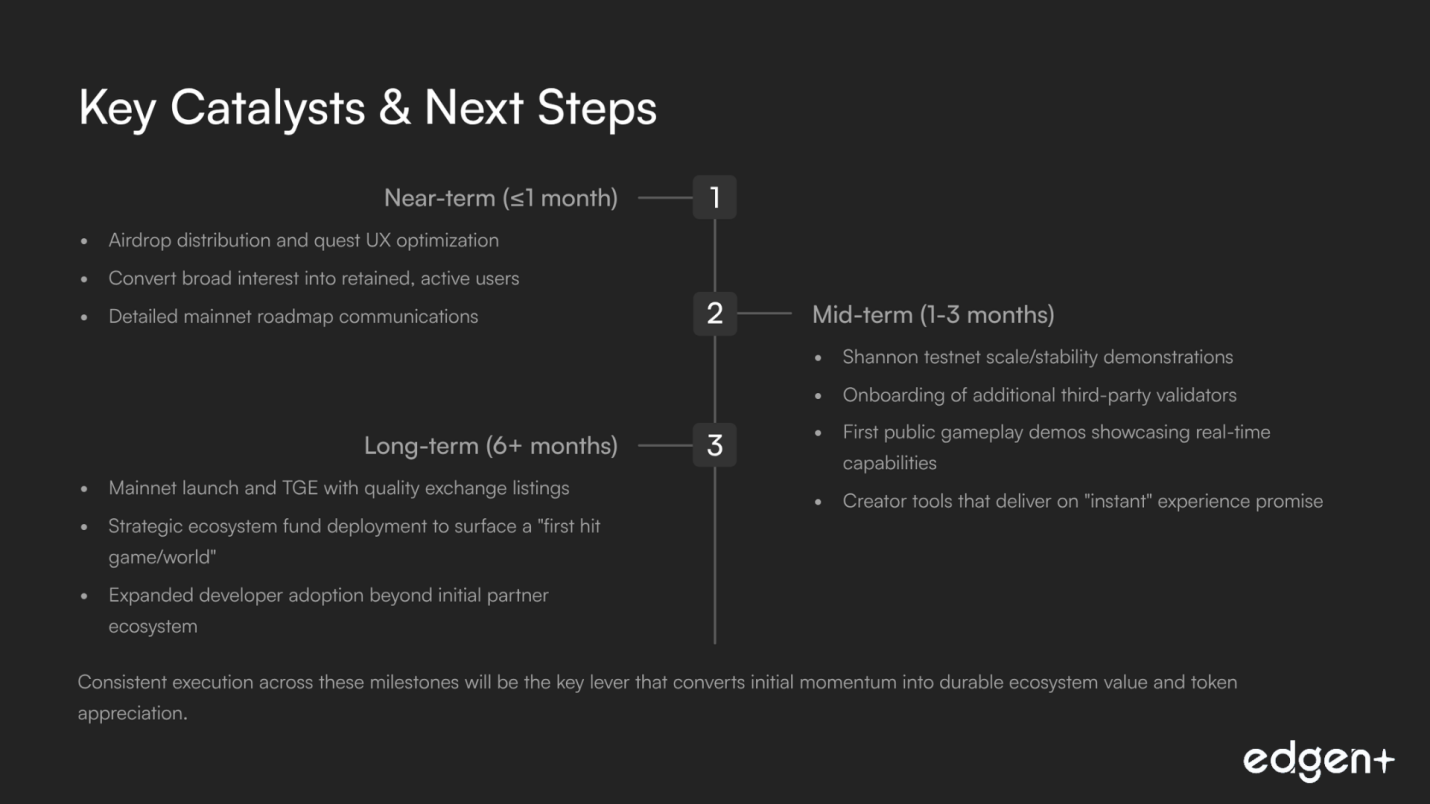
Corto plazo (≤1 mes):

  • Comunicar los aprendizajes del airdrop + una UX de misión clara como el cristal. Convertir un interés amplio en usuarios felices y retenidos puede restablecer el sentimiento rápidamente.

Medio plazo (1-3 meses):

  • Prueba de escala/estabilidad de la testnet Shannon y más validadores de terceros; primeros gameplays públicos y herramientas de creación que se sienten instantáneos.

Largo plazo (6+ meses):

  • Mainnet + TGE con listados de calidad y liquidez; despliegue de fondos del ecosistema que dé lugar a un “primer juego/mundo exitoso”.

La cadencia de ejecución es la palanca que convierte el impulso en valor duradero.

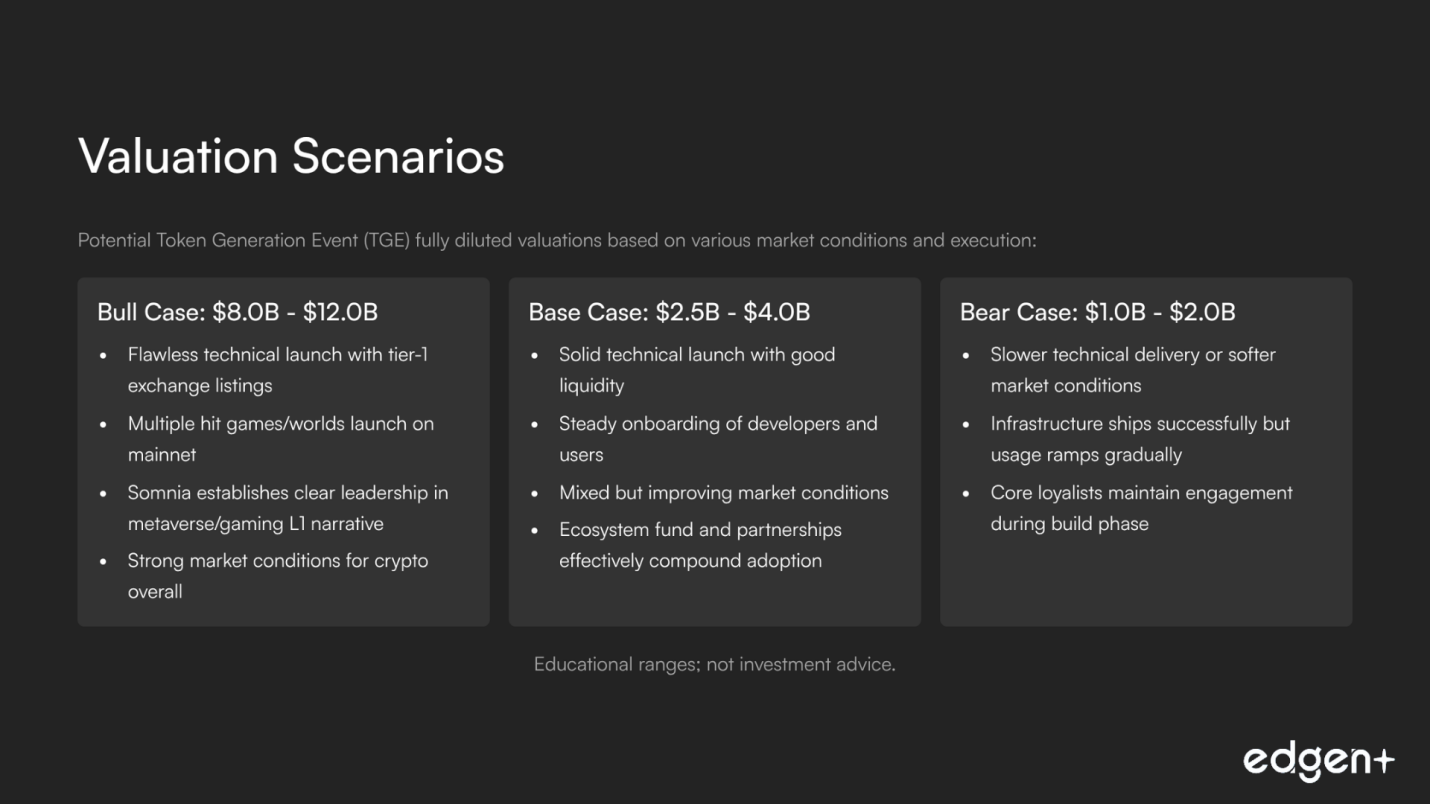
IV. Análisis de escenario de valoración (FDV de TGE)

Escenario

FDV (miles de millones de USD)

Breve narrativa

Caso alcista

8.0 – 12.0

Lanzamiento impecable + listado de nivel 1; juegos exitosos en vivo; Somnia lidera la narrativa L1 de metaverso/juegos.

Caso base

2.5 – 4.0

Tecnología sólida + incorporación constante en un mercado mixto; fondo + socios compuestas la adopción.

Caso bajista

1.0 – 2.0

Entrega más lenta o mercado más suave; la infraestructura se envía, el uso aumenta gradualmente con los leales principales.

Rangos educativos; no es asesoramiento de inversión.

Panorama de la competencia (ángulo del token en/cerca del TGE)

Red

Token

Enfoque

Posición en el caso base vs Somnia

Ronin

$RON

EVM L1 para juegos (liderado por el editor)

Sólida trayectoria probada; Somnia compite en un alcance de mundo abierto más amplio y objetivos de rendimiento brutos.

Immutable zkEVM

$IMX

L2 para juegos, fuerza de mercado

Estudios e infraestructura profundos; Somnia contrarresta con rendimiento L1 + EVM + quema de tarifas.

Solana

$SOL

L1 de alto rendimiento (ejecución paralela)

Ecosistema maduro; Somnia se diferencia por su historia de rendimiento de estado caliente y la familiaridad con EVM.

Aptos

$APT

L1 de alto rendimiento (Move)

Tecnología fuerte; Somnia reduce la fricción de desarrollo a través de EVM + narrativa especializada de metaverso.

Conclusión final

Somnia parece muy prometedor: un L1 especializado y compatible con EVM con un plan realista para potenciar mundos en cadena en tiempo real. Con una financiación de ecosistema significativa, socios de primera línea y un diseño dirigido directamente a cargas de trabajo de estado caliente, está configurado para transformar la visión en uso. El camino hacia una valoración en la banda superior es sencillo pero estricto: operaciones de lanzamiento claras como el cristal, juegos tempranos visibles, un TGE fluido y envíos consistentes.

Contenido educativo; no es asesoramiento financiero.

Recommend
banner.jpg

What is a money person? The plain-English alternative to a financial advisor

The short version: a money person is a smart, warm friend who happens to be good with money and explains it like a person, not a bank. Practically, it's a second opinion on your whole financial picture — cash, debt, tax exposure, concentration, and the goals you're working toward — that tells you in plain language what to look at first. It's not a traditional advisor managing your portfolio for 1% a year, and it's not a coach cheering you on. It's the honest read a good advisor's first meeting would give you, without the fee or the asset minimum. It's the role Ed Wealth was built to play. Strip away the label and a money person does four concrete things: Just as important is what it doesn't do: it doesn't take custody of your money, it doesn't sell you products for commission, and it doesn't pretend a forecast is a promise. It's a second opinion: it shows you the structure and lets you decide. People reach for four different things when they say "I should talk to someone." They're not
Edgen
·
Jul 10 2026
banner.jpg

Is a financial advisor worth it? Advisor vs robo vs money person

The short version: a financial advisor is worth it when your money has real complexity — a business, concentrated stock, an estate, a divorce, or turning savings into retirement income. There, a fee pays for itself. But most people don't have a complexity problem; they have a clarity one, and paying 1% of your assets a year — about $3,000 on a $300,000 portfolio, every year — is a lot to pay for reassurance. You have three tiers to choose from: a human advisor (~1% of assets), a robo-advisor (~0.25%), and a money person — a flat-fee second opinion that doesn't grow as your savings do. Start with the honest case for paying. A good advisor earns their fee when your situation is genuinely complex: selling a business, a big block of company stock or options, an estate with kids, a divorce, a windfall, or building a retirement-income plan with real moving parts. In those moments, one right call can save you many times the fee, and the job becomes picking a good one (that's how to choose a f
Edgen
·
Jul 10 2026
banner.jpg

Do You Actually Need a Financial Advisor? (An Honest Test)

The short version: you need a financial advisor when your money has genuine complexity — equity comp across several employers, a business sale, an estate with kids involved, a divorce, a sudden windfall, or a retirement-drawdown plan with real moving parts. If your situation is closer to "I earn well but somehow feel behind," that's a clarity problem, not a complexity one, and hiring someone to manage your money for about 1% a year is an expensive way to solve it. Here's how to tell which one you have. Almost everyone reaching for an advisor falls into one of two camps, and confusing them is where money gets wasted. A complexity problem is when there are real moving parts that interact: decisions where a wrong move costs far more than any fee. Selling a company, exercising stock options with a tax bill attached, splitting assets in a divorce, planning how to draw income across a 30-year retirement. Here, a good advisor earns their keep. A clarity problem looks different. Good income, a
Edgen
·
Jul 06 2026
banner.jpg

How to Choose a Financial Advisor in 2026 (and Whether You Even Need One)

The short version: picking a financial advisor isn't about finding the "smartest" one. It comes down to three boring questions that actually predict whether you'll be treated well: are they legally a fiduciary, how do they get paid, and do you even need one yet. Get those right and the rest is noise. Here's how to run the check — and what to do if you want guidance but can't (or don't want to) meet a $250,000 minimum. Before you choose one, ask whether this is the right tool at all. A full-service advisor earns their fee when your situation is genuinely complex — a business sale, equity comp across several companies, estate planning, a divorce, a sudden windfall, or a retirement-income plan with real moving parts. But a lot of people reaching for an advisor don't have a complexity problem. They have a clarity problem: a good income, a few scattered accounts, and a nagging sense of being behind. That doesn't need someone to manage your money for 1% a year. It needs a clear read on where
Edgen
·
Jul 06 2026
Redeem miles for gift cards and each is worth ~1 cent; redeem for long-haul business and they're worth 2.5-4+. With programs now dynamically priced, the one check that decides every redemption.

How to redeem airline miles without wasting them

The single biggest mistake with miles is redeeming them for the easy stuff: gift cards, merchandise, seat upgrades at the gate. Do that and each mile is worth about one cent. Redeem the *same* miles for flights, especially long-haul or premium-cabin flights, and they're often worth two to five cents each, sometimes more. So the real skill isn't earning miles; it's not throwing away their value at the finish line. Here's how to actually use them. A mile has no fixed price; its value depends entirely on what you redeem it for. The way to judge any redemption is simple math: (cash price of the flight) ÷ (miles it costs) = cents per mile. If a flight costs $400 or 20,000 miles, that's 2 cents a mile, a solid deal. If a $90 flight costs 18,000 miles, that's half a cent, which is terrible; pay cash and keep the miles. Run this check before every redemption. It instantly separates a great use from a waste, and it's the one habit that makes miles worth having. As a rule of thumb, most major ai
Edgen
·
Jun 30 2026
Short-term goals (under ~3 years) belong in safe cash; long-term goals (5+ years) can take market risk. The best HYSAs now pay ~4-5% APY. How to sort yours and run both.

Long-term vs short-term financial goals (and how to plan both)

The difference comes down to one thing: time. A short-term goal is money you'll need within roughly three years (an emergency fund, a trip, a wedding, next year's tax bill), so it has to be *safe and reachable*. A long-term goal is five-plus years out (retirement, a house down the road, a kid's education), so it can take market risk, because time smooths the bumps out. Get that match right and you've done most of the work. It's not the size, it's the deadline. A $2,000 goal you need in six months is short-term; a $2,000 goal you won't touch for fifteen years is long-term, and they belong in completely different places. This is the part that actually matters, and where people lose money without realizing it. Short-term money should not be in the stock market. If your emergency fund is in stocks and the market drops 20% the same month your car dies, you're selling at the worst possible time. Short-term goals go somewhere stable and accessible, and a high-yield savings account is the clas
Edgen
·
Jun 30 2026
Mortgages near 6.5%, home prices flat, and the Fed split on rate cuts vs hikes. With timing a coin flip, the 3 questions that actually decide whether to buy now or wait.

Should you buy a house now or wait? How to actually decide

The honest answer: buy when you'll stay put for at least five years and you'll still have an emergency fund left after the down payment. Otherwise, waiting (and renting) is often the smarter money move, not the weaker one. "Rent vs buy" isn't a math problem with one right answer, and it's almost never really about timing the market. It's about your *life*, in three questions. Before the three questions, here's the mid-2026 backdrop — because "now or wait" usually hides a bet on rates and prices, and the data says that bet is a coin flip. The picture: mortgages are still pricey, prices have gone flat (more than half of the 20 big metros saw year-over-year declines in March), and the cheap-money era hasn't returned. So "buy before it runs away" and "wait for the crash" are *both* weak arguments right now. The whole "wait for rates to drop" plan rests on the Fed, and the Fed is split down the middle. In its June 2026 projections, policymakers were divided: 8 expected no change this year,
Edgen
·
Jun 30 2026
Most financial goals fail because they're wishes, not systems. Here's the 3-part anatomy of a goal that sticks (a number, a date, one automatic move), plus why 37% of adults can't cover a $400 surprise.

How to set financial goals you'll actually hit

A financial goal you'll actually hit has three things a vague wish doesn't: a number, a date, and one automatic move that happens whether or not you remember it. "Save more" is a wish. "$6,000 in a separate account by next December, $500 auto-transferred on payday" is a goal. The gap between those two sentences is the reason most goals quietly die, and it has almost nothing to do with willpower. Key Takeaways A real financial goal answers three questions: how much, by when, and what for. Drop any one and it stops working. "Pay off debt" has no number and no date, so there's nothing to aim at or measure, while "$8,000 of card debt cleared in 18 months" tells you exactly whether you're on track and the day you're done. The "what for" matters more than people expect. A goal tied to something real (a buffer so a bad month isn't a crisis, a deposit on a first place) survives the months when motivation dips. In our experience reading how people actually use a money tool, the goals that get
Edgen
·
Jun 30 2026
A big RSU grant just vested — now what? Here's what a modern money tool actually surfaces first, using Ed as a worked example: a reality check, the 22% tax gap most high earners miss, and the concentration risk nobody flags.

Your RSUs Just Vested. Here's What a Money Tool Surfaces First.

You just had a big RSU grant vest. Congratulations — and now the awkward part: a six-figure pile of your own company's stock, a vague sense you should "do something," and no one actually telling you what. An advisor, a spreadsheet, and a piece of software each handle this moment differently. Here's what a modern money tool surfaces in a moment like this — using Ed as a worked example — so you can decide what kind of help actually fits. Key takeaways You connect your brokerage and bank through read-only aggregation, so the tool can read balances but can't move a dollar. Ed's framing is simple: precise about your money, blind to your identity. Instead of sorting your lattes into categories, Ed opens on a single Financial Reality Check — a read on whether your money could survive a bad month. For a lot of high earners, that one number lands harder than any budget, because it answers a question the other apps never ask. (If the Reality Check is the numbers side, your money type is the beha
Edgen
·
Jun 26 2026
A money personality test is more than a quiz if it measures behavior, not just vibes. Here's the science behind money types, how Ed's test works, and how to use your result.

What Is a Money Personality Test? The Science Behind Your Money Type

The short version: a good money personality test should feel like a roast and work like a mirror — fun on the surface, behavioral underneath. The useful ones don't tell you what you know; they show you how you act with money, and the one blind spot worth watching. Key takeaways Here's the uncomfortable backdrop. U.S. financial literacy has been stuck for a decade — adults answer only about 49% of the standard knowledge questions correctly, essentially flat since 2017 (TIAA Institute–GFLEC, 2025) — even as free financial information became infinite. If facts fixed money, they'd have fixed it by now. They don't, because the thing that actually drives your outcomes lives one level below the facts: how you're wired to behave when money is on the line. That's the whole premise of financial fitness — and it's what a money personality test is built to surface. Not what you know. What you do. The idea has real research behind it — money behavior is patterned and measurable, and a few tradition
Edgen
·
Jun 23 2026

Invertir, por fin, ya no es cosa de uno solo.

Prueba Edgen gratis. Sin tarjeta, sin compromiso.