
Content
TL;DR
What is Moonbirds
I. Foundational & Strategic Analysis
1. Vision and Investor Alignment
2. Exceptional Team and Execution Prowess
3. Capital Strength and Endorsements
4. Market Opportunity and Fit
5. Competitive Landscape & Differentiators
II. Pre-Launch Ecosystem & Go-to-Market
1. Community & Narrative Momentum
2. On-Chain Footprint
3. Partnerships that Add Utility
4. Tokenomics & Value Accrual (Today)
III. Forward-Looking Analysis (Catalysts & Opportunities)
Near-Term (≤1 month)
Mid-Term (1–3 months)
Long-Term (6+ months)
IV. Valuation Scenario Analysis (TGE FDV)
Competitor Landscape (Token Angle at or near TGE)
Final Take

Markets Confusing? Ask Edgen Search.

Instant answers, zero BS, and trading decisions your future self will thank you for.

Try Search Now

Moonbirds: IP Revival With Real Utility

· Mar 31 2026
Moonbirds: IP Revival With Real Utility

An assessment of Moonbirds under Orange Cap Games, focused on strategy, execution, partnerships, and valuation scenarios. You can find Moonbirds guide here:

TL;DR

  • OCG is applying a proven IP revival playbook that moves from community to brand to products, already converting attention into activity and demand.
  • Elite investor alignment, tangible utility like Kaito AI social-to-earn, Otherside avatars, and partner airdrops give Moonbirds strong momentum with clear paths to durable value.

What is Moonbirds

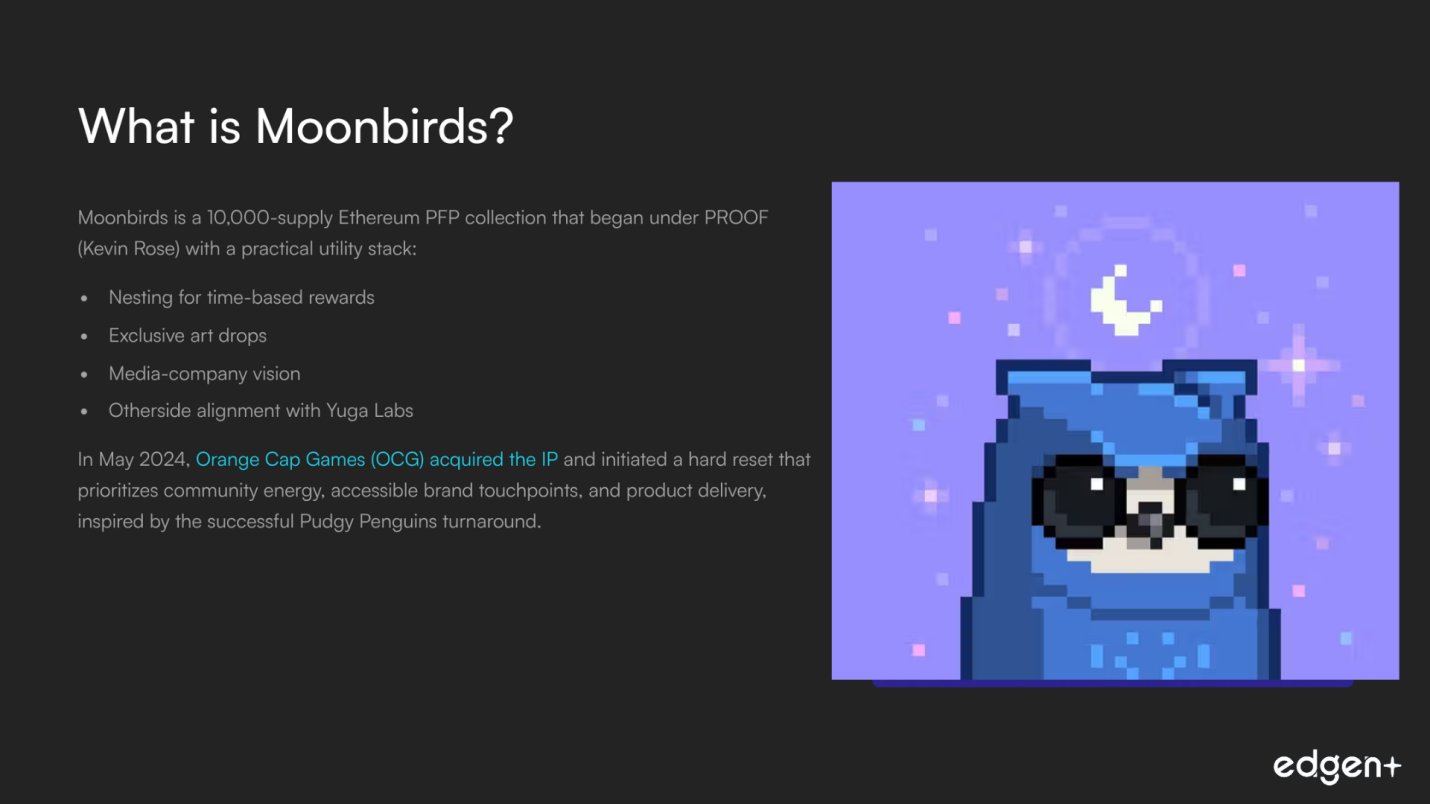
Moonbirds is a 10,000-supply Ethereum PFP collection that began under PROOF (Kevin Rose) with a practical utility stack: Nesting for time-based rewards, exclusive art drops, and a media-company vision. It later aligned with Yuga Labs for Otherside. In May 2025, Orange Cap Games (OCG) acquired the IP and initiated a hard reset that prioritizes community energy, accessible brand touchpoints, and product delivery, inspired by the successful Pudgy Penguins turnaround.

Led by Spencer Gordon-Sand, OCG brings crypto-native credibility and product execution experience, including the Vibes trading card game. The plan is to expand Moonbirds across digital and physical channels, build distribution on mainstream platforms, and translate community momentum into revenue and sustainable economics. Partnerships such as Kaito AI (social-to-earn) and airdrop access with projects like Monad and Towns add immediate holder value while the team builds toward a broader IP and gaming platform.

With renewed leadership, high-signal backers, and a clear operating model, Moonbirds is positioned to evolve from a storied NFT collection into a durable, utility-anchored brand.
I. Foundational & Strategic Analysis

1. Vision and Investor Alignment

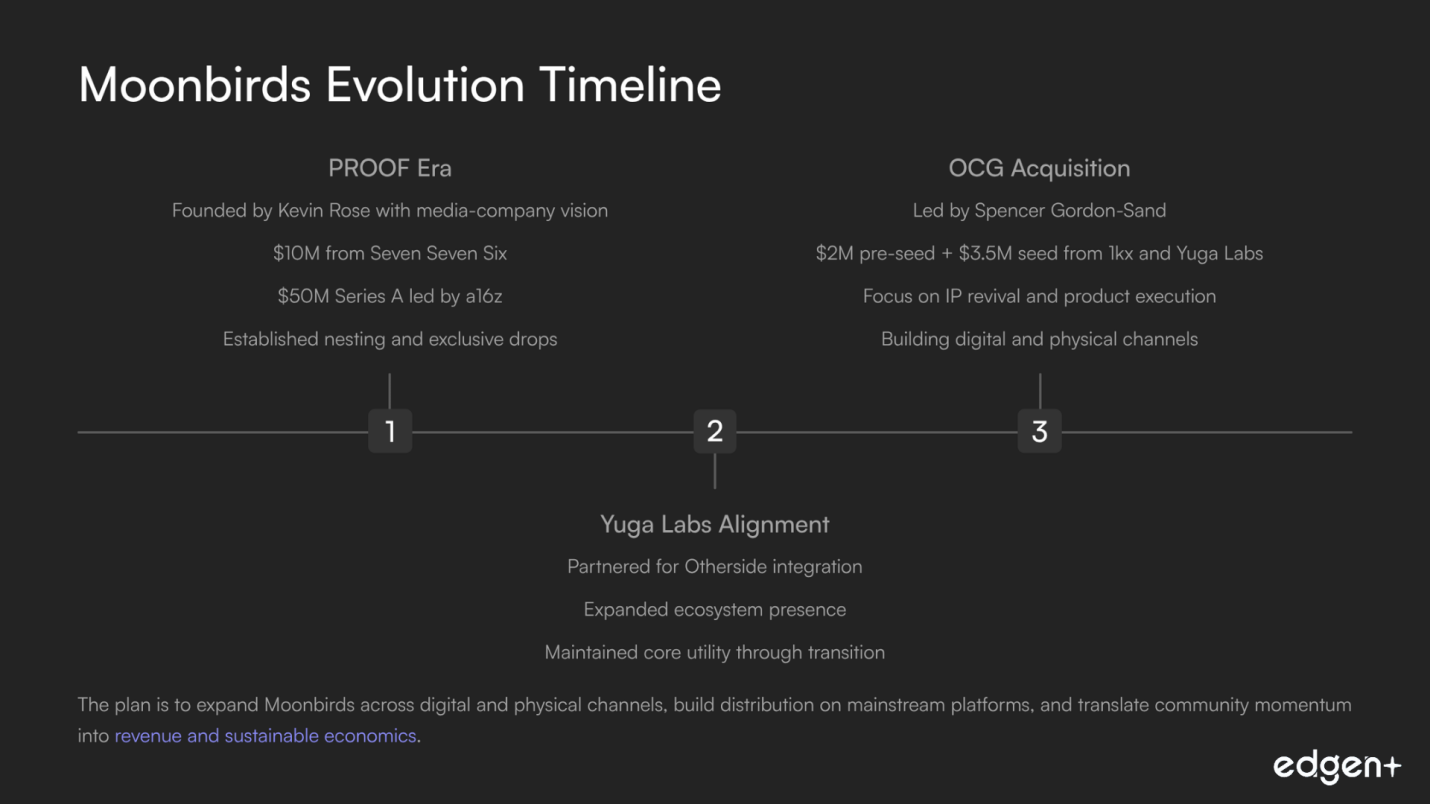
Strategy has evolved across three eras, from PROOF to Yuga to OCG, toward a focused mission: revive IP, energize community, and ship products.

Investor support mirrors this arc, from a16z backing PROOF’s media thesis to 1kx and Yuga Labs co-leading OCG’s seed, aligning capital with the turnaround plan.
2. Exceptional Team and Execution Prowess

  • Operator-led execution from CEO Spencer Gordon-Sand, an early NFT investor and visible community leader, matched with practical product experience.
  • Vibes TCG demonstrates physical and digital execution, plus an operational path to manufacturing and scale through Asia-based capabilities.

3. Capital Strength and Endorsements

Historical raises include $10M from Seven Seven Six and a $50M Series A led by a16z with top-tier participants.

Today, OCG is supported by a $3.5M seed from 1kx and Yuga Labs, following a $2M pre-seed, and augmented by revenue from Vibes. This creates a healthy, execution-focused runway.

4. Market Opportunity and Fit

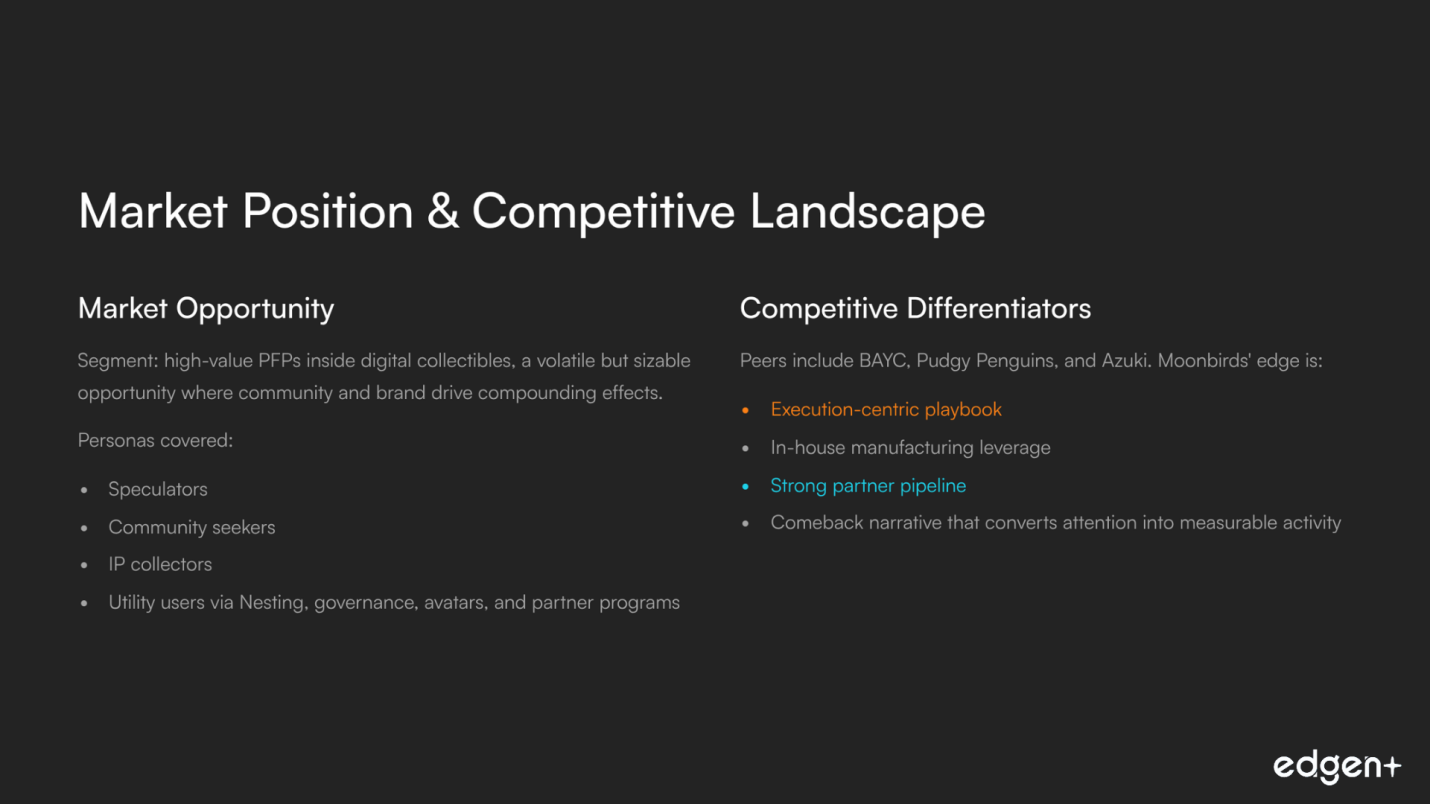
  • Segment: high-value PFPs inside digital collectibles, a volatile but sizable opportunity where community and brand drive compounding effects.
  • Personas covered: speculators, community seekers, IP collectors, and utility users via Nesting, governance, avatars, and partner programs.


5. Competitive Landscape & Differentiators

Peers include BAYC, Pudgy Penguins, and Azuki. Moonbirds’ edge is an execution-centric playbook, in-house manufacturing leverage, a strong partner pipeline, and a comeback narrative that converts attention into measurable activity.

Foundational Take: Remarkable foundational strength with aligned investors, practical operators, and a product-led roadmap.
II. Pre-Launch Ecosystem & Go-to-Market

1. Community & Narrative Momentum

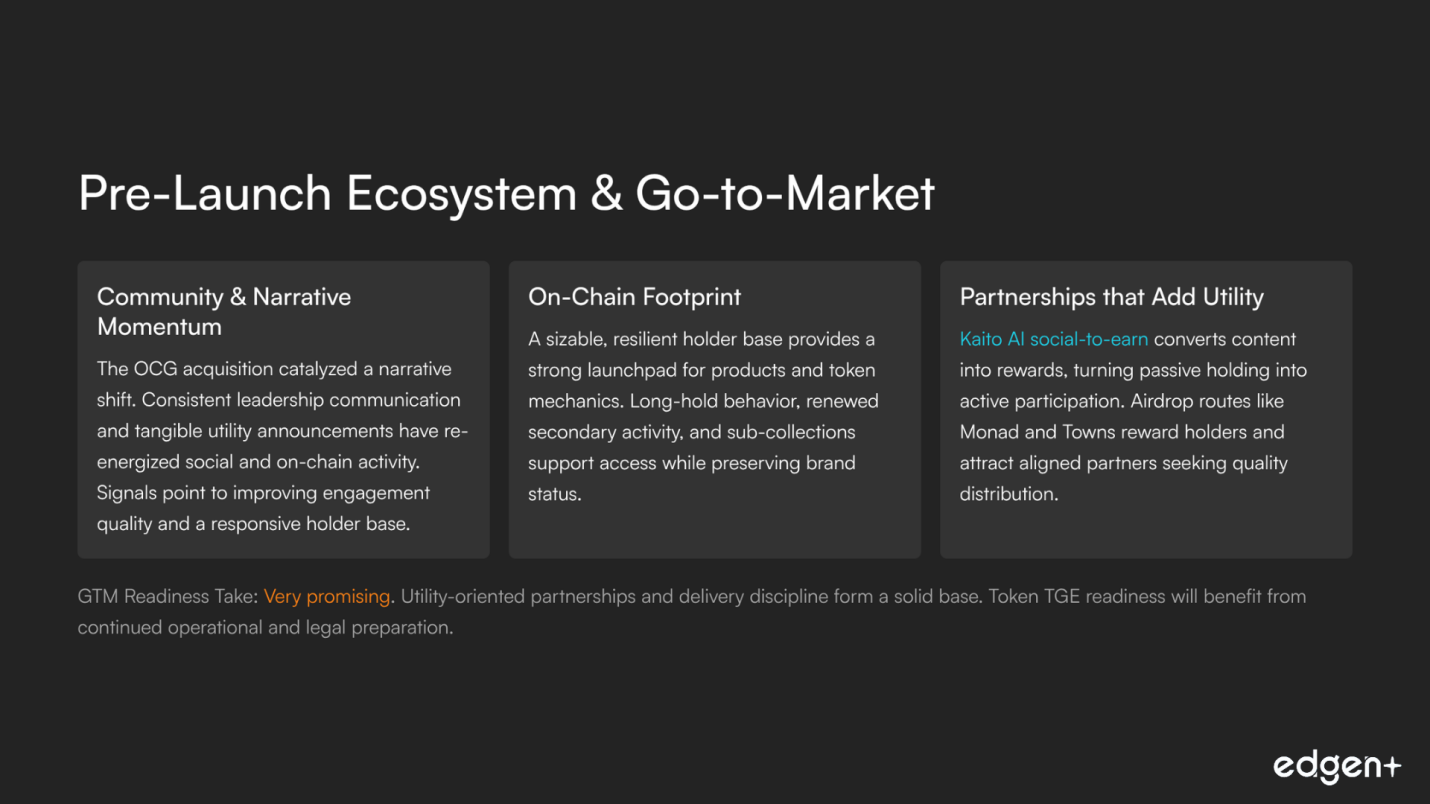
The OCG acquisition catalyzed a narrative shift. Consistent leadership communication and tangible utility announcements, such as Kaito AI, have re-energized social and on-chain activity. Signals point to improving engagement quality and a responsive holder base.

2. On-Chain Footprint

A sizable, resilient holder base provides a strong launchpad for products and token mechanics. Long-hold behavior, renewed secondary activity, and sub-collections support access while preserving brand status.

3. Partnerships that Add Utility

  • Kaito AI social-to-earn converts content into rewards, turning passive holding into active participation and discovery.
  • Airdrop routes like Monad and Towns reward holders and attract aligned partners seeking quality distribution; Otherside-ready 3D avatars extend cross-ecosystem utility.

4. Tokenomics & Value Accrual (Today)

  • Nesting creates time-based rewards that support holding behavior and primes the system for a future $TALONS token.
  • Governance through the Lunar Society ties influence to core NFTs and a treasury, reinforcing long-term alignment between participants and the brand.

GTM Readiness Take: Very promising. Utility-oriented partnerships and delivery discipline form a solid base. Token TGE readiness will benefit from continued operational and legal preparation.
III. Forward-Looking Analysis (Catalysts & Opportunities)

Near-Term (≤1 month)

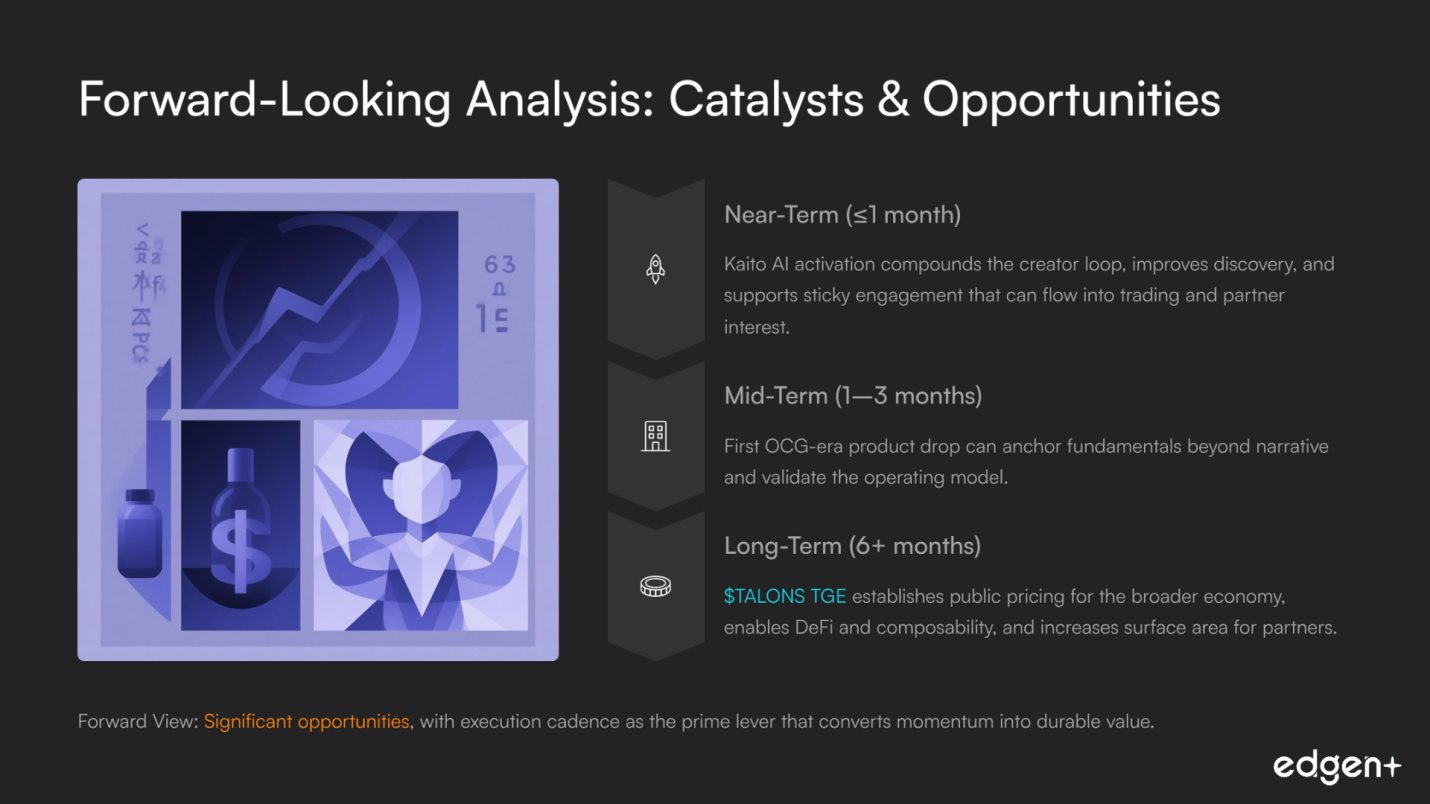
Kaito AI activation compounds the creator loop, improves discovery, and supports sticky engagement that can flow into trading and partner interest.

Mid-Term (1–3 months)

First OCG-era product drop can anchor fundamentals beyond narrative and validate the operating model.

Long-Term (6+ months)

$TALONS TGE establishes public pricing for the broader economy, enables DeFi and composability, and increases surface area for partners.

Forward View: Significant opportunities, with execution cadence as the prime lever that converts momentum into durable value.
IV. Valuation Scenario Analysis (TGE FDV)

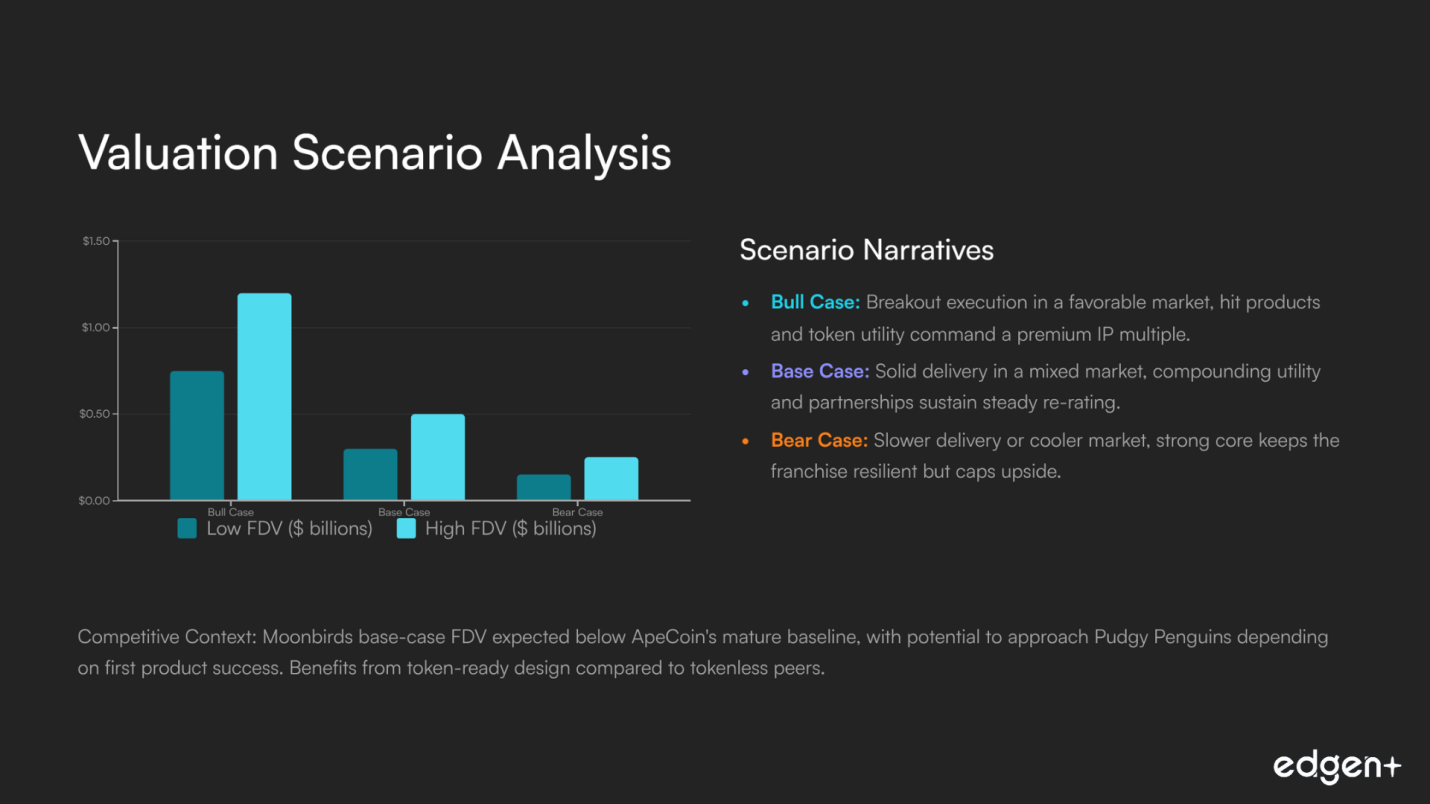
Scenario

FDV (USD billions)

Brief Narrative

Bull Case

0.75 – 1.20

Breakout execution in a favorable market, hit products and token utility command a premium IP multiple.

Base Case

0.30 – 0.50

Solid delivery in a mixed market, compounding utility and partnerships sustain steady re-rating.

Bear Case

0.15 – 0.25

Slower delivery or cooler market, strong core keeps the franchise resilient but caps upside.

Competitor Landscape (Token Angle at or near TGE)

Project

Token

TGE/Token Angle

Holder Linkage

Distribution Style

Position vs Moonbirds (Base-Case)

ApeCoin / Otherside

$APE

Ecosystem utility and governance

BAYC alignment

Airdrop plus listings

Moonbirds base-case FDV expected below APE’s mature baseline, strategic ties with Yuga are additive.

Pudgy Penguins

$PENGU

IP, toys, and gaming flywheel

Penguin holders

Community-aligned

Moonbirds base-case FDV near or below PENGU, contingent on first product success.

Azuki

(none)

Brand and anime-forward IP

Collection-driven

N/A

Tokenless peer benchmark, Moonbirds benefits from token-ready design for added accrual.

Final Take

Moonbirds shows strong potential as a professionally run IP revival with authentic community roots and practical product paths. With elite investor alignment and early utility traction, the project looks very promising. Execution speed and quality remain the key to unlocking the upper bands of the valuation range.

Educational content, not financial advice.

Recommend
banner.jpg

What is a money person? The plain-English alternative to a financial advisor

The short version: a money person is a smart, warm friend who happens to be good with money and explains it like a person, not a bank. Practically, it's a second opinion on your whole financial picture — cash, debt, tax exposure, concentration, and the goals you're working toward — that tells you in plain language what to look at first. It's not a traditional advisor managing your portfolio for 1% a year, and it's not a coach cheering you on. It's the honest read a good advisor's first meeting would give you, without the fee or the asset minimum. It's the role Ed Wealth was built to play. Strip away the label and a money person does four concrete things: Just as important is what it doesn't do: it doesn't take custody of your money, it doesn't sell you products for commission, and it doesn't pretend a forecast is a promise. It's a second opinion: it shows you the structure and lets you decide. People reach for four different things when they say "I should talk to someone." They're not
Edgen
·
Jul 10 2026
banner.jpg

Is a financial advisor worth it? Advisor vs robo vs money person

The short version: a financial advisor is worth it when your money has real complexity — a business, concentrated stock, an estate, a divorce, or turning savings into retirement income. There, a fee pays for itself. But most people don't have a complexity problem; they have a clarity one, and paying 1% of your assets a year — about $3,000 on a $300,000 portfolio, every year — is a lot to pay for reassurance. You have three tiers to choose from: a human advisor (~1% of assets), a robo-advisor (~0.25%), and a money person — a flat-fee second opinion that doesn't grow as your savings do. Start with the honest case for paying. A good advisor earns their fee when your situation is genuinely complex: selling a business, a big block of company stock or options, an estate with kids, a divorce, a windfall, or building a retirement-income plan with real moving parts. In those moments, one right call can save you many times the fee, and the job becomes picking a good one (that's how to choose a f
Edgen
·
Jul 10 2026
banner.jpg

Do You Actually Need a Financial Advisor? (An Honest Test)

The short version: you need a financial advisor when your money has genuine complexity — equity comp across several employers, a business sale, an estate with kids involved, a divorce, a sudden windfall, or a retirement-drawdown plan with real moving parts. If your situation is closer to "I earn well but somehow feel behind," that's a clarity problem, not a complexity one, and hiring someone to manage your money for about 1% a year is an expensive way to solve it. Here's how to tell which one you have. Almost everyone reaching for an advisor falls into one of two camps, and confusing them is where money gets wasted. A complexity problem is when there are real moving parts that interact: decisions where a wrong move costs far more than any fee. Selling a company, exercising stock options with a tax bill attached, splitting assets in a divorce, planning how to draw income across a 30-year retirement. Here, a good advisor earns their keep. A clarity problem looks different. Good income, a
Edgen
·
Jul 06 2026
banner.jpg

How to Choose a Financial Advisor in 2026 (and Whether You Even Need One)

The short version: picking a financial advisor isn't about finding the "smartest" one. It comes down to three boring questions that actually predict whether you'll be treated well: are they legally a fiduciary, how do they get paid, and do you even need one yet. Get those right and the rest is noise. Here's how to run the check — and what to do if you want guidance but can't (or don't want to) meet a $250,000 minimum. Before you choose one, ask whether this is the right tool at all. A full-service advisor earns their fee when your situation is genuinely complex — a business sale, equity comp across several companies, estate planning, a divorce, a sudden windfall, or a retirement-income plan with real moving parts. But a lot of people reaching for an advisor don't have a complexity problem. They have a clarity problem: a good income, a few scattered accounts, and a nagging sense of being behind. That doesn't need someone to manage your money for 1% a year. It needs a clear read on where
Edgen
·
Jul 06 2026
Redeem miles for gift cards and each is worth ~1 cent; redeem for long-haul business and they're worth 2.5-4+. With programs now dynamically priced, the one check that decides every redemption.

How to redeem airline miles without wasting them

The single biggest mistake with miles is redeeming them for the easy stuff: gift cards, merchandise, seat upgrades at the gate. Do that and each mile is worth about one cent. Redeem the *same* miles for flights, especially long-haul or premium-cabin flights, and they're often worth two to five cents each, sometimes more. So the real skill isn't earning miles; it's not throwing away their value at the finish line. Here's how to actually use them. A mile has no fixed price; its value depends entirely on what you redeem it for. The way to judge any redemption is simple math: (cash price of the flight) ÷ (miles it costs) = cents per mile. If a flight costs $400 or 20,000 miles, that's 2 cents a mile, a solid deal. If a $90 flight costs 18,000 miles, that's half a cent, which is terrible; pay cash and keep the miles. Run this check before every redemption. It instantly separates a great use from a waste, and it's the one habit that makes miles worth having. As a rule of thumb, most major ai
Edgen
·
Jun 30 2026
Short-term goals (under ~3 years) belong in safe cash; long-term goals (5+ years) can take market risk. The best HYSAs now pay ~4-5% APY. How to sort yours and run both.

Long-term vs short-term financial goals (and how to plan both)

The difference comes down to one thing: time. A short-term goal is money you'll need within roughly three years (an emergency fund, a trip, a wedding, next year's tax bill), so it has to be *safe and reachable*. A long-term goal is five-plus years out (retirement, a house down the road, a kid's education), so it can take market risk, because time smooths the bumps out. Get that match right and you've done most of the work. It's not the size, it's the deadline. A $2,000 goal you need in six months is short-term; a $2,000 goal you won't touch for fifteen years is long-term, and they belong in completely different places. This is the part that actually matters, and where people lose money without realizing it. Short-term money should not be in the stock market. If your emergency fund is in stocks and the market drops 20% the same month your car dies, you're selling at the worst possible time. Short-term goals go somewhere stable and accessible, and a high-yield savings account is the clas
Edgen
·
Jun 30 2026
Mortgages near 6.5%, home prices flat, and the Fed split on rate cuts vs hikes. With timing a coin flip, the 3 questions that actually decide whether to buy now or wait.

Should you buy a house now or wait? How to actually decide

The honest answer: buy when you'll stay put for at least five years and you'll still have an emergency fund left after the down payment. Otherwise, waiting (and renting) is often the smarter money move, not the weaker one. "Rent vs buy" isn't a math problem with one right answer, and it's almost never really about timing the market. It's about your *life*, in three questions. Before the three questions, here's the mid-2026 backdrop — because "now or wait" usually hides a bet on rates and prices, and the data says that bet is a coin flip. The picture: mortgages are still pricey, prices have gone flat (more than half of the 20 big metros saw year-over-year declines in March), and the cheap-money era hasn't returned. So "buy before it runs away" and "wait for the crash" are *both* weak arguments right now. The whole "wait for rates to drop" plan rests on the Fed, and the Fed is split down the middle. In its June 2026 projections, policymakers were divided: 8 expected no change this year,
Edgen
·
Jun 30 2026
Most financial goals fail because they're wishes, not systems. Here's the 3-part anatomy of a goal that sticks (a number, a date, one automatic move), plus why 37% of adults can't cover a $400 surprise.

How to set financial goals you'll actually hit

A financial goal you'll actually hit has three things a vague wish doesn't: a number, a date, and one automatic move that happens whether or not you remember it. "Save more" is a wish. "$6,000 in a separate account by next December, $500 auto-transferred on payday" is a goal. The gap between those two sentences is the reason most goals quietly die, and it has almost nothing to do with willpower. Key Takeaways A real financial goal answers three questions: how much, by when, and what for. Drop any one and it stops working. "Pay off debt" has no number and no date, so there's nothing to aim at or measure, while "$8,000 of card debt cleared in 18 months" tells you exactly whether you're on track and the day you're done. The "what for" matters more than people expect. A goal tied to something real (a buffer so a bad month isn't a crisis, a deposit on a first place) survives the months when motivation dips. In our experience reading how people actually use a money tool, the goals that get
Edgen
·
Jun 30 2026
A big RSU grant just vested — now what? Here's what a modern money tool actually surfaces first, using Ed as a worked example: a reality check, the 22% tax gap most high earners miss, and the concentration risk nobody flags.

Your RSUs Just Vested. Here's What a Money Tool Surfaces First.

You just had a big RSU grant vest. Congratulations — and now the awkward part: a six-figure pile of your own company's stock, a vague sense you should "do something," and no one actually telling you what. An advisor, a spreadsheet, and a piece of software each handle this moment differently. Here's what a modern money tool surfaces in a moment like this — using Ed as a worked example — so you can decide what kind of help actually fits. Key takeaways You connect your brokerage and bank through read-only aggregation, so the tool can read balances but can't move a dollar. Ed's framing is simple: precise about your money, blind to your identity. Instead of sorting your lattes into categories, Ed opens on a single Financial Reality Check — a read on whether your money could survive a bad month. For a lot of high earners, that one number lands harder than any budget, because it answers a question the other apps never ask. (If the Reality Check is the numbers side, your money type is the beha
Edgen
·
Jun 26 2026
A money personality test is more than a quiz if it measures behavior, not just vibes. Here's the science behind money types, how Ed's test works, and how to use your result.

What Is a Money Personality Test? The Science Behind Your Money Type

The short version: a good money personality test should feel like a roast and work like a mirror — fun on the surface, behavioral underneath. The useful ones don't tell you what you know; they show you how you act with money, and the one blind spot worth watching. Key takeaways Here's the uncomfortable backdrop. U.S. financial literacy has been stuck for a decade — adults answer only about 49% of the standard knowledge questions correctly, essentially flat since 2017 (TIAA Institute–GFLEC, 2025) — even as free financial information became infinite. If facts fixed money, they'd have fixed it by now. They don't, because the thing that actually drives your outcomes lives one level below the facts: how you're wired to behave when money is on the line. That's the whole premise of financial fitness — and it's what a money personality test is built to surface. Not what you know. What you do. The idea has real research behind it — money behavior is patterned and measurable, and a few tradition
Edgen
·
Jun 23 2026

Your money person, finally.

Try Edgen free. No credit card. No commitment.