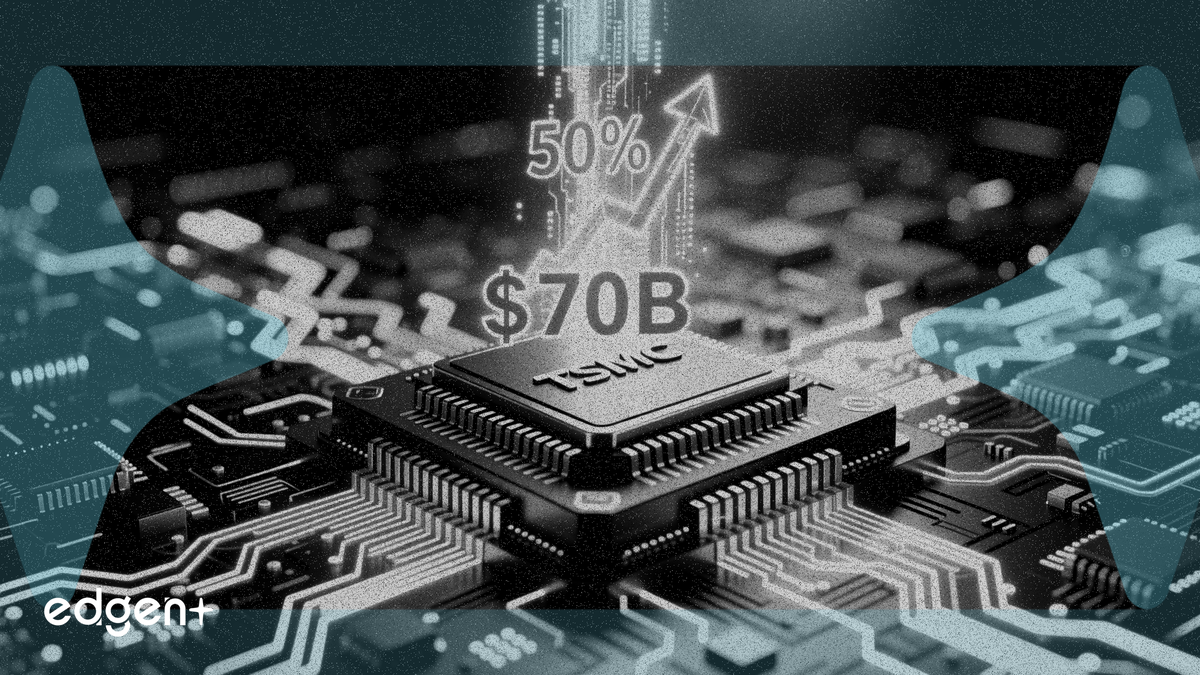
JP Morgan Lifts TSMC AI Growth Forecast to Over 50%
JP Morgan has significantly increased its outlook for TSMC, projecting the company's AI-related revenue will grow at a compound annual rate (CAGR) of over 50% from 2024 to 2029. In a March 24 report, the bank raised its forecast from the mid-40% range, signaling accelerating demand from the artificial intelligence sector. This explosive growth underpins a massive capital investment cycle, with expenditures expected to surpass $60 billion in 2027 and approach $70 billion by 2028. For 2026 alone, TSMC's capex is guided between $52 billion and $56 billion.
This spending is aimed squarely at expanding cutting-edge manufacturing capacity. The company's N3 node capacity is projected to exceed 200,000 wafers per month by 2028, while N2 node capacity is expected to reach approximately 100,000 wafers per month by the end of 2026. The bank maintained its 'overweight' rating on TSMC, setting a price target of NT$2250, reflecting expectations for dollar-denominated revenue to grow by more than 30% in 2026.
TSMC Maintains 2-Year Lead Over Intel and Samsung
Despite aggressive spending by competitors, JP Morgan assesses that TSMC's market share risk is limited due to its formidable technology lead and high customer switching costs. The bank estimates that Intel's 18A process is roughly equivalent to TSMC's N3E node, while Samsung's 2nm technology aligns with TSMC's 3nm generation, placing both rivals about two years behind. With chip design cycles lasting two to three years and production ramp-up taking another one to two years, migrating foundries is a costly, five-year endeavor for clients.
This technological moat renders external initiatives like Tesla's proposed 'TeraFab' a low-probability threat. Building a leading-edge foundry requires surmounting immense technological, operational, and financial hurdles. A single N2 wafer fab with 100,000 wafer-per-month capacity costs between $50 billion and $60 billion, a capital barrier that reinforces TSMC's dominant position as the primary fabricator for the world's most advanced AI chips.
Margins Forecast to Hit 70% as Pricing Power Strengthens
TSMC's technological dominance is translating directly into powerful financial performance. JP Morgan forecasts the company's gross margins could reach the high-60% to 70% range in the first half of 2026. This profitability is driven by a confluence of factors, including strong demand for advanced processes, a higher proportion of premium-priced 'hot-run' orders, and a favorable product mix weighted toward high-performance computing (HPC) clients.
Furthermore, TSMC's blended average selling price (ASP) is expected to climb by approximately 20% in 2026 as previously negotiated price increases of 6% to 10% on leading-edge processes take effect. While potential supply chain risks from energy costs or helium shortages exist, the report concludes these are manageable. Taiwan is expected to prioritize power for its strategically critical semiconductor industry, and TSMC has secured over a month's worth of helium inventory, positioning it to navigate short-term supply pressures.
 Edgen Stock·Mar 24 2026, 14:19