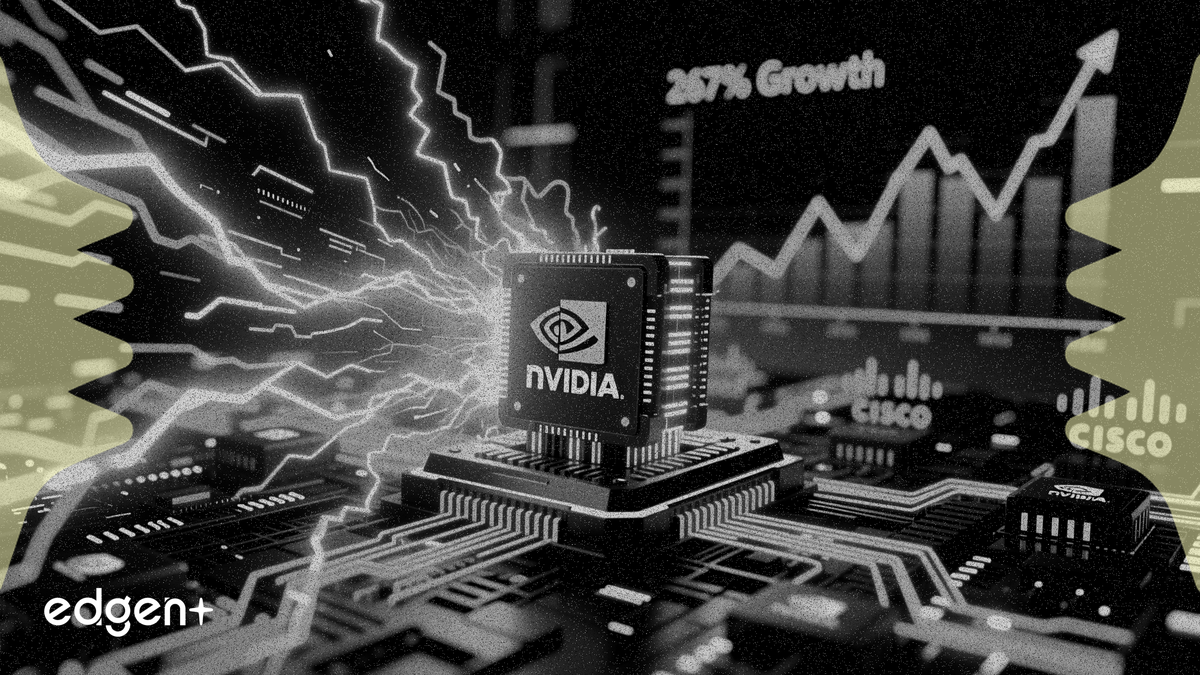
Networking Revenue Hits $11B, Surpassing Legacy Rivals
Nvidia's data center networking business has emerged as a dominant force, generating $11 billion in revenue in its latest fiscal quarter. This represents a 267% year-over-year surge, bringing the division's full-year revenue to over $31 billion. The explosive growth has quickly repositioned Nvidia as a leader in a market once controlled by legacy hardware companies.
The scale of this achievement is stark when compared to established competitors. According to Zacks Investment Research, Nvidia's quarterly networking revenue alone now exceeds the estimated annual networking revenue of industry giant Cisco. This rapid ascent underscores a fundamental shift in the market, where demand for integrated AI infrastructure is displacing traditional networking models.
$7B Mellanox Bet Builds 'AI Factory' Foundation
The networking division's success stems directly from the strategic acquisition of Israeli firm Mellanox for $7 billion in 2020. CEO Jensen Huang identified networking as the crucial missing component to deliver a complete, high-performance computing solution for AI. This move allowed Nvidia to package its dominant GPUs with perfectly matched networking technology, creating a full-stack offering.
This integrated approach is the core of Nvidia's "AI Factory" concept, where the network acts as the fundamental backbone of the data center. The company's technology suite, including NVLink, InfiniBand, and Spectrum-X platforms, provides the essential infrastructure for training massive AI models. As Kevin Deierling, Nvidia's SVP of Networking, stated, the network is no longer a peripheral for simple tasks but is now the foundational "backplane of the AI factory."
GTC Announcements Solidify Full-Stack Dominance
At its GTC technology conference on March 16, Nvidia reinforced its strategy by unveiling a new series of networking systems. The company launched the Rubin platform, which includes six new chips designed to power next-generation AI supercomputers. It also announced more efficient Spectrum-X Ethernet Photonics switches, further solidifying its ability to sell a complete, integrated hardware stack optimized for AI workloads.
By controlling both the computational GPUs and the networking fabric that connects them, Nvidia has created a powerful competitive moat. The company sells these technologies as part of a complete solution through its partners, a business model that rivals find difficult to replicate. This full-stack capability ensures maximum performance and efficiency, cementing Nvidia's central role in the build-out of global AI infrastructure.
 Edgen Stock·Mar 19 2026, 03:15