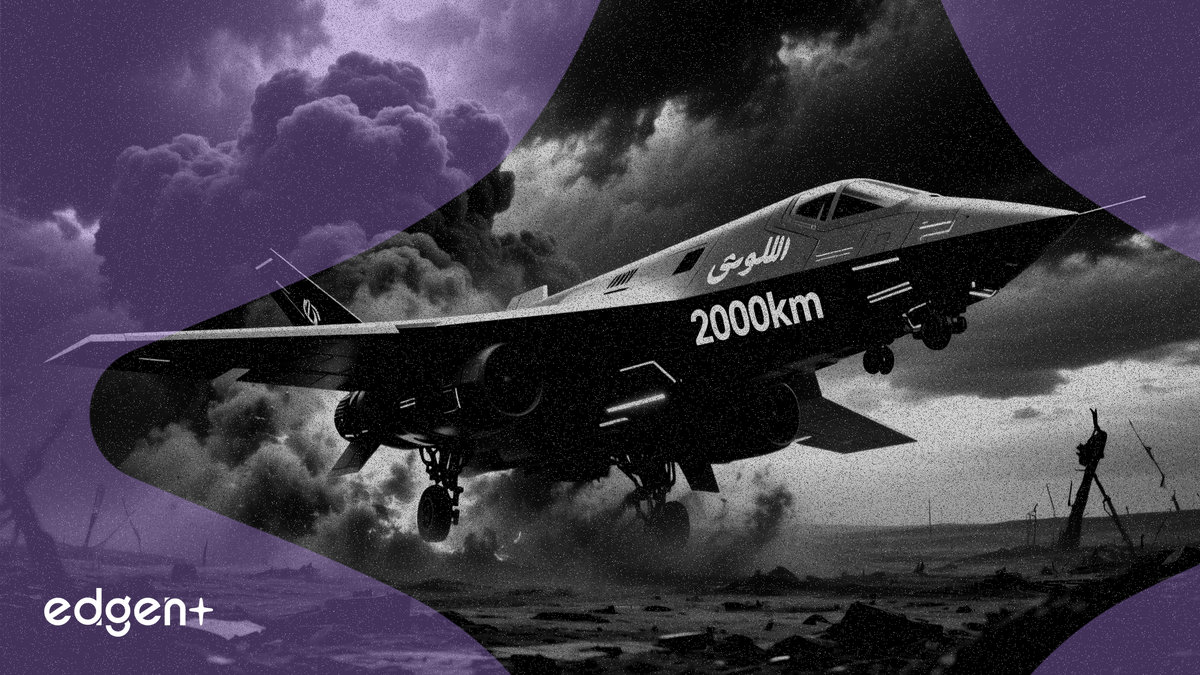
Iran Claims Strike on Israeli Airport With New 2000km Drone
Iran's military declared a formal pivot from a defensive to an offensive military posture on March 22, stating it used a new advanced drone to attack Israel's Ben Gurion Airport. Commander Abdollahi of the Khatam al-Anbiya Central Headquarters announced the strategic change, asserting that new, low-cost weapons would "thoroughly disrupt the enemy's deployment."
The weapon identified in the strike is the Arash-2, a kamikaze drone with a stated range of 2,000 kilometers and a warhead of approximately 260 kg. Iranian officials describe the drone as having a low radar cross-section, making it difficult for air defense systems to detect. The choice of Ben Gurion Airport as a target is significant, as the hub is central to Israel's trade and international connectivity, making it a high-impact economic target.
New Doctrine Aims for "Maximum Chaos" to Restore Deterrence
This attack marks a fundamental change in Iranian military doctrine, shifting from "forward defense"—confronting adversaries through proxies—to one of "raw offense." The new strategy aims to inflict direct and widespread pain on the global economy in response to any attack, thereby restoring deterrence. Tehran's goal is to make military action against it so costly that it becomes untenable for its adversaries.
This offensive posture includes explicit threats to global energy supplies. Iranian military exercises have signaled contingency plans to close the Strait of Hormuz, a critical chokepoint for international trade. By expanding the conflict's potential impact beyond regional military targets to the global economy, Iran seeks to create leverage and deter future attacks on its territory and interests.
Oil Markets Brace for Supply Shock as Recession Risk Grows
The pivot to an offensive strategy directly threatens the global energy market. The Strait of Hormuz accounts for the transit of roughly one-fifth of the world's total oil production, and any significant interruption would immediately impact prices. In a previously simulated war scenario, benchmark crude oil prices rose 44.6% in just two weeks.
A prolonged supply disruption lasting six to twelve months would almost certainly trigger a global recession and widespread inflation. Iran's strategy effectively forces a defensive reaction from the United States and its allies, shifting the conflict's focus from military targets to the protection of global economic stability. This calculus raises the stakes for the global economy, tying its fate directly to the escalating conflict in the Middle East.
 Edgen Stock·Mar 22 2026, 10:36