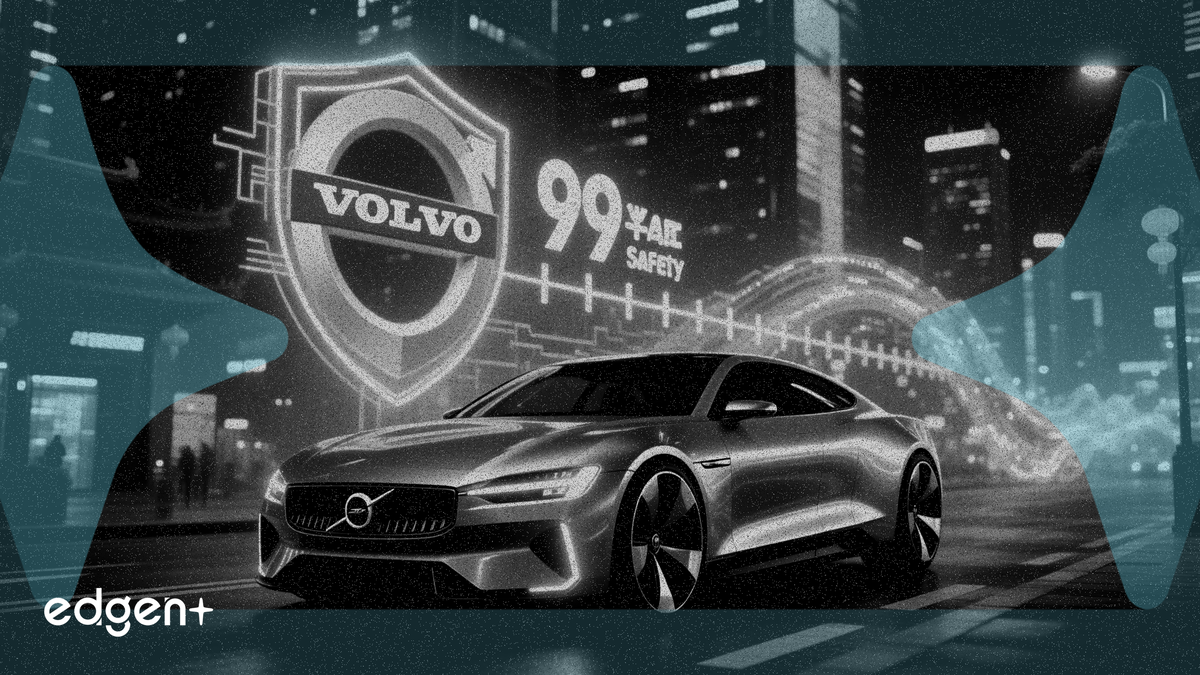
Volvo is betting its 99-year history is the key to its future in China, pivoting to safety as its core differentiator in the world’s most crowded electric vehicle market. The Swedish automaker unveiled three new models, including two flagship EVs, in a bid to win over premium buyers in a market where technology and performance are becoming increasingly commoditized.
"Brands must stick to their core identity to have a foothold in the market," Volvo Cars Greater China President Yu Kexin said in an interview after the launch event. For Volvo, that identity is safety, an area where the company has been accumulating data and building its brand for nearly a century.
The new lineup includes the pure electric EX90 SUV, with pre-sales starting at 539,900 RMB, and the ES90 sedan, starting at 429,900 RMB. Both are built on the SPA2 native pure-electric platform, featuring an 800V architecture and a self-developed third-generation electric drive. The ES90 boasts a range of 848 kilometers and a 3.9-second 0-100 km/h acceleration time, positioning it against the BMW i5, Nio ET7, and the upcoming electric Mercedes-Benz GLC.
Volvo’s strategy hinges on convincing its base of over one million Chinese customers that its safety credentials justify a premium. The company’s challenge is translating a reputation built on decades of engineering into a compelling reason to buy now, especially as competitors like BMW and Mercedes prepare to launch their own new EVs and local brands like Nio and Aito dominate headlines.
A Foundation Built on Hybrids
Volvo isn't going all-in on pure electrics immediately. The company is using its successful plug-in hybrid XC70 to acclimate its customer base. The model has sold over 20,000 units since its launch in late September, with over 90 percent of buyers choosing high-spec versions priced above 300,000 RMB. This indicates that customers are buying based on product strength, not just a low price.
"The XC70 lets customers experience the safety, performance, and reliability of Volvo's new energy vehicles," Yu said. "When we build that trust, they will naturally choose Volvo when they switch to a pure electric car." This two-step approach aims to secure current market share while cultivating a loyal base for the full EV transition.
Redefining Safety in the Smart Era
As competitors load up on lidar sensors and processing power, Volvo is doubling down on a more fundamental, data-driven approach to safety. Since 1970, the company has sent investigation teams to real-world crash sites, using that data to develop safety standards that often exceed regulatory requirements. For example, its side pillar crash tests are conducted at speeds far higher than the industry-standard 32km/h.
This philosophy extends to its driver assistance systems. The new EX90 and ES90 use a Driver Understanding System (DUS) with two infrared cameras to monitor driver alertness, intervening in stages if distraction is detected. The system is built on the premise that "people will make mistakes." This contrasts with the industry's prevailing narrative, which often assumes an ever-attentive driver.
"Our hardware is capable of high-level autonomous driving, but we cannot rush to open it up to customers," said Yuan Xiaolin, President and CEO of Volvo Cars Asia Pacific. "We cannot let our customers be the test pilots for our products." This cautious stance may prove to be a key advantage as the market grows more aware of the gap between the marketing of autonomous driving and its real-world capabilities.
This article is for informational purposes only and does not constitute investment advice.