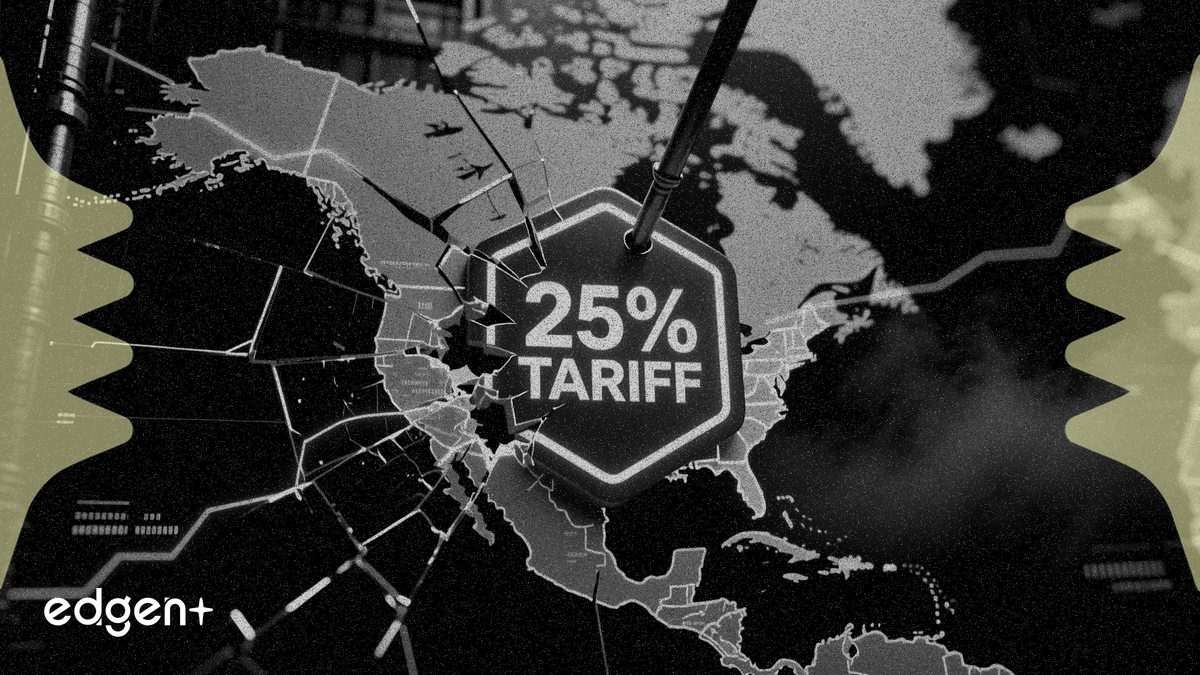
A new 25% U.S. tariff on manufactured goods from Canada and Mexico containing non-U.S. metals went into effect on April 6, escalating trade tensions just months before the United States-Mexico-Canada Agreement (USMCA) faces a mandatory six-year review. The move signals a potential unraveling of the pact, creating significant uncertainty for the nearly $1.8 trillion in annual continental trade.
According to a Reuters report, U.S. Trade Representative Jamieson Greer communicated a hostile stance toward free trade during a recent visit to Mexico City, telling auto and steel industry representatives not to expect the removal of tariffs. This follows former President Donald Trump's previous imposition of 50% tariffs on steel and aluminum from Mexico and Canada under Section 232 of the Trade Expansion Act of 1962.
The new tariffs target the entire value of products like appliances and vehicles if they are "substantially made" of non-U.S. steel, aluminum, or copper, a direct blow to the highly integrated North American supply chains. While intra-USMCA trade has grown 29% since 2020 to over $1.6 trillion, the agreement is now strained by issues of transshipment and enforcement. Data from Altana shows a 14-fold increase in U.S.-bound transshipment in 2025, with an estimated $40 billion in U.S. tariff revenue lost.
The upcoming joint review in summer 2026 is now a major flashpoint. While 62.9% of trade experts surveyed by Altana anticipate a conditional renewal with amendments, the new tariffs raise the risk of a breakdown. If the three parties fail to agree on an extension, the existing deal remains in effect with annual reviews, but the prolonged uncertainty could chill investment and undermine economic potential across North America.
Transshipment and Forced Labor Concerns Mount
Beyond the tariff disputes, the USMCA review is set to grapple with significant enforcement challenges. Analysis revealed that $86 billion worth of shipments bound for the USMCA bloc between 2024 and 2025 had upstream inputs exposed to forced labor. This is over 35 times the value of goods stopped under the Uyghur Forced Labor Prevention Act (UFLPA) during the same period, highlighting major gaps in supply chain visibility.
Addressing transshipment—where goods from countries like China are rerouted through Mexico or Canada to evade U.S. tariffs—is considered a "critical" negotiation point by 56.5% of trade leaders. Experts overwhelmingly agree that the future of trade enforcement will rely on technology, with 87% believing component-level supply chain visibility will become the dominant paradigm.
Economic and Political Stakes
The tariffs represent a significant challenge to the North American economic partnership. The automotive sector, which has seen trade between the three countries rise 38% since the USMCA was ratified, is particularly vulnerable due to its deeply integrated supply chains. The new 25% duty on the non-U.S. portion of vehicles could increase costs for manufacturers and ultimately for consumers.
The political strategy behind the tariffs is to make final products from Mexico and Canada less affordable, but this comes at a time of consumer sensitivity to prices. Retaliatory tariffs from Mexico and Canada, which have previously targeted U.S. farm and liquor exports, remain a distinct possibility, potentially harming American producers in key sectors. The escalating dispute puts businesses and investors on edge as they await the outcome of the summer review.
This article is for informational purposes only and does not constitute investment advice.