
A high-stakes “game of chicken” between the US and Iran over the Strait of Hormuz is throttling 20% of the world’s oil supply, with stalled diplomacy pushing the global economy toward a protracted energy crisis.
A high-stakes “game of chicken” between the US and Iran over the Strait of Hormuz is throttling 20% of the world’s oil supply, with stalled diplomacy pushing the global economy toward a protracted energy crisis.
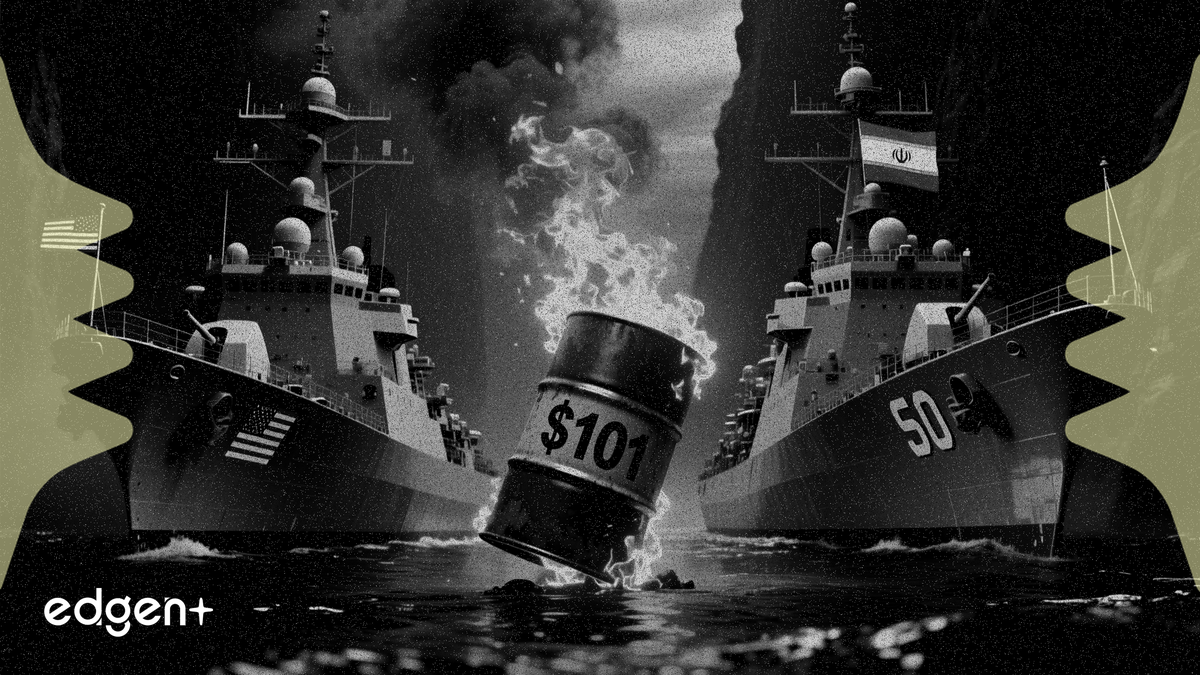
The standoff between the US and Iran intensified after peace talks collapsed, with President Donald Trump declaring "no timetable" to end the conflict as a dual blockade in the Strait of Hormuz sent Brent crude prices surging more than 35% above pre-war levels to over $101 a barrel.
"This is purely a leverage-seeking exercise," said Behnam Ben Taleblu, a senior fellow at the Foundation for Defense of Democracies. "It’s a bet that Iran will fold before the rest of the world does, and that’s a very risky bet. The Iranian regime is fighting for its survival and has proven its ability to tolerate the pain of choked-off oil exports."
The escalation followed the cancellation of a negotiating trip to Pakistan by US Vice President JD Vance after Iran refused to attend. In response to the diplomatic stalemate, Iran’s Revolutionary Guard Corps attacked three commercial vessels and seized two, while the US maintained its naval blockade of Iranian ports, which has turned back 28 ships.
With the Pentagon estimating a six-month timeline to clear the strategic waterway of mines, the continued closure threatens to keep global energy prices elevated, costing the European Union an estimated €500 million per day and risking a significant slowdown in the global economy.
In the high-stakes chess match, both Washington and Tehran are using maritime pressure to gain leverage. The US has maintained a naval blockade around Iranian ports, aiming to cripple the nation's oil export revenue. According to US Central Command, American forces have instructed at least 28 vessels to turn back since the blockade began. The effort includes interdicting ships in the wider region, with US forces recently boarding a sanctioned oil tanker in the Indian Ocean.
Iran has countered by effectively shutting down the Strait of Hormuz, the critical chokepoint for about one-fifth of global oil trade. On Wednesday, Iran’s Islamic Revolutionary Guard Corps (IRGC) fired on multiple commercial ships, including the MSC Francesca and the Liberia-flagged Epaminondas, causing heavy damage to the latter's bridge. The IRGC then seized both vessels, directing them to Iranian waters. The White House, however, stated the attacks did not violate the current ceasefire terms because the ships were international vessels, not American or Israeli.
Despite the American blockade, data from intelligence firm Vortexa showed that at least 34 tankers with links to Iran had managed to bypass the cordon, representing about 10.7 million barrels of crude.
The military maneuvers come as diplomatic efforts have completely broken down. Hopes for a second round of peace talks in Islamabad were dashed when Iran declined to send a delegation, citing the ongoing US blockade as a breach of the ceasefire agreement. Iranian Foreign Minister Abbas Araghchi said that reopening the strait is "impossible with such flagrant breach of the ceasefire."
In response, President Trump has adopted a strategy of indefinite pressure, extending a military ceasefire but doubling down on the economic strangulation. He dismissed rumors of a "3 to 5 day" deadline for Iran to return to the table, stating there is "no timetable" for ending the conflict.
The impasse is inflicting a growing toll on the global economy. Brent crude, the international benchmark, has consistently traded above $100 a barrel, with spot prices hitting $107. The surge has pushed US gasoline prices to a near four-year high, feeding inflationary pressures that were already a concern for central banks.
"Previously Iran was still exporting oil while other countries could not pass smoothly, which meant that time and pressure were not on Washington's side," said Michael Singh, a former senior director for Middle East affairs at the National Security Council. He warned, however, that the blockade is a "double-edged sword" that could backfire on the US as global energy costs climb.
This article is for informational purposes only and does not constitute investment advice.