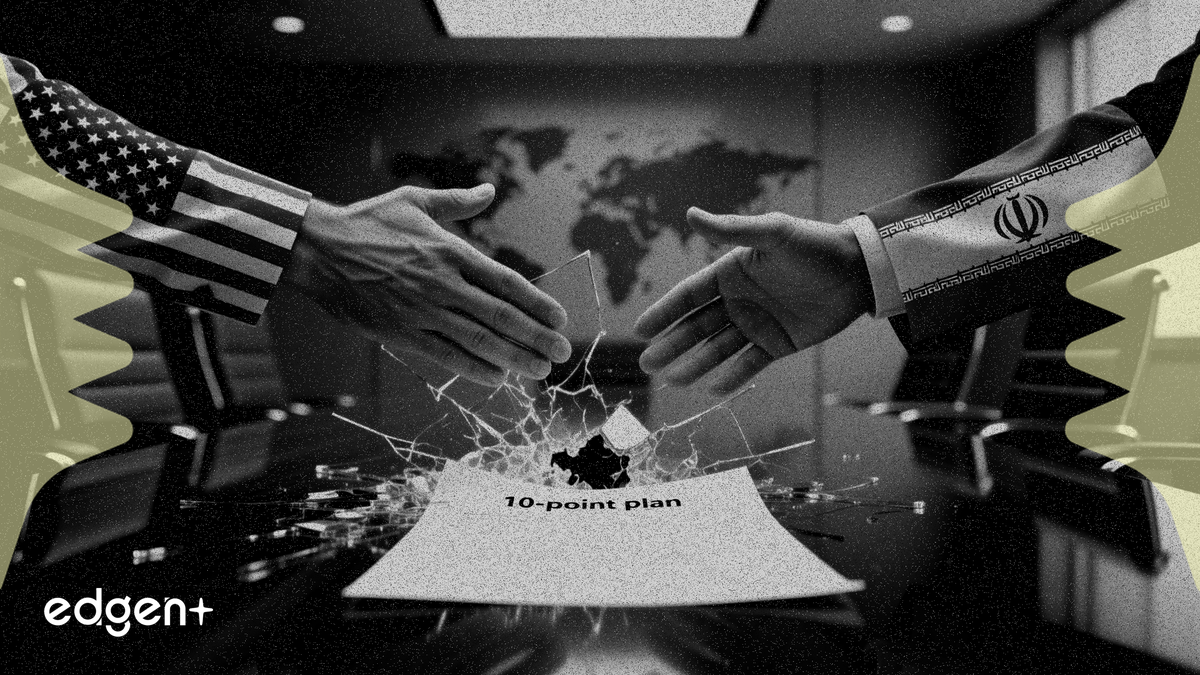
US and Iranian officials will meet in Pakistan for direct negotiations on April 11, a major diplomatic development aimed at ending a five-week conflict that has rattled global energy markets. The White House confirmed the talks, to be led by Vice President JD Vance, after President Donald Trump’s negotiating team flatly rejected an initial 10-point proposal from Tehran.
"The initial 10-point plan from Iran was a non-starter and was directly rejected by the president," White House Press Secretary Karine Jean-Pierre said at a briefing on Monday. She added that a subsequent "revised and completely different streamlined plan" was deemed a viable basis for discussion and would be negotiated against a 15-point framework from Washington.
The US has maintained its core demand that Iran must not conduct any uranium enrichment on its own soil, a long-standing point of contention. In a new complication, Iranian officials have told mediators that their participation is contingent on a ceasefire in Lebanon. As a precondition for the talks, the US has demanded the Strait of Hormuz, a critical oil chokepoint, must remain open without any restrictions.
These direct talks represent the most significant diplomatic effort to date to de-escalate a conflict that has included strikes on Iranian territory and retaliatory attacks on Saudi petrochemical facilities. The negotiations’ success hinges on navigating the deep mistrust that led to the war, which erupted just two days after a seemingly promising round of indirect talks concluded in Geneva. The last major diplomatic breakthrough, the 2015 nuclear deal, caused Brent crude to fall over 15 percent in the subsequent six months.
Vance's Pivotal Role
The choice of JD Vance to lead the US delegation is a strategic one, reflecting Tehran's preference for a negotiator perceived as more cautious about foreign intervention. According to regional sources, Iran has refused to engage with previous envoys Steve Witkoff and Jared Kushner since the war began, feeling the pre-war negotiations were a stalling tactic for military preparations. Vance was not involved in those earlier talks, making him a more politically acceptable figure for Tehran.
His role was quietly confirmed by President Trump, who noted Vance was central to the back-channel efforts facilitated by Pakistan's army chief, Field Marshal Asim Munir. Analysts suggest Vance is carefully balancing loyalty to Trump with his long-held skepticism of Middle East conflicts, potentially positioning himself for a 2028 presidential run as a peacemaker.
A Fragile Framework
The negotiations are set to proceed in a closed-door format for two weeks. The framework reportedly involves a sequenced process, starting with confidence-building measures before a formal ceasefire. While details remain private, Iran’s ambassador to Pakistan acknowledged on Tuesday that Islamabad’s mediation efforts were approaching a "critical, sensitive stage."
However, the diplomatic track contrasts sharply with President Trump's recent rhetoric. On Tuesday, he posted on his Truth Social platform that "A whole civilization will die tonight," while also suggesting "complete and total regime change" may be underway in Iran. This escalation in language puts immense pressure on the negotiators in Islamabad to produce a tangible de-escalation path.
This article is for informational purposes only and does not constitute investment advice.