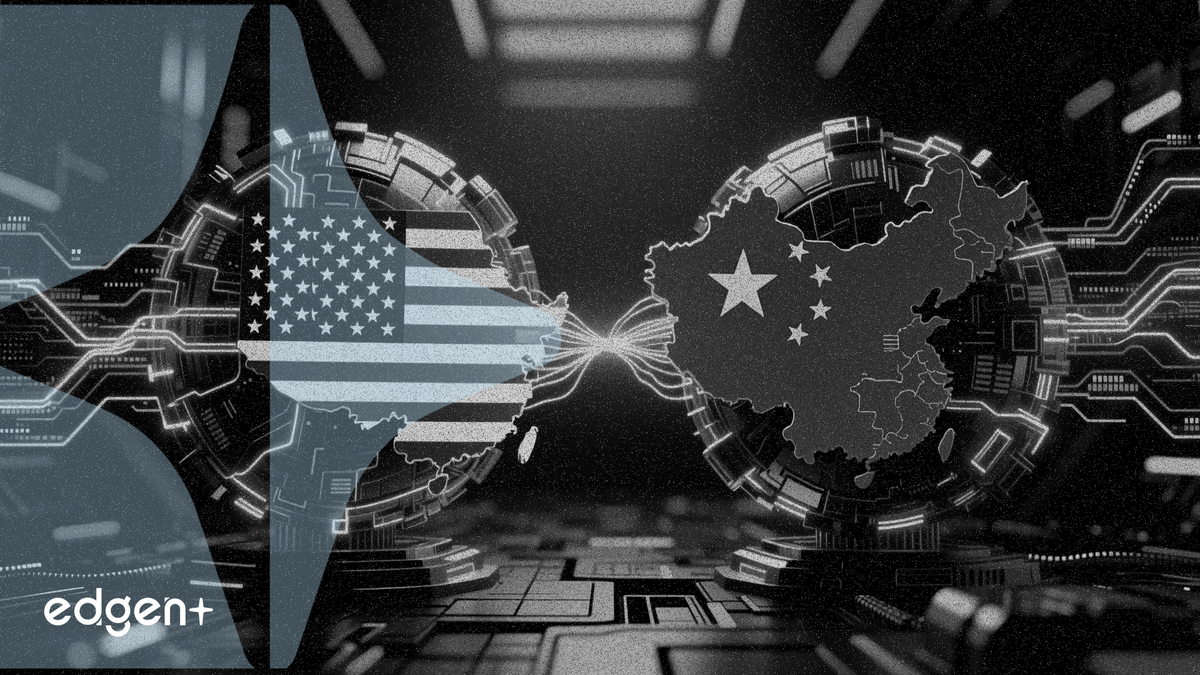
The world's two largest economies are creating a new forum to manage competition in the critical field of artificial intelligence, a move that could de-risk the sector for investors.

In a move to manage escalating tech rivalry, the U.S. and China have agreed to launch a new intergovernmental dialogue on artificial intelligence, a decision reached during President Donald Trump's recent summit in Beijing that provides a new, if untested, venue for de-escalation.
"For Washington, the summit was about making competition manageable enough to deliver economic and political dividends," Zongyuan Zoe Liu, Maurice R. Greenberg senior fellow for China studies at the Council on Foreign Relations, said. "For Beijing, it was about changing the vocabulary of the relationship."
The agreement comes against a backdrop of heightened market volatility, with the Vanguard Information Technology ETF (VGT) up nearly 20 percent year-to-date on AI optimism while energy markets have been roiled by crude oil prices surging from $67 to over $100 per barrel since March. The dialogue aims to create predictability in a sector where geopolitical risk has been a primary investor concern, separate from broader economic shocks.
The new dialogue's success will depend on whether both sides can bridge their vastly different definitions of "strategic stability." For investors, the forum represents a potential easing of tech-related sanctions and trade restrictions, but the core conflicts over semiconductor export controls, data security, and military applications of AI remain unresolved.
The announcement of a formal dialogue mechanism offers a sliver of stability in what has become an increasingly transactional and volatile relationship between the world's two largest economies. According to Chinese Foreign Ministry spokesperson Guo Jiakun, the two heads of state held "constructive exchanges" on AI, recognizing the need to jointly advance its development and governance. However, the underlying tensions that have characterized the relationship persist.
Washington's readout of the summit emphasized practical deliverables and the management of trade disputes through new boards of trade and investment. In contrast, Beijing's interpretation, articulated by Foreign Minister Wang Yi, framed "strategic stability" in broader political terms, including respect for China's "core interests" and development path. This fundamental difference in perspective suggests that while communication channels are opening, the root causes of friction—from Taiwan's status to control over advanced semiconductors—remain firmly in place.
The market's reaction to geopolitical events has been bifurcated. While AI-related stocks, including beneficiaries like Nvidia, have soared on technological optimism, the global economy remains fragile. The closure of the Strait of Hormuz has pushed oil prices to multi-year highs, threatening to fuel inflation and dampen consumer spending. According to Sahil Mahtani, a director at Ninety One’s investment institute, markets are "simultaneously pricing accelerating AI optimism and a potentially serious energy shock." The new dialogue could be seen as an attempt to insulate the tech sector from wider geopolitical instability.
This effort at managed competition is not without precedent. The previous U.S.-China Strategic and Economic Dialogue aimed to manage a wide range of issues. However, the new AI forum appears more narrowly focused, designed to keep specific trade and investment disputes from becoming crises rather than to forge a grand strategic settlement. For technology investors, this suggests a potential reduction in headline risk, but it does not eliminate the underlying danger of unilateral tariffs or entity-list designations.
This article is for informational purposes only and does not constitute investment advice.