
The UK's decision to share classified Storm Shadow component data with Ukraine shifts Western support from gifting finite stockpiles to enabling domestic production.
The UK's decision to share classified Storm Shadow component data with Ukraine shifts Western support from gifting finite stockpiles to enabling domestic production.
The UK's decision to share classified Storm Shadow component data with Ukraine shifts Western support from gifting finite stockpiles to enabling domestic production.
The UK authorized MBDA on Monday to release classified technical data on British-made Storm Shadow components, clearing the final hurdle for Ukraine and France to establish domestic SCALP cruise missile assembly lines inside Ukraine.
"This is all part of a momentum towards more explicit and extensive European support of Ukraine, especially after U.S. support ended, and a greater integration of Ukraine into the European defense industry," said Nick Cunningham, defense analyst at Agency Partners. "There is clearly a lot more of this to come."
Prime Minister Andy Burnham announced the decision during his first overseas trip to Kyiv on Ukraine's 35th Independence Day. France had already authorized its half of the classified package in July, when President Emmanuel Macron approved licensed production of SCALP and Aster interceptor missiles. The SCALP — known as Storm Shadow in the UK — is jointly developed by MBDA France and MBDA UK, with classified data split by national origin, requiring separate authorization from each government. The EU simultaneously approved €6.1 billion in new defense procurement covering air defense, missiles, ammunition, and radar systems, bringing total authorized under the €90 billion Ukraine Assistance Support Loan to approximately €22 billion.
The technology transfer does not address Ukraine's most binding constraint: financing. Zelensky called on European countries Saturday to accelerate financial support, warning the country is running short of funds. Ukraine's two domestically developed cruise missiles — the Neptune and Flamingo, the latter carrying a 2,500-pound warhead over 1,800 miles — cannot reach large-scale production without capital. "It's not only an industrial war, it is the war of the budgets," said Oleg Krot, CEO of Ukrainian drone maker Sichen.
The structural significance extends beyond the immediate announcement. The joint development architecture means the same bilateral-consent requirement applies to any jointly developed European weapon — Meteor, Aster, and the future Stratus system planned to replace Storm Shadow. Monday's decision establishes that both partners in a joint program can independently authorize transfer in wartime, a precedent that did not exist before.
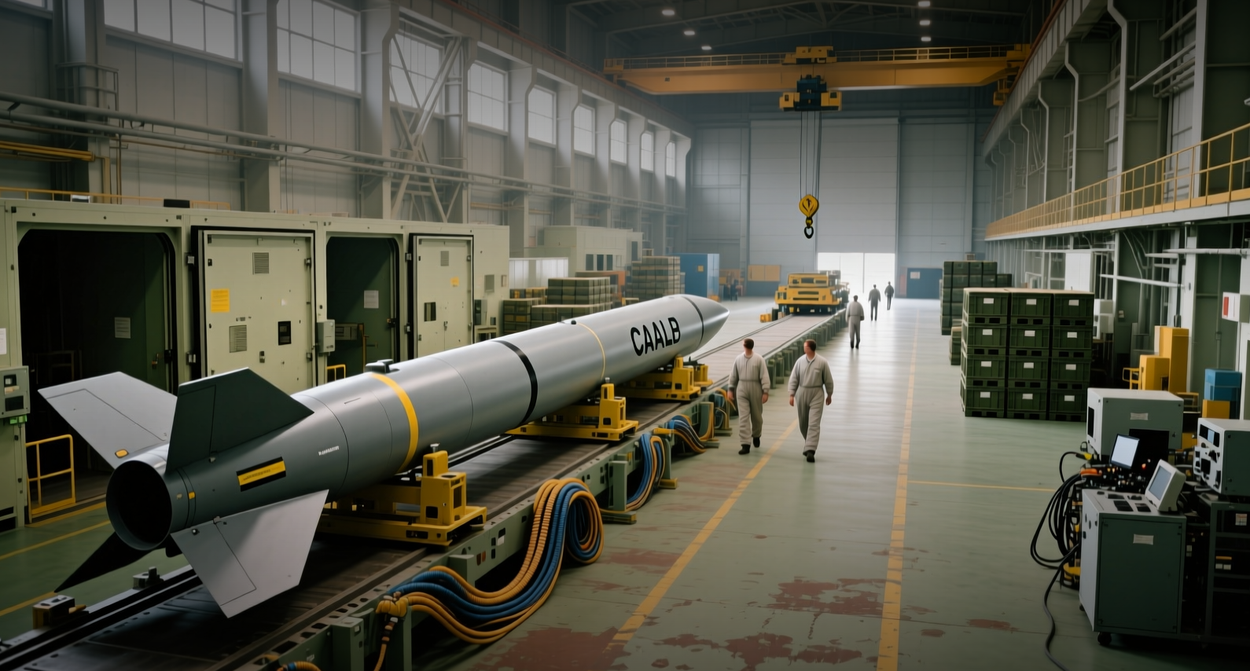
The SCALP is a 5.1-meter, 1,300-kilogram cruise missile carrying a 450-kilogram BROACH multistage penetrator designed to defeat hardened targets — command bunkers, aircraft shelters, and ammunition storage sites that survive drone attacks. It flies at Mach 0.95 using TERPROM terrain-following navigation, with a military range of up to 550 kilometers. Ukraine currently fires it from Su-24M and Mirage 2000 jets.
Funding gap remains the binding constraint
The UK's decision coincides with Project Brakestop, a separate UK-led effort to develop lower-cost long-range strike weapons for Ukraine. Total UK support since 2022 has reached £25 billion, while Norway pledged $9.2 billion for 2027. But previous attempts to localize Western weapons production have stalled on financing. Rheinmetall CEO Armin Papperger said talks to manufacture hundreds of tanks on Ukrainian territory never materialized because "the financing and orders never arrived." BAE Systems signed a deal last month for Ukraine to manufacture one of its howitzers, but only a handful of smaller foreign drone makers have started production so far.
The Kremlin responded immediately. Spokesman Dmitry Peskov called the decision "fuel on the fire," while Foreign Minister Sergei Lavrov said Russia has the right to regard "the direct involvement of British missile forces" as "participation in the war, with all the ensuing consequences." Peskov added that Russian forces are gathering intelligence on potential production sites.
The announcement was timed to the largest diplomatic convergence in Kyiv since the war began, with leaders from the UK, France, Germany, and a dozen other European nations attending the Coalition of the Willing meeting. No US representative was listed, reflecting cooler Washington-Kyiv relations under the Trump administration. The EU and its member states have collectively provided €220.2 billion in support to Ukraine since 2022, including €3.8 billion derived from immobilized Russian sovereign asset returns.
The last time the West transferred weapons technology of this sensitivity was the 2023 decision to supply Storm Shadow missiles themselves, which preceded a series of strikes on Russian naval headquarters in Sevastopol and command centers in occupied territory. Whether domestic assembly can replicate that impact depends on how quickly Ukraine can harden production sites against Russian strikes — Moscow recorded 376 missile strikes in July, the deadliest month since April 2022.
This article is for informational purposes only and does not constitute investment advice.
