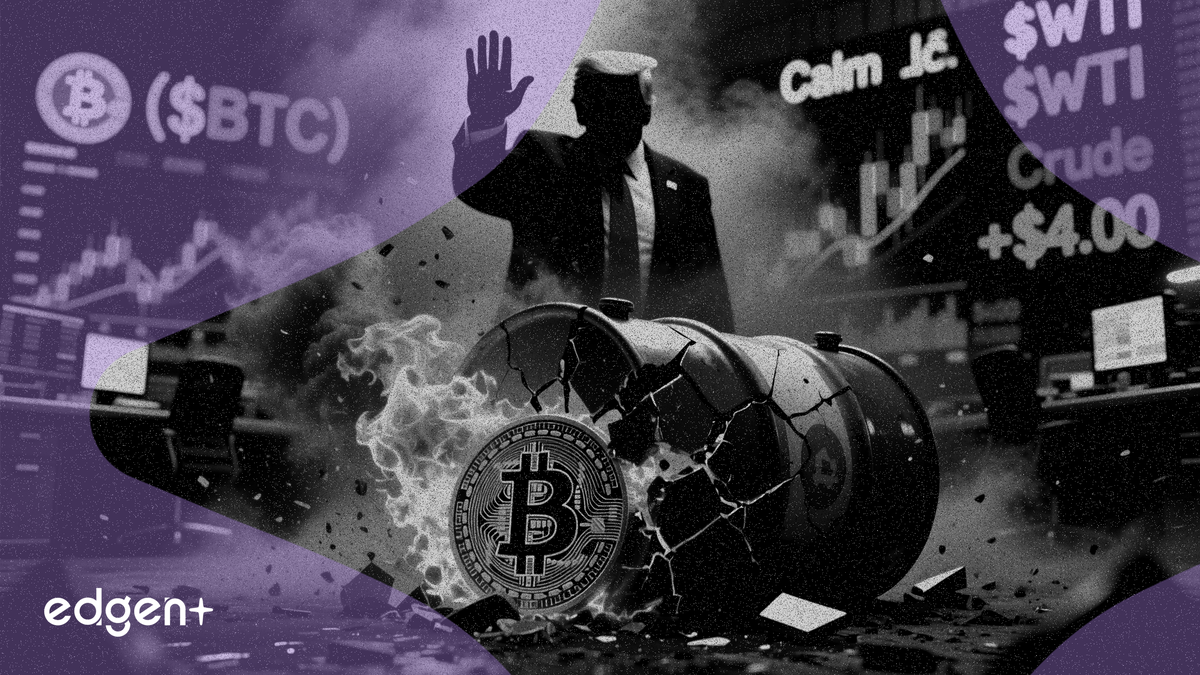
President Donald Trump intervened directly in Middle East diplomacy Monday, urging Israeli Prime Minister Benjamin Netanyahu not to retaliate against Iran as oil surged and Bitcoin whipsawed on the most serious exchange of fire since an April ceasefire.
Trump urged Netanyahu to stand down after Israel struck petrochemical facilities in Iran's Khuzestan province, sending Brent crude up $4.40 to $97.49 a barrel and triggering a whipsaw in Bitcoin as traders assessed the risk of a broader regional conflict.
"The United States bears responsibility for the Israeli regime's aggression, and it will also be responsible for the consequences of any escalation in tensions," Esmail Baghaei, Iranian Foreign Ministry spokesman, said in a briefing Monday in Tehran.
Israeli strikes wounded at least 15 people in Iran, according to the National Emergency Medical Organization, while Iran's joint military command said it was halting offensive operations hours after launching missiles at Israeli military bases. Netanyahu acknowledged the halt but vowed to respond "with force" to future attacks. The exchange marked the first direct hostilities since an April 8 ceasefire brokered by the U.S.
The fragile truce now faces its sternest test. Iran's UN envoy said Monday he hopes US-Iran talks "will reach a conclusion" by the end of June, but the renewed crossfire has already rippled through global markets. Brent crude traded at $97.49, up nearly 5%, while Bitcoin swung sharply as traders weighed whether Trump's intervention could de-escalate tensions or signal deeper instability.
Oil Markets Price In Renewed Risk Premium
The oil surge reflected the market's assessment that supply routes through the Strait of Hormuz — which handles about 21 percent of global crude trade — are once again vulnerable. Iraq closed its airspace for 72 hours as a precautionary measure, while Syria temporarily shut Damascus International Airport. The European Union approved sanctions against Iranian individuals and entities involved in disrupting transit through the strait, the first use of a new freedom-of-navigation sanctions system.
Bitcoin Whipsaws on Headline Risk
Bitcoin swung between gains and losses as traders reacted to the fast-moving geopolitical headlines. The cryptocurrency's volatility reflected its sensitivity to macro risk events, with the whipsaw reflecting deep uncertainty about whether the confrontation would escalate or cool. Trump's intervention — which he described as urging an immediate ceasefire — could either de-escalate tensions, potentially bullish for risk assets, or signal deeper instability if Israel defies the request.
Historical Precedent and Forward Outlook
The last time Israel and Iran traded direct fire in April, oil briefly touched $95 before retreating as the ceasefire held. This time, the stakes are higher: Israel has also been striking Hezbollah targets in Lebanon, where 29 Lebanese army members have been killed since March, according to Lebanese Information Minister Paul Morcos. The Houthi rebels in Yemen have also re-entered the fray, claiming a missile attack on Israel and warning that Israel-affiliated vessels would again be targets in the Red Sea.
If the ceasefire holds, oil could retreat toward $90 as the risk premium unwinds. If hostilities resume, Brent could test $100 for the first time since 2022, with Bitcoin likely to face further selling pressure as investors rotate into safe-haven assets.
This article is for informational purposes only and does not constitute investment advice.