
President Trump signed a national security memorandum Thursday ordering the Navy to abandon electromagnetic catapults on future Ford-class carriers and return to steam.
President Trump signed a national security memorandum Thursday ordering the Navy to abandon electromagnetic catapults on future Ford-class carriers and return to steam.
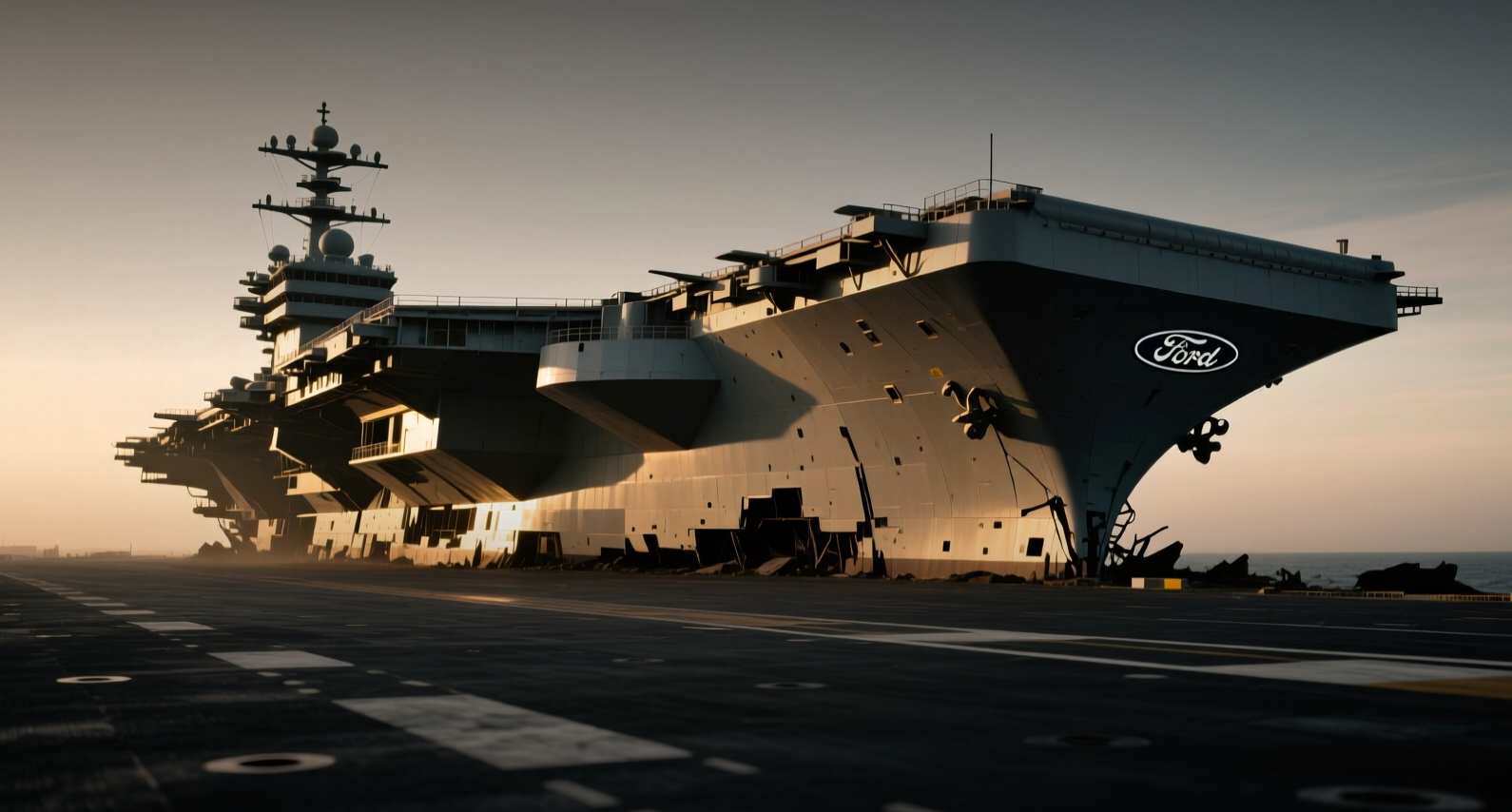
President Trump signed a national security memorandum Thursday directing the Navy to strip electromagnetic catapults from future Ford-class carriers and reinstall steam systems, a reversal that will cost billions and upend a design the service has defended for a decade.
"I've launched off the front of aircraft carriers hundreds of times, have a master's degree in aeronautical engineering, and am a test pilot, and even I wouldn't suggest to the Navy how to engineer specific systems on its ships," said Democratic Sen. Mark Kelly of Arizona, a former Navy combat pilot and NASA astronaut.
The directive requires redesigning the fourth Ford-class ship, the future USS Doris Miller, and all subsequent vessels, while the first three — the Ford, John F. Kennedy and Enterprise — keep their electromagnetic systems. The change fulfills a promise Trump made nearly a decade ago after a sailor praised steam catapults during a first-term ship visit. The Doris Miller, whose keel is set to be laid this year, is not expected to enter the fleet until 2034.
The reversal carries billions in cost and schedule risk because the electromagnetic launch system is integral to the Ford class's internal design, which eliminated steam infrastructure that powered catapults, heating, freshwater evaporators and galley equipment on older Nimitz-class ships. Early Navy data shows the Ford costs about $100 million less a year to operate than a Nimitz-class carrier and needs 500 fewer sailors, while nearly 37,000 aircraft had launched from its four electromagnetic catapults as of March.
General Atomics, which builds the Electromagnetic Aircraft Launch System and Advanced Arresting Gear for the Ford class, said the decision "warrants careful reconsideration." The company, awarded the Doris Miller catapult contract in 2023, said its work is nearly 50 percent complete and "changing course now would introduce significant cost, schedule, and integration risks."
"The decision will have broader implications for carrier readiness, national security, and U.S. technological superiority, potentially creating opportunities for adversaries to close the capability gap," General Atomics said. HII, which builds the Ford class at Newport News Shipbuilding, said it would "work closely with the Navy to implement any potential changes to ships under construction."
The international backdrop sharpens the stakes. China already uses electromagnetic catapults on its newest carriers, and France plans to adopt the Ford-class-derived system for its next carrier, according to the Wall Street Journal. The last US carrier built with steam catapults, the USS George H.W. Bush, entered the fleet in 2009.
Bryan Clark, a naval expert at the Hudson Institute, said replacing the electromagnetic system with steam will likely cost billions given how deeply the Ford class's internal design departs from the Nimitz class. "Electric is more reliable," Clark said. "If I can turn these components to be electric instead of steam, it eliminates all the steam related mechanical parts."
The memorandum also orders new investments in US shipyards, including a new public shipyard — the first opened in 83 years — to "supercharge submarine repair," plus a Component Repair Center to serve as a submarine spare-parts warehouse. The Navy recently awarded General Dynamics Electric Boat and HII Newport News Shipbuilding a $76.6 billion contract for nine Virginia-class and five Columbia-class submarines to be delivered by 2038, as it works toward building two Virginia-class and one Columbia-class submarine annually.
The directive also pushes foreign direct investment into US shipbuilding, permitting a foreign shipbuilder to construct up to two ships overseas while training American workers and investing in domestic yards. The model mirrors the Coast Guard's icebreaker program, which uses Finland's Rauma Marine Constructions with additional vessels built in Louisiana by Bollinger Shipyards.
The order marks Trump's latest intervention in military hardware design. He previously inserted himself into Air Force One and F-35 negotiations, directed design changes to the Constellation-class frigate and championed Trump-class battleships. The Ford, the first ship in its class, cost more than $13 billion and completed an 11-month deployment earlier this year that included operations against Venezuela and supporting the war in Iran.
The reversal comes as the Navy touts the electromagnetic system's performance — in February it said the Ford's catapults and arresting gear enabled launch and recovery rates above Nimitz-class ships. If the redesign proceeds, the Doris Miller's 2034 delivery could slip, and the US risks ceding a technological lead to China and France, which are both moving ahead with electromagnetic launch systems. The Pentagon has 60 days to deliver a plan on what installing hydraulic catapults on the Doris Miller would require, per Bloomberg.
This article is for informational purposes only and does not constitute investment advice.
