
President Trump confronts a May 1 legal deadline to secure congressional approval for the conflict with Iran, a constitutional showdown that threatens to upend energy markets as the war's costs surpass $30 billion.
President Trump confronts a May 1 legal deadline to secure congressional approval for the conflict with Iran, a constitutional showdown that threatens to upend energy markets as the war's costs surpass $30 billion.
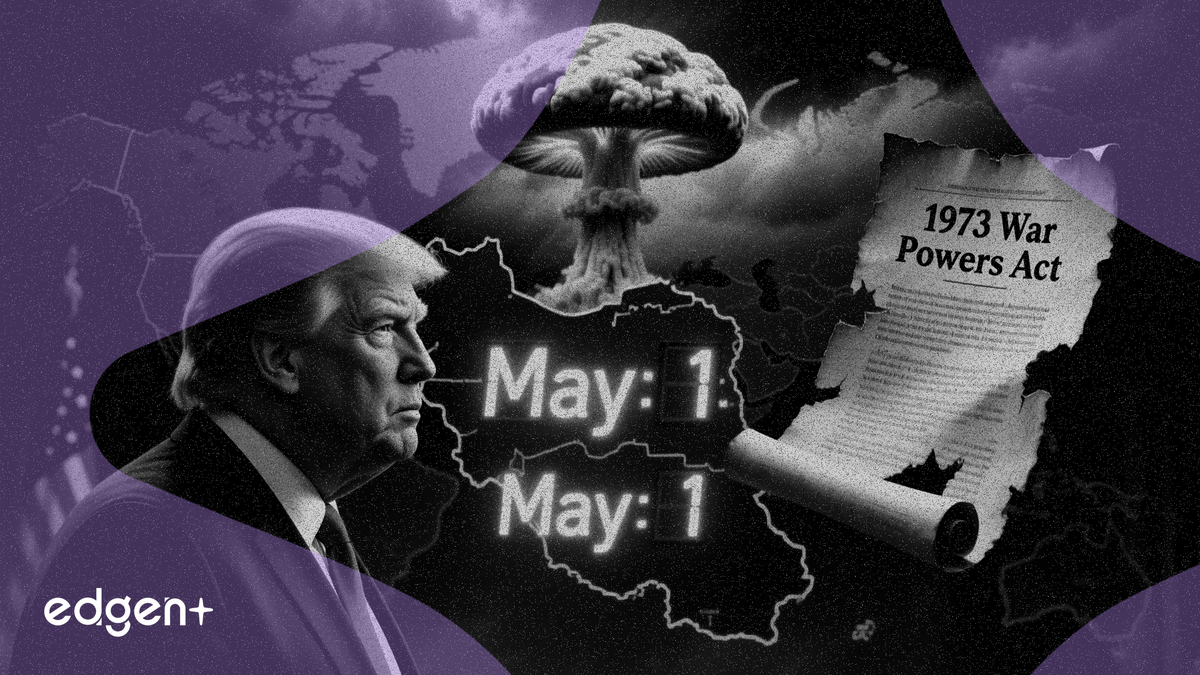
The administration of President Donald Trump is approaching a critical May 1 deadline established by the 1973 War Powers Act, forcing a constitutional reckoning over his authority to continue the military conflict against Iran without explicit congressional authorization. The 60-day countdown, triggered by the start of US strikes on February 28, has injected profound uncertainty into global markets, which have seen oil prices surge past $110 a barrel amid the most significant Middle East conflict in decades.
"Legally speaking, we either approve continued operations or we stop," Nebraska Republican Representative Don Bacon said, highlighting the stark choice facing lawmakers. "If it's not approved, by law, the action must stop."
The legal deadline arrives amid a flurry of contradictory diplomatic and military signals. While a fragile two-week ceasefire is set to expire, a second round of peace talks hosted by Pakistan hangs in the balance, with US Vice President JD Vance expected to lead the American delegation. Hopes for a diplomatic off-ramp have been complicated by the US Navy's seizure of an Iranian-flagged cargo ship over the weekend, an act Iran’s foreign ministry condemned as a violation of the ceasefire. The market has reacted to every twist, with Brent crude futures falling 0.6% to $94.94 on hopes for talks Tuesday, after jumping nearly 7% a day earlier on news of the ship seizure and Iran's re-closure of the Strait of Hormuz.
At stake is not only the trajectory of the war but also the balance of power in Washington. Trump faces three distinct paths: seek a formal Authorization for Use of Military Force (AUMF) from a divided Congress, withdraw US forces and effectively concede a victory to Tehran, or openly defy federal law by continuing the conflict. The decision is further complicated by an expected White House request for $80 billion to $100 billion in supplemental funding, forcing lawmakers to take a financial stance on a war they have not legally sanctioned.
The War Powers Act was enacted in 1973 over President Nixon's veto to prevent presidents from drawing the nation into prolonged conflicts without congressional consent. It mandates that a president who commits armed forces to foreign hostilities must terminate their use within 60 days unless Congress declares war or provides an AUMF.
President Trump has sought to circumvent this constraint by labeling the conflict a "military operation," a semantic choice he admitted was intended to avoid congressional oversight. While Republican leadership has so far blocked four resolutions aimed at ending the conflict, cracks are appearing in the party's support as the legal deadline transforms from a hypothetical to a reality. North Carolina Senator Thom Tillis and Oklahoma Senator James Lankford have both stated that the president must either present an exit plan or seek authorization come May 1.
For investors, the political drama in Washington translates directly to market risk. The conflict has already cost an estimated $30 billion, with damage to global energy infrastructure exceeding $50 billion, according to the original source material. The war has choked off the Strait of Hormuz, a vital artery for about 20 percent of the world's oil supply, sending prices soaring and forcing Asian economies to scramble for alternatives.
Oil markets remain on a knife's edge, swinging wildly on geopolitical headlines. "Optimism appears to be clouding the reality of the supply shock," ING analysts said in a note, suggesting markets are underpricing the risk of a prolonged disruption. The last time a similar Mideast crisis led to a sustained closure of the strait in the 1980s, it triggered a global recession. With Asian buyers like India and China already seeing their alternative supplies of Russian crude dwindle, a failure to secure a lasting peace could have severe economic consequences.
This article is for informational purposes only and does not constitute investment advice.