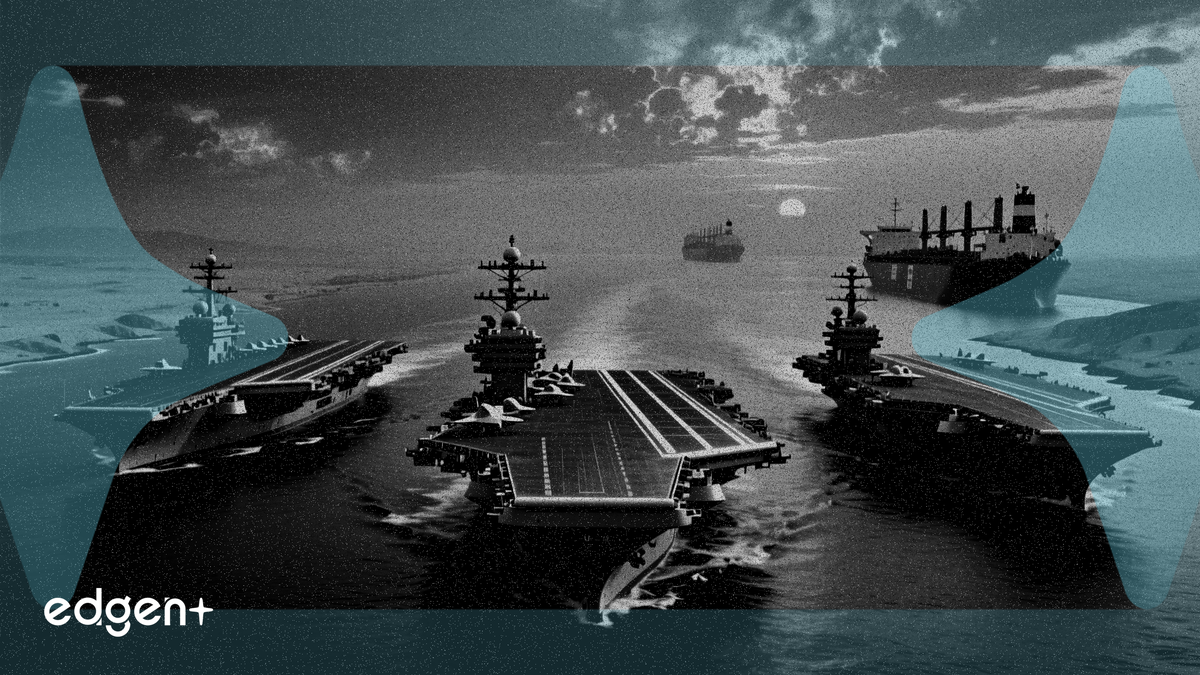
President Donald Trump confirmed the US has not withdrawn its military forces from the Strait of Hormuz, stating three aircraft carrier groups remain in the region as the conflict with Iran enters its second month.
President Donald Trump said Monday the US has not withdrawn its forces from the Strait of Hormuz, confirming a military presence that includes three aircraft carrier strike groups near the critical oil chokepoint as tensions with Iran continue to escalate.
"The full reopening of the Strait is something the Administration is working towards, but the core objectives of the operation have been clearly defined," White House Press Secretary Karoline Leavitt said at a briefing, emphasizing goals of dismantling Iran's missile capabilities and preventing its acquisition of a nuclear weapon.
The deployment involves the USS George H.W. Bush, USS Gerald R. Ford, and USS Abraham Lincoln carrier strike groups, alongside 2,500 recently arrived Marines. The heightened military presence follows a month of conflict that has seen Iran disrupt shipping, allowing only a small number of tankers from nations it deems non-hostile to pass, which has driven up global crude oil prices.
The standoff places global energy security at risk, as the Strait of Hormuz accounts for over 20% of the world's oil trade. While Trump has threatened to destroy Iranian energy infrastructure if the strait is not "immediately open for business," his administration has also downplayed its reopening as a "core objective," creating uncertainty for markets and allies over the conflict's endgame, which the Pentagon suggests could be mid-April.
Conflicting Signals on Diplomatic Front
Trump's confirmation of the continued military presence comes alongside mixed messages regarding a diplomatic resolution. The president has mentioned "great progress" and "very strong talks" with what he calls a "more reasonable regime" in Iran. However, Iranian leaders have publicly denied being in direct talks with the US.
Tehran has outlined several conditions for negotiations, including the lifting of US sanctions, payment of reparations for the military strikes that began on Feb. 28, and US acknowledgement of Iranian sovereignty over the Strait of Hormuz. Trump, meanwhile, has asserted that "regime change" has already been achieved with the killing of previous Iranian leaders, a claim that is disputed as the underlying government structure remains intact.
Allies Divided as Waterway Remains Choked
The ongoing disruption in the world’s busiest oil shipping channel has drawn a mixed reaction from US allies. Trump has publicly criticized European partners, particularly the UK, for their initial refusal to participate in military action. "You’ll have to start learning how to fight for yourself, the USA won’t be there to help you anymore," Trump said in a social media post.
While the UK government under Prime Minister Keir Starmer initially insisted it would not be "drawn into the wider war," it has since authorized the use of British military bases for strikes targeting Iranian missile launchers aimed at commercial ships. Iran, meanwhile, continues to exert control over the strait, allowing a trickle of ships from nations like China, India, and Malaysia to pass while an Iranian parliamentary committee considers a proposal to levy tolls on transiting vessels.
This article is for informational purposes only and does not constitute investment advice.