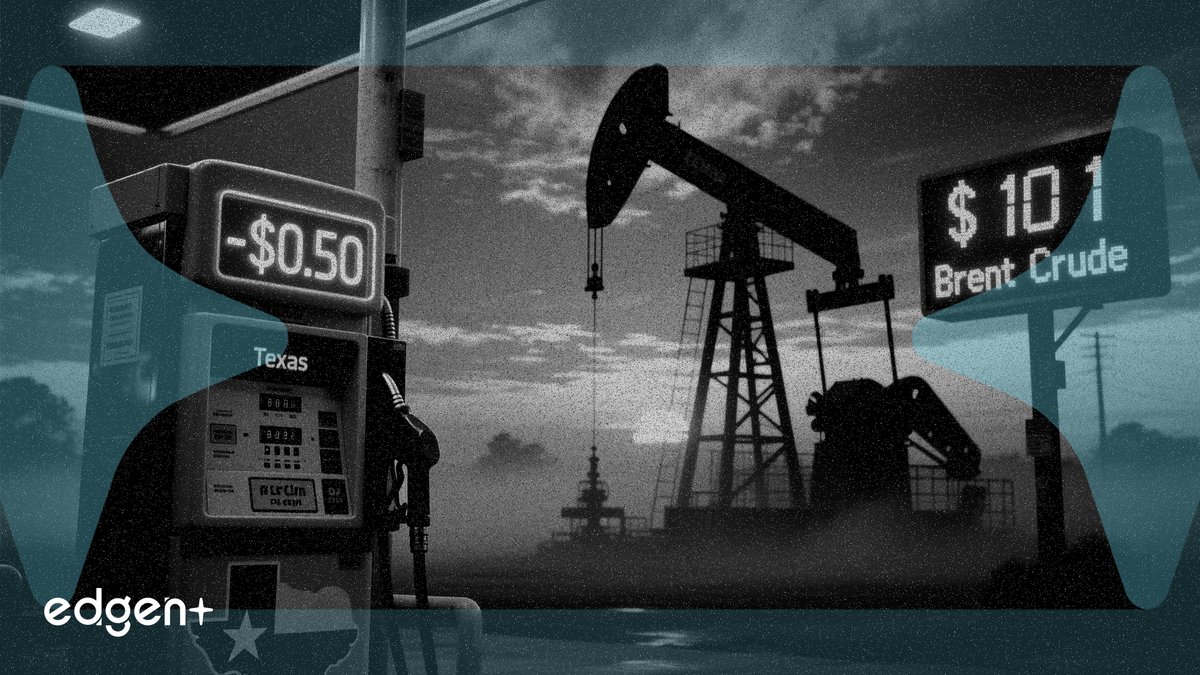
Natural gas prices in the Permian Basin fell below zero on Wednesday, a stunning development that highlights a severe regional glut of the fuel, even as the ongoing Iran war keeps global oil and gas benchmarks at elevated levels.
"Beyond the immediate disruption, the crisis is expected to have implications for the medium-term outlook," the International Energy Agency said in its quarterly report on Friday, noting that damage to LNG infrastructure in Qatar will prolong tight markets through 2026.
While producers in West Texas were forced to pay to offload their gas, Brent crude remained above $101 a barrel and West Texas Intermediate traded near $93, according to AAA Texas. The divergence comes as the war in the Middle East disrupts global supply, with the IEA forecasting a cumulative loss of 120 billion cubic meters of LNG supply through 2030 due to infrastructure damage.
The negative prices in Texas signal a critical lack of pipeline takeaway capacity, creating significant financial distress for local producers. This regional bottleneck contrasts sharply with a global market where supply fears remain paramount, suggesting that while Texas producers face immediate pain, the broader energy price risk remains skewed to the upside for the next two years.
A Tale of Two Markets
The sub-zero prices in the Permian Basin are a direct result of a production glut overwhelming the region's pipeline capacity. This forces producers to pay to have the excess gas, which is often a byproduct of oil drilling, taken off their hands.
This local crisis stands in stark contrast to the global energy picture. The war between Iran and its neighbors, now in its second month, has effectively closed the Strait of Hormuz, a chokepoint for one-fifth of the world's oil and LNG supplies. The conflict has also led to significant damage at Qatar's Ras Laffan LNG export terminal, which could take up to five years to repair, according to Qatar's energy minister. The IEA's head, Fatih Birol, has called the disruption "the biggest crisis in history."
Consumer Impact
For Texas drivers, the local gas glut has provided some relief at the pump, even if it's disconnected from the negative prices seen in the wholesale natural gas market. The statewide average for regular unleaded gasoline fell to $3.59 per gallon this week, down 14 cents from the prior week, according to the U.S. Energy Information Administration.
However, this is still 85 cents higher than a year ago. The current Texas average is about 11.3% lower than the national average of $4.04 per gallon. Petroleum analyst Patrick De Haan said that while markets are pricing in higher risk, another 20 to 30 cent per gallon increase is still likely in the weeks ahead as the summer driving season approaches.
This article is for informational purposes only and does not constitute investment advice.