
Three companies worth a combined $5 trillion are about to go public, and the money has to come from somewhere.
Three companies worth a combined $5 trillion are about to go public, and the money has to come from somewhere.
Three companies worth a combined $5 trillion are about to go public, and the money has to come from somewhere.
A trio of mega-IPOs from SpaceX, OpenAI and Anthropic threatens to drain as much as $5 trillion from existing stock holdings, forcing the biggest reshuffling of investor capital since the dot-com era.
"The money has to come from somewhere, the appetite is immense," said Paul Kedrosky, a veteran investor and market commentator who has written extensively on the coming wave. "This will only get more dramatic in the coming weeks and months. Money will increasingly flood out of a host of financial nooks and crannies, and into anything with any connection to what's coming."
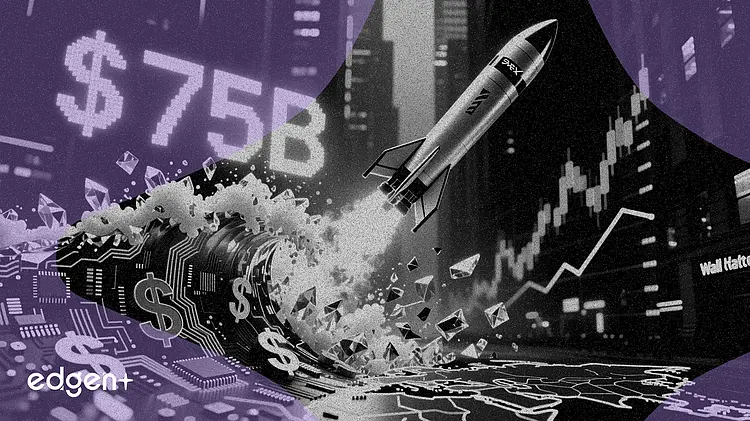
SpaceX plans to raise as much as $75 billion in its June 12 IPO at a valuation of up to $2 trillion, making it the largest offering in history. Anthropic's secondary market valuation has already topped $1 trillion, up 40% in less than a month. Combined, the three companies could be worth close to $5 trillion, Kedrosky estimated — approaching the inflation-adjusted value of all US IPOs since World War II, including the dot-com boom.
The scale of these offerings comes at a time when investors have little cash left on the sidelines. Bank of America data shows fund managers' cash holdings have fallen below 4% for the first time since February 2024, with stocks at record highs. That means every dollar that flows into the new listings must come from somewhere else — likely from the very large-cap tech stocks that dominate portfolios today.
Nasdaq's Fast-Track Rule Forces Passive Ownership
Nasdaq changed its index rules effective May 1 to allow newly listed companies that rank among the top 40 components of the Nasdaq-100 by market capitalization to be included after just 15 trading days, exempt from previous seasoning and liquidity requirements. The timing fits SpaceX's IPO schedule perfectly: the stock would join the index on July 7, triggering automatic buying by every fund that tracks the Nasdaq-100.
The mechanics are staggering. With Nasdaq-100 tracking products holding roughly $600 billion in assets, index inclusion alone generates mechanical demand of around $6 billion — triggered not by an investment decision but by a rule change. "Passive funds will be forced buyers once these names join the indexes, which will happen much faster than usual, given recent index rule changes," Kedrosky wrote. "That means mechanical selling pressure on whatever many funds currently own, which is mostly the same large-cap tech stocks everyone else owns."
The forced-buying mechanism extends beyond ETFs. US pension funds including CalPERS, the New York State Common Retirement Fund, and the five New York City pension funds — which together manage more than $1 trillion — will become SpaceX shareholders by default through their index holdings. In a joint letter, they called SpaceX's planned corporate structure the "most management-friendly governance structure ever introduced to the US markets to this extent," citing perpetual super-voting shares and a CEO removal clause requiring the CEO's consent.
A Liquidity Squeeze in the Making
The concentration risk is unprecedented. Bob Doll, CEO of Crossmark Global Investments and former equities chief at BlackRock, told Business Insider that investors' appetite for tech means they could sell stocks in other sectors to make room. "These tech owners, they just want to own more, so maybe they do sell their Procter & Gamble."
The rush is already visible in secondary markets. The Destiny Tech 100 fund, which counts Anthropic, SpaceX and OpenAI as its top holdings, has surged 90% in a month. SpaceX's own financials show why the capital is needed: the company slipped from a $791 million profit in 2025 into a $4.9 billion loss last year, with another $4.3 billion added in the first quarter of 2026, driven by Starship development costs and the integration of xAI and X.
The trio of IPOs will result in a US stock market where AI-linked stocks account for roughly 50% of total value, according to Kedrosky's analysis. OpenAI and Anthropic are also preparing for IPOs that would meet the same fast-entry criteria, meaning the forced-buying mechanism could repeat multiple times. SEC Chairman Paul Atkins has argued that fewer rules encourage companies to go public, though the American Federation of Teachers has urged the SEC to closely examine the SpaceX offering, calling it "not an ordinary offering" whose size, governance and listing mechanism raise "numerous red flags for investor protection."
This article is for informational purposes only and does not constitute investment advice.
