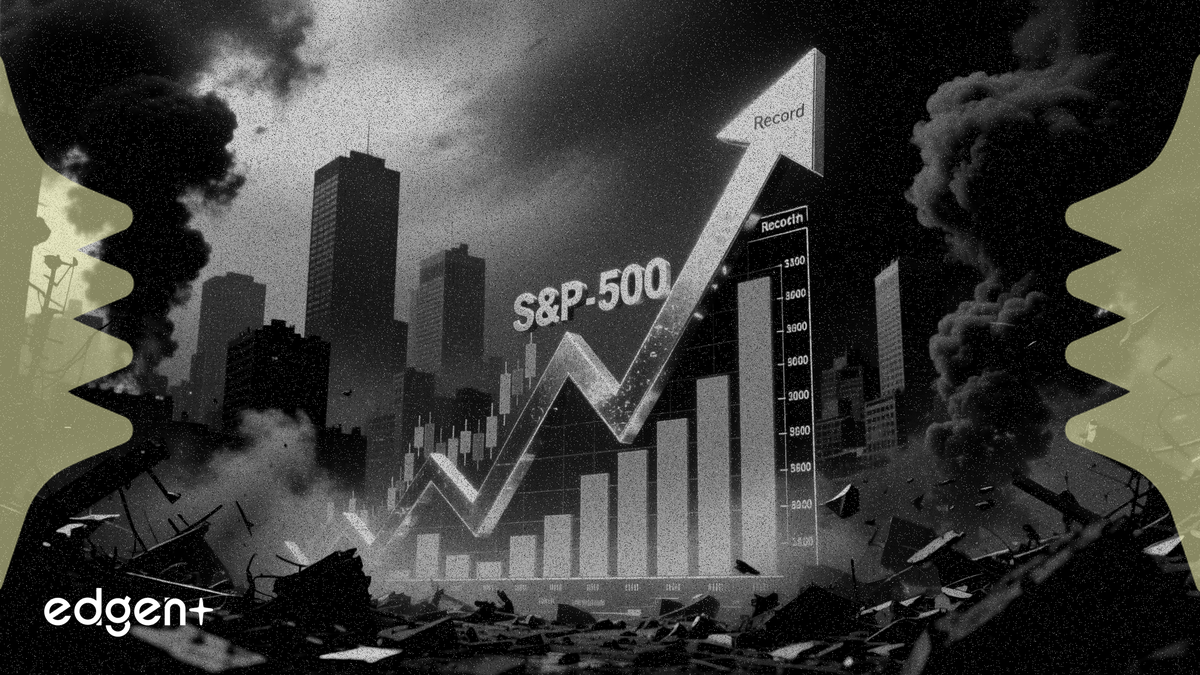
The S&P 500 topped the 7000-point mark for only the second time ever, closing at an all-time high of 7022 points on Wednesday after a rapid 15-day recovery.
"If the portfolio was built with a time horizon, diversification, and realistic liquidity needs in mind, then a chaotic day is not automatically a signal to abandon it," said Charu Chanana, chief investment strategist at Saxo Bank. "More often, it is a reminder to stick to the process."
The benchmark’s recovery was largely powered by mega-cap tech stocks. Since the post-war low on March 30, about 40% of the S&P 500's 660-point gain came from Nvidia, Alphabet, Apple, Amazon, and Microsoft. This has left an equal-weight index of the S&P 500 trailing the official benchmark by about four percentage points over the same period.
The outperformance of tech giants raises questions about market concentration, as the "Magnificent Seven" now comprise around 35% of the S&P 500’s market value. The information technology, communications services, and consumer discretionary sectors are expected to contribute nearly half of the benchmark's first-quarter profits.
Investors witnessed a pretty frightening pullback in the S&P 500 over the 21 days that followed the U.S. war with Iran and the surge in global oil prices. As quickly as the market declined, its recovery was even faster. The S&P 500 bottomed out on March 30 and took just 15 trading days to reclaim its pre-war levels.
This V-shaped rebound highlights the cost of sitting out pullbacks. Data from JPMorgan shows that over the past 20 years, about 70% of the stock market’s best 10-day stretches occur within two weeks of the worst 10-day performances. Missing just five of those days would have cut an investor's returns by 40%, according to BlackRock.
“When Mega Tech runs, it drives the market-weight S&P far beyond the even-weight S&P,” said Louis Navellier of Navellier Calculated Investing. “Mega Tech is not concerned about oil prices.”
However, risks remain. Private credit losses, software sector disruption from AI, and a potential tech bubble are sources of concern. The ongoing war and potential for oil prices to trend toward $100 a barrel, along with upcoming midterm elections, will test investor patience.
Despite these risks, some analysts believe many concerns are already priced into the market. “Markets aren’t typically so gracious as to offer multiple opportunities, which is why we have encouraged investors to be early,” said Morgan Stanley’s Mike Wilson. “The bottom line is that markets are doing what they typically do—discounting the future ahead of the headlines.”
This article is for informational purposes only and does not constitute investment advice.