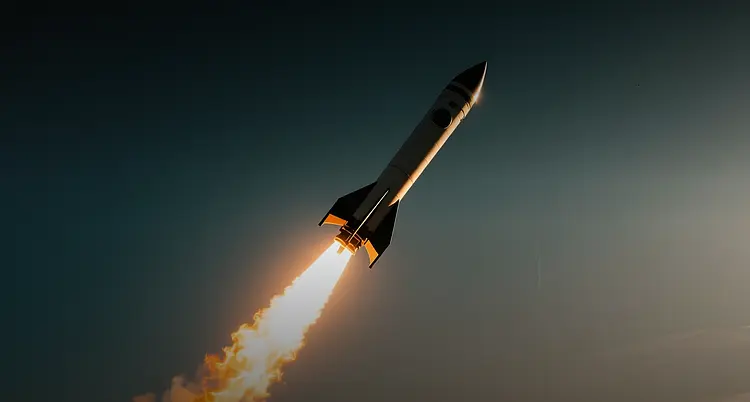
A US Space Force exercise designed to test the military's ability to respond to orbital threats unfolded with little public notice last week, as Rocket Lab launched a satellite from New Zealand within 17 hours of receiving orders — the fastest responsive space mission on record.
Rocket Lab Corp. (Nasdaq: RKLB) lifted off its Electron rocket from Launch Complex 1 in Mahia, New Zealand at 10:20 UTC on June 19, just 16 hours and 42 minutes after the US Space Force's Space Safari program office issued the call-up order. The mission, designated VICTUS HAZE, deployed Rocket Lab's own Pioneer spacecraft into a polar orbit ranging between 215 miles and 286 miles at a 97.5-degree inclination, according to the US military's space object catalog.
"This is what modern space power looks like: the ability to reinforce and reimagine national security space architecture at will," said Sir Peter Beck, founder and chief executive officer of Rocket Lab, in a statement. The company vertically engineered, built, and tested the Pioneer spacecraft in-house, incorporating its own propulsion, solar arrays, reaction wheels, and flight software — eliminating third-party delays that typically stretch defense acquisition timelines to years.
The mission shattered the previous TacRS record set by VICTUS NOX in 2023, when Firefly Aerospace launched a Millennium Space Systems satellite within 27 hours of call-up. Rocket Lab's spacecraft completed on-orbit commissioning within 72 hours and immediately began rendezvous and proximity operations alongside True Anomaly's Jackal satellite, which launched May 3 on a SpaceX Falcon 9 rideshare. Public orbit data tracked by astrophysicist Jonathan McDowell showed the Pioneer spacecraft — designated Victus Haze Puma — approached within 60 miles of the Jackal satellite just eight hours after launch.
VICTUS HAZE marks the first time a single prime contractor delivered an all-in-one TacRS mission — spacecraft design, launch, and on-orbit operations — as a complete package. The demonstration simulates a threat-response scenario in which a US spacecraft pursues, photographs, and monitors a non-compliant satellite in real time, giving the military space domain awareness capabilities that Col. Bryon McClain, acting portfolio acquisition executive for space combat power, described as a stress test of the entire commercial pipeline. "Adapting to those anomalies is just as good as everything going perfectly," McClain said.
The mission's path to orbit was not without disruption. True Anomaly originally planned to launch on Firefly's Alpha rocket, but two mishaps in 2025 grounded the vehicle for nearly a year. The company pivoted to SpaceX's Falcon 9 rideshare, while Firefly will support a future Victus mission with its Alpha Block II rocket. The total cost of VICTUS HAZE, borne by a mix of government funding and private capital, totaled about $92 million.
What Comes Next
Space Safari has three additional named Victus missions on its docket. Victus Surgo and Victus Salo involve two highly maneuverable spacecraft built by Impulse Space that will launch on a commercial rideshare and remain pre-positioned on orbit for space domain awareness missions, currently scheduled for the first half of 2027. Victus Sol will be the service's first operational TacRS mission, to be called up at a future date to support a combatant command's tasking request.
For Rocket Lab, the mission validates its strategy of vertical integration as a competitive advantage in the responsive space market — a priority for the US Space Force as it seeks to compress what is typically a multi-year defense acquisition cycle into days. The company's ability to launch from two pads in New Zealand and its in-house spacecraft manufacturing give it a structural edge over rivals that rely on third-party suppliers, according to the company. Rocket Lab previously demonstrated rapid launch capability in 2024 by launching two Electron missions from two hemispheres within 24 hours.
As the TacRS program matures, public visibility into these missions will diminish. "We're learning publicly, just to emphasize the capability that's out there," McClain said. "But like all of our continuous operational systems, once we start getting into an operational case, it'll probably get a lot more quiet."
This article is for informational purposes only and does not constitute investment advice.