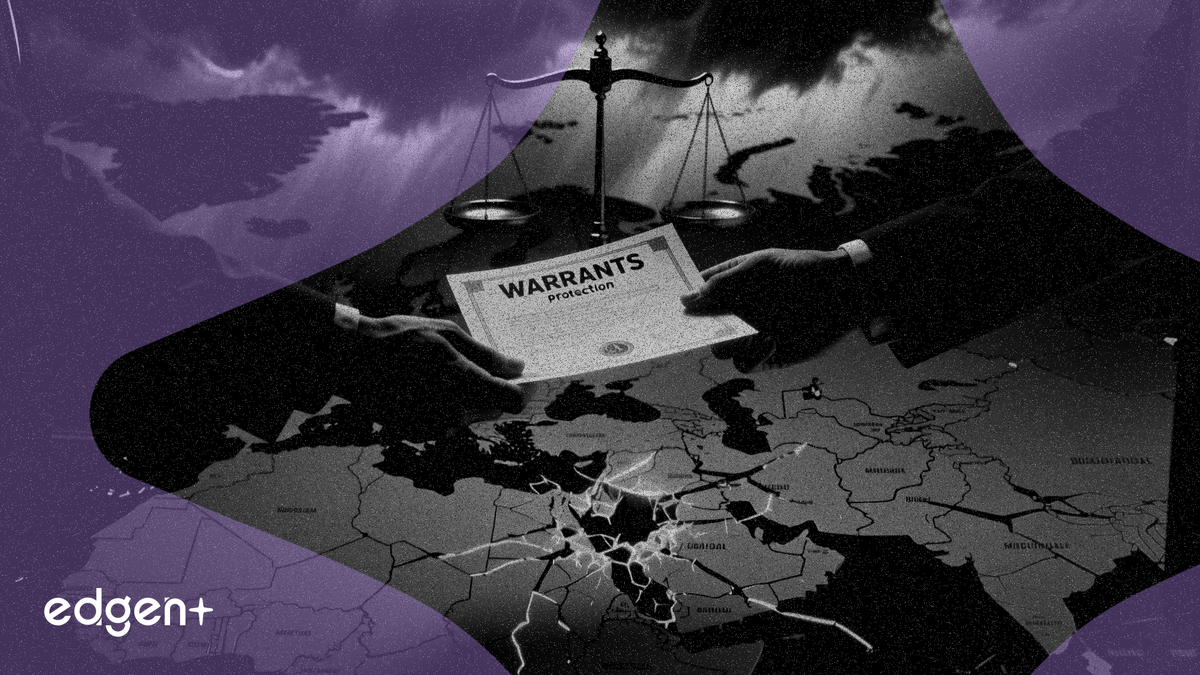
Fresh allegations suggest Qatar’s government may have influenced the International Criminal Court's 2024 move to issue arrest warrants for Israeli leaders, a development that introduces significant geopolitical risk into global markets.
A witness statement submitted to the US Federal Bureau of Investigation alleges the Qatari government promised to “look after” International Criminal Court prosecutor Karim Khan in exchange for issuing arrest warrants against Israeli Prime Minister Benjamin Netanyahu, threatening to inflame Middle East tensions and inject fresh volatility into energy markets.
“He was like, ‘I want to issue the warrant, but I’m terrified to do it.’ And they said, ‘if you do it, then we’ll look after you,’” an intelligence operation’s manager is heard saying in an Aug. 5 recording, according to the witness statement reviewed by the Wall Street Journal. A lawyer for Mr. Khan denied the allegations, stating his client “was not offered or given (and would not have sought or accepted) any ‘promise’ by any state.”
The new evidence, which includes audio recordings, builds on reports of a private intelligence operation allegedly linked to Qatar that targeted Mr. Khan's accusers and internal ICC critics. The news sent Brent crude futures ticking up 0.5% in early trading on fears of renewed instability in the energy-rich region, while gold, a traditional safe-haven asset, climbed 0.3%.
The claims place the world’s top war crimes court at the center of a geopolitical firestorm, potentially undermining its legitimacy and creating unpredictable diplomatic fallout. For investors, the key risk is that a destabilized Middle East could threaten major energy chokepoints, recalling the 15% spike in oil prices seen during similar escalations in 2019. The ICC’s governing body, which is already pursuing disciplinary proceedings against Khan for separate misconduct allegations, must now decide its next steps by its June meeting.
The Qatar Connection
The allegations stem from a witness familiar with a private intelligence operation conducted by firms including Highgate and Elicius Intelligence. According to the statement, the operation sought to discredit a subordinate ICC lawyer who had accused Khan of sexual assault. The Qatari embassy in Washington reiterated a previous statement calling the allegations “unfounded.”
Recordings reportedly capture investigators discussing their “client country,” referred to as “Q country,” with two sources telling the Journal that Qatar was the ultimate client. The operation also allegedly targeted Tom Lynch, the senior ICC official who first reported the assault allegation, and US Senator Lindsey Graham.
This development compounds the pressure on Khan, who took a voluntary leave of absence in May 2025 after the assault allegations became public. A United Nations inquiry found a “factual basis” for the claims, though a subsequent ICC-commissioned panel determined the evidence did not meet the “beyond reasonable doubt” standard required for criminal cases. Still, the court’s governors voted this month to advance disciplinary proceedings.
A Court Under Scrutiny
The controversy adds to a series of challenges for the ICC, which has faced criticism for its focus on certain countries while allegedly ignoring abuses by others. Human rights group Amnesty International warned in a recent report of a "predatory' world order" where powerful leaders fuel crises and undermine the global protection systems built over the last 80 years.
The 2024 decision to seek warrants for both Hamas leaders and the democratically elected leaders of Israel was seen by many as a false equivalence that ignored the nature of Hamas's initial aggression. The move shocked many of Khan's own staff and junked his own investigatory timeline, according to the Journal.
For the families of victims in other cases, such as the Philippine drug war, the court remains a crucial, if slow-moving, avenue for justice. The ICC's Appeals Chamber recently affirmed its jurisdiction over a case involving former Philippine President Rodrigo Duterte, a ruling hailed by victims' lawyers as a "triumph of their right... to truth and justice." However, the allegations against its chief prosecutor risk tarnishing the court's reputation and its ability to function as an impartial arbiter of international law.
This article is for informational purposes only and does not constitute investment advice.