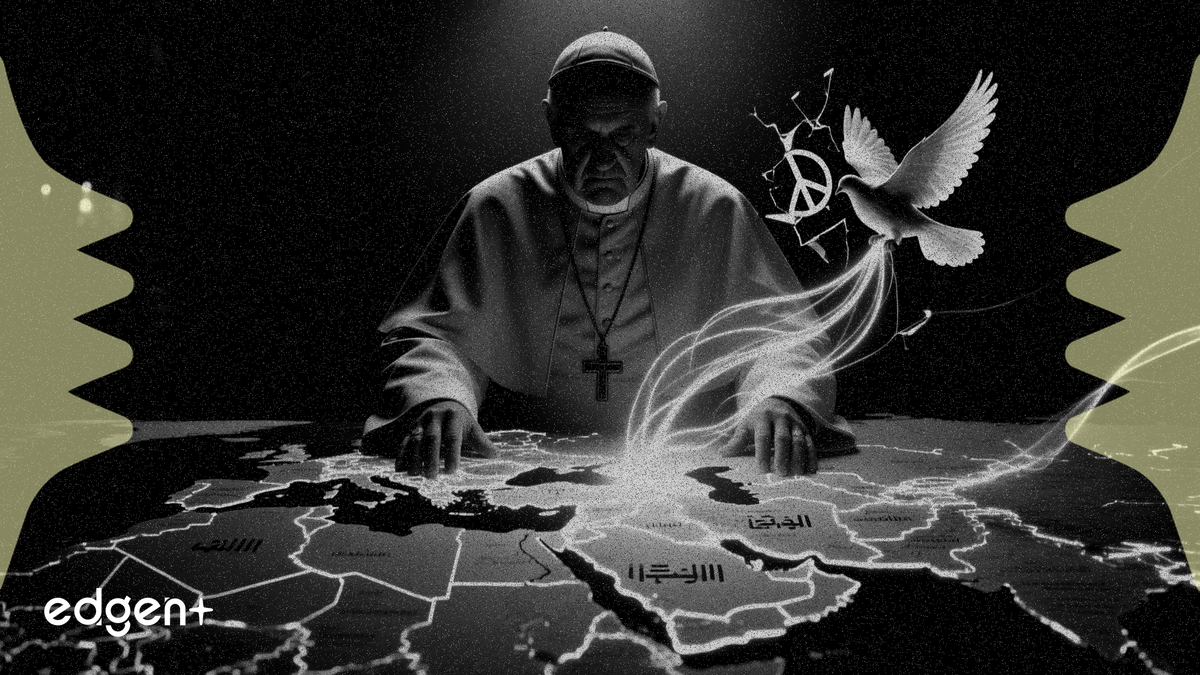
Pope Leo XIV delivered a pointed message on the war in Iran during his Easter Sunday address, urging leaders to “choose peace” through dialogue in a statement widely interpreted as a critique of US President Donald Trump. The remarks, made before thousands in St. Peter's Square, have intensified an ongoing debate within the Catholic Church over its traditional just-war doctrine versus a perceived shift toward functional pacifism.
"Let those who have the power to unleash wars choose peace!” the pontiff said. While no specific leaders were named, the address was broadly seen as directed at the White House. The conflict has so far involved a limited number of US casualties, with more than a dozen American lives lost, but has prompted significant soul-searching among military personnel regarding the ethical dimensions of the war.
The Pope's message highlights a broader trend in recent papal commentary. Pope Francis previously declared, “There is no such thing as a just war” in remarks concerning Ukraine, and Pope St. John Paul II expressed opposition to the U.S. war in Iraq in 2003. These statements have created the public impression that pacifism is the only valid Christian response to conflict, a view that critics argue is a misapplication of long-standing principles.
The controversy centers on the Church's just-war tradition, which dates back to St. Augustine and provides a framework for determining the moral legitimacy of warfare. This tradition outlines specific criteria for when resorting to force is permissible, standing in contrast to a purely pacifist stance.
A Duty to Protect
Critics of the perceived pacifist trend argue that it represents an abdication of the moral duty to protect innocent people from aggression. "Christianity isn’t a pacifist religion," said the Rev. Gerald Murray, a Catholic priest and commentator on EWTN. "Churchmen need to affirm that the legitimate use of force is virtuous. Protecting the innocent isn’t simply the ideal we hope to attain, it is a clear duty."
This perspective holds that while turning one's own cheek is a personal choice, one does not have the right to "turn my neighbor's cheek." Proponents of this view suggest that military action is often a necessary precursor to negotiation, required to bring aggressors to the table. They argue that a blanket condemnation of all military force serves only the interests of the wicked.
The Just-War Framework
The just-war theory is not a simple yes-or-no checklist but a set of rigorous criteria for leaders to consider before engaging in conflict. It requires weighing the necessity of action and the moral implications of military decisions. Those with the most information on the ground—in this case, President Trump and Iranian leadership—bear the primary responsibility for these judgments.
While war is always a failure of diplomacy and carries immense human costs, proponents of the just-war tradition maintain that it provides a necessary moral compass. By appearing to dismiss the possibility of a just war, church leaders risk undermining the moral clarity needed by both political leaders and the soldiers who must carry out their orders. The debate sparked by Pope Leo XIV's address is therefore not just about a single conflict, but about the fundamental principles guiding the response to aggression in the modern world.
This article is for informational purposes only and does not constitute investment advice.