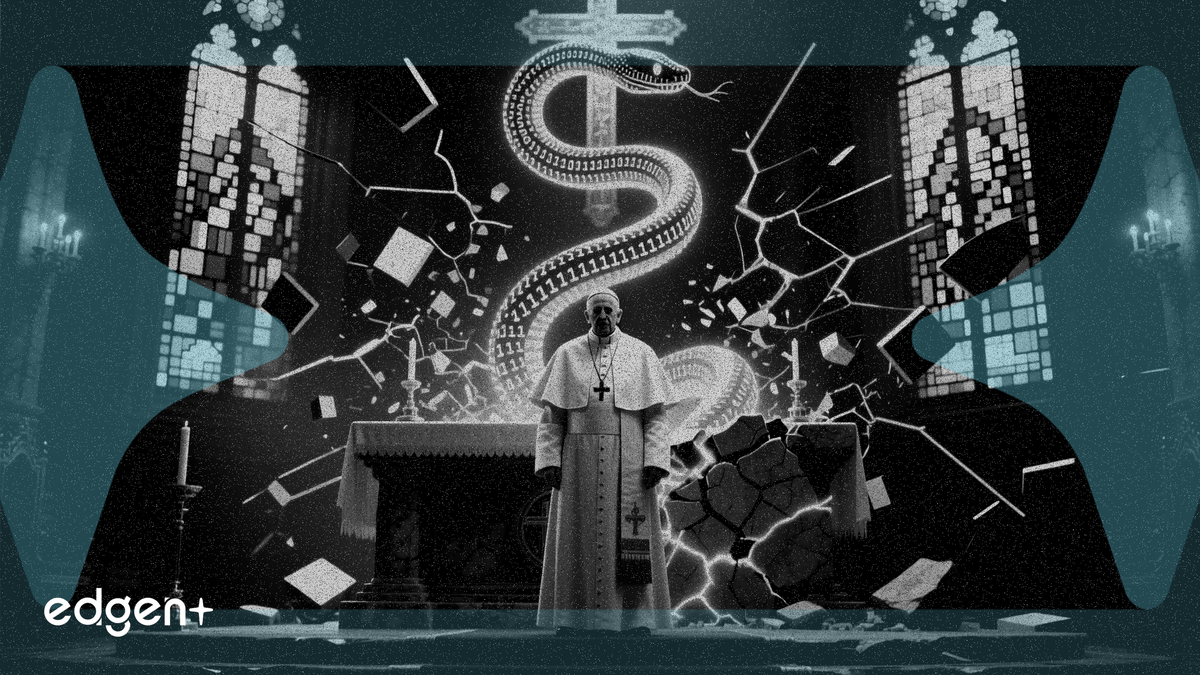
Pope Leo XIV's first encyclical casts artificial intelligence as a modern Tower of Babel, demanding regulation to prevent an "anti-human vision" from taking hold.

Pope Leo XIV warned that artificial intelligence "threatens to normalize an anti-human vision" in his first encyclical, a 40-page document that positions the Vatican as a moral counterweight to Silicon Valley's rapid AI development.
"It is not enough to invoke ethics in the abstract; robust legal frameworks, independent oversight, informed users and a political system that does not abdicate its responsibility are required," the pontiff wrote in "Magnifica Humanitas," signed May 15.
The encyclical draws on 2,000 years of Catholic social teaching and is explicitly inspired by Pope Leo XIII's 1891 "Rerum Novarum," which defended workers against industrial-era exploitation. Leo XIV compared humanity's choice to "constructing Babel or rebuilding Jerusalem" — the former representing top-down projects driven by pride and profit, the latter a collaborative rebuilding of fraternal coexistence. The risk, he said, is that humans will be reduced "to mere cogs in a system driven toward ever greater efficiency."
The document arrives as AI companies face growing public backlash over job displacement, energy consumption and autonomous weapons. In the US, President Trump last week delayed an executive order that would have created voluntary testing protocols for AI models, putting the White House at odds with the Vatican's call for binding regulation.
The Vatican's AI Doctrine
Leo XIV has made AI the signature issue of his pontificate since his election in May 2025, when he told cardinals that artificial intelligence represented the industrial revolution of the modern age. The encyclical condemns the concentration of "immense digital power" in the hands of a few private actors and calls for external oversight of AI systems developed by companies including OpenAI, Google DeepMind and Anthropic.
Christopher Olah, a co-founder and safety researcher at Anthropic, attended the encyclical's presentation — a decision that drew criticism for appearing to give the AI firm the Vatican's moral endorsement. Vatican officials said Olah's participation was intended to encourage dialogue with the industry. Olah acknowledged that AI companies face commercial pressures that conflict with safety priorities, saying it is "enormously important that there be people outside those incentives" who insist on ethical safeguards.
The encyclical also addresses AI's role in warfare, declaring that the Catholic Church's "just war" theory is now outdated because of technological advances. AI-driven weapons systems risk lowering the moral threshold for the use of force and make "war more 'feasible' and less subject to human control," Leo wrote.
Economic and Historical Reckoning
Leo XIV called the prospect of mass unemployment caused by digital innovations "a true social calamity" and condemned labor exploitation tied to the technology sector, including workers in rare-earth mines and underpaid data center employees. "Technology is never neutral, because it takes on the characteristics of those who devise, finance, regulate and use it," he wrote.
In a separate passage, the pontiff apologized for the Holy See's role in legitimizing the enslavement of non-Christians until the 19th century, calling it "a wound in Christian memory" and asking for pardon in the name of the Church.
The encyclical positions the Vatican alongside a growing coalition of regulators and civil society groups pushing back against unfettered AI development. For investors, the document signals that regulatory risk for AI companies is rising across multiple fronts — from Brussels to Washington to the Vatican. Alphabet, Microsoft and Anthropic face the prospect of tighter oversight on model safety, data privacy and autonomous systems, even as they compete to deploy increasingly powerful AI products.
This article is for informational purposes only and does not constitute investment advice.