OpenAI's new AI model, GPT-Rosalind, aims to shorten the 10-15 year timeline for drug development by integrating with over 50 scientific databases.
OpenAI's new AI model, GPT-Rosalind, aims to shorten the 10-15 year timeline for drug development by integrating with over 50 scientific databases.
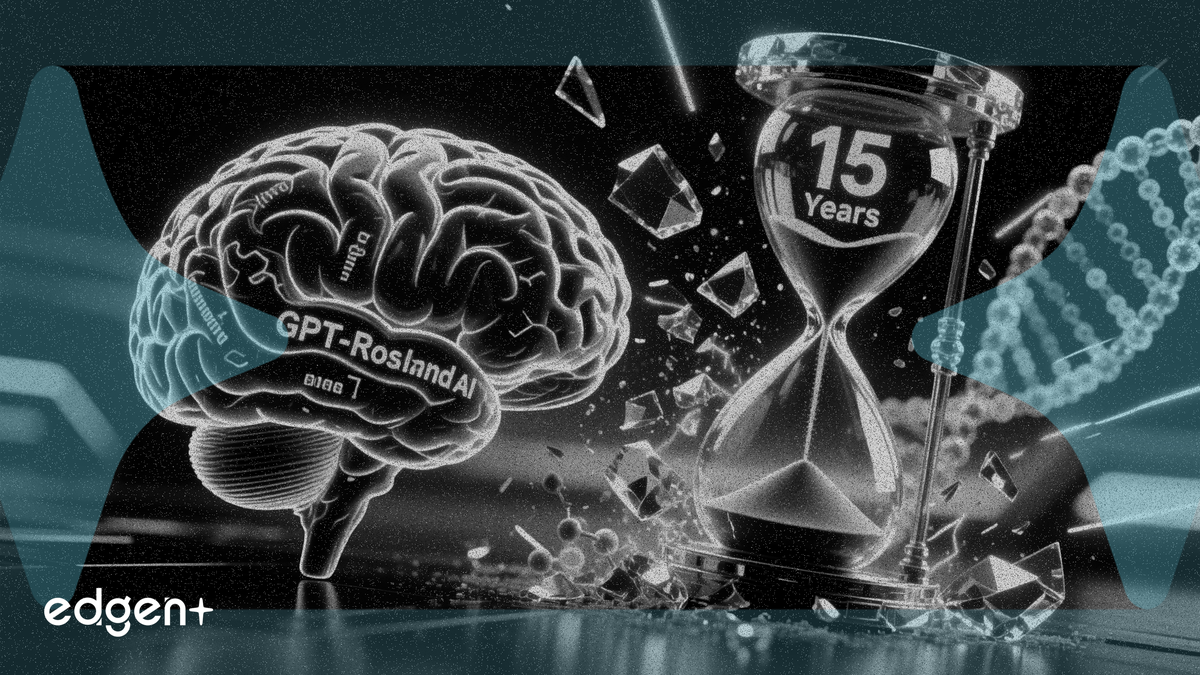
OpenAI is targeting the pharmaceutical industry’s 15-year research and development cycle with GPT-Rosalind, its first reasoning model purpose-built for life sciences, which is already being tested by partners including Amgen Inc. and Moderna Inc. The model, named after DNA pioneer Rosalind Franklin, is designed to accelerate early-stage drug discovery by synthesizing evidence, generating hypotheses, and planning experiments across chemistry, genomics, and protein engineering.
"Our unique collaboration with OpenAI enables us to apply its most advanced capabilities and tools in new and innovative ways, with the potential to accelerate how we deliver medicines to patients,” Sean Bruich, senior vice president of artificial intelligence and data at Amgen, said in a statement.
GPT-Rosalind integrates with over 50 scientific tools and databases through a new Life Sciences research plugin, allowing researchers to connect disparate data sources within a single environment. Early benchmarks show the model outperforming its predecessor, GPT-5.4, on several tasks in the LABBench2 suite and exceeding the 95th percentile of human experts on certain RNA prediction tasks, according to OpenAI. The model is available as a research preview to qualified customers through a trusted access program.
The launch represents a strategic move into high-value, regulated industries where even marginal improvements in R&D efficiency can translate into billions of dollars. The drug discovery process is notoriously slow and expensive, with high failure rates for candidates entering clinical trials. By accelerating the initial stages of hypothesis generation and experimental design, OpenAI aims to reduce costly errors and shorten the time from target discovery to a viable drug candidate.
OpenAI enters a sector that has attracted more than $17 billion in investment since 2019, though few AI-developed drugs have reached large-scale clinical trials, according to a January report from PitchBook. The move follows several high-profile partnerships between big tech and big pharma, including OpenAI’s own collaboration with Novo Nordisk and Eli Lilly & Co.’s work with both OpenAI and Nvidia Corp. to build an industry-leading supercomputer for drug discovery.
GPT-Rosalind is positioned as a specialized reasoning system, not a general-purpose language model, a trend sweeping the AI industry. Rather than simply processing language, it is optimized for multi-step scientific workflows that involve complex data analysis and tool use. This specialization aims to reduce the risk of model "hallucinations" and provide more reliable outputs for expert users in a lab setting.
While performance on benchmarks like BixBench and LABBench2 is promising, the true test for GPT-Rosalind will be its adoption and impact within real-world laboratory workflows. OpenAI and its partners emphasize that the model is a decision-support tool that requires human-in-the-loop validation, not a replacement for scientific expertise. The model's success will depend on the rigorous verification of its outputs and its seamless integration with existing Laboratory Information Management Systems (LIMS) and analysis software.
The initial enterprise pilot includes partners like Amgen (AMGN), Moderna (MRNA), and Thermo Fisher Scientific (TMO), giving OpenAI a critical pathway for real-world validation. Successful pilots could pressure other biotech and pharmaceutical companies to adopt similar AI strategies to remain competitive, potentially revaluing companies based on their AI-driven research capabilities. The development solidifies the role of large technology firms as essential infrastructure providers for the future of medicine.
This article is for informational purposes only and does not constitute investment advice.