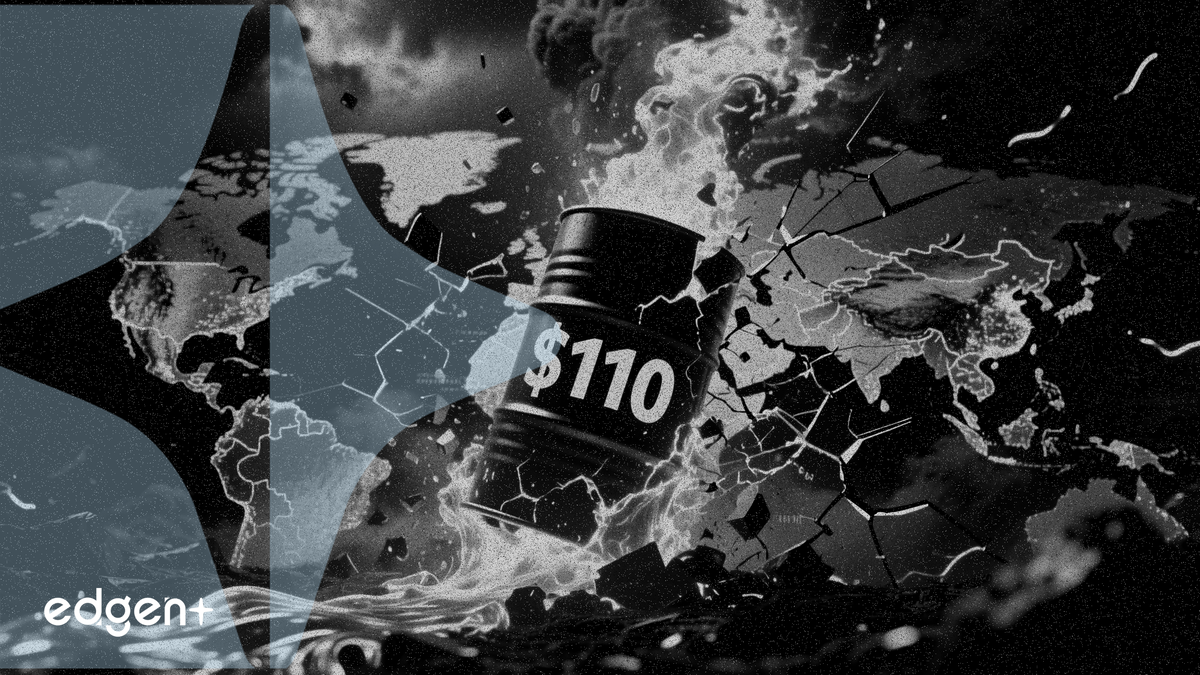
A deepening conflict in the Middle East sent oil prices to a four-year high, forcing traders and central banks to re-evaluate the global outlook as the disruption chokes off a critical artery for the world economy.
“The market is no longer just pricing barrels; it is pricing access, reliability and geopolitical risk,” said Lars Hansen, Head of Research at The Gold & Silver Club. “This is why the Iran war is no longer just an energy story. It is becoming an everything story. The longer Hormuz remains impaired, the more the shock migrates from oil screens into supermarket shelves, factory costs and central-bank decisions.”
Brent crude for July delivery surged 5.8% to settle at $110.44 per barrel, having peaked at $111.84 during trading. The move followed Iran’s closure of the Strait of Hormuz, a waterway that historically carries about 20% of global petroleum flows, in response to a U.S. blockade. The spike rattled broader markets, with the Dow Jones Industrial Average falling 0.6% while traders fled to safety, pushing the 10-year Treasury yield to 4.41%.
The oil shock now threatens to upend the global economic landscape, delaying a widely anticipated cycle of central bank rate cuts. The U.S. Federal Reserve already paused its easing plans this week, citing inflation risks. In the bond market, the two-year Treasury yield, which is sensitive to Fed policy, jumped nine basis points to 3.93% as traders priced out rate cuts for 2026. The International Energy Agency has called the situation the “worst energy shock the world has ever seen.”
A Widening Economic Shockwave
The price surge is not contained to crude. The real problem may be in refined products like diesel, gasoline, and jet fuel, where tight refinery capacity makes supply harder to replace. This feeds directly into higher freight costs, which in turn raises prices for food, construction materials, and consumer goods.
The impact is already visible in global inflation data. Germany and Spain saw consumer prices hit multiyear highs, with German inflation reaching 2.9% in April. The U.K.’s leading economic research body raised its 2026 inflation forecast to an average of 3%, with an expected peak of 4.1% in January 2027. The International Monetary Fund abandoned its single global growth forecast, instead presenting three scenarios based on the Hormuz disruption, with growth ranging from a baseline 3.1% down to 2% if the crisis is prolonged.
From Energy Scarcity to Policy Shock
The sustained energy spike is forcing a painful reassessment for policymakers who had been preparing for a world of easing inflation. The last time the world faced oil shocks of this magnitude, in 1973 and 1979-80, it forced structural economic shifts in manufacturing powerhouses like Japan and South Korea.
For now, the pressure is building on global supply chains beyond just energy. Data from GSC Commodity Intelligence shows surging prices for Sulphur and Sulfuric Acid, key inputs for copper, nickel, and battery-metal production, as fertilizer and industrial chemical flows from the Gulf are disrupted. This highlights how energy scarcity is quickly becoming a broader story of food scarcity, metals scarcity, and persistent inflation.
This article is for informational purposes only and does not constitute investment advice.