
Geopolitical tensions have sent oil prices to their highest levels since March 9 as traders price in the risk of a prolonged disruption to one of the world’s most critical energy chokepoints.
Geopolitical tensions have sent oil prices to their highest levels since March 9 as traders price in the risk of a prolonged disruption to one of the world’s most critical energy chokepoints.
Geopolitical tensions have sent oil prices to their highest levels since March 9 as traders price in the risk of a prolonged disruption to one of the world’s most critical energy chokepoints.
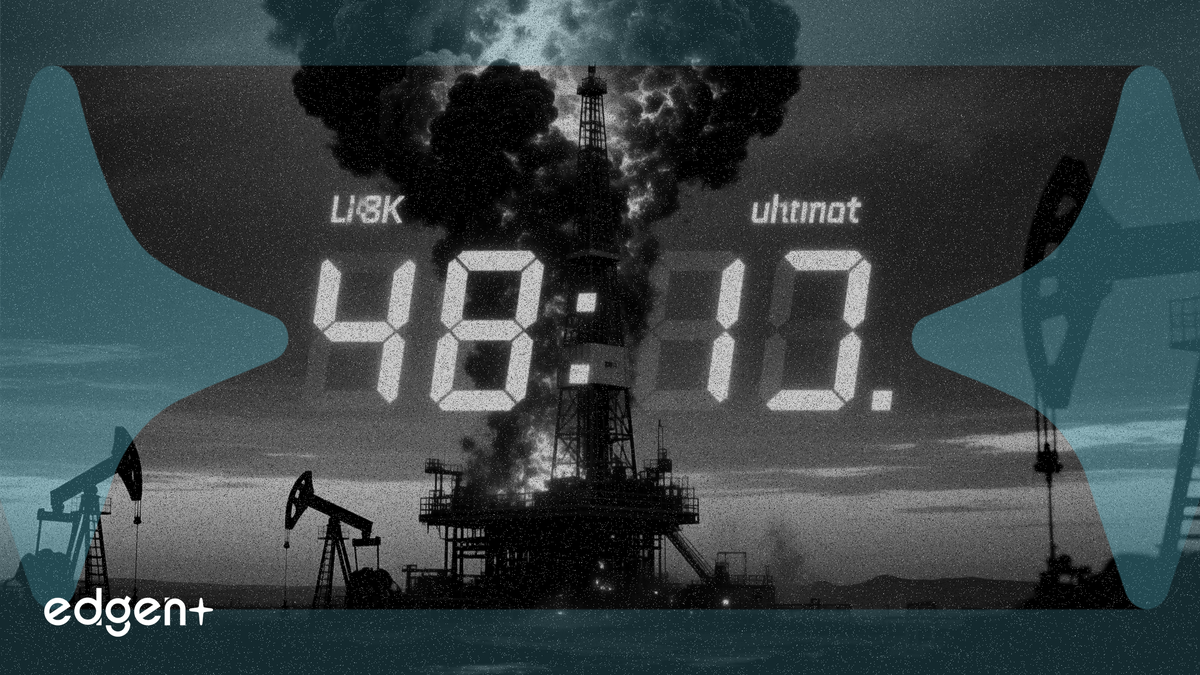
Brent crude futures jumped over 8 percent to nearly $110 a barrel after President Donald Trump issued a 48-hour ultimatum to Iran to reopen the Strait of Hormuz or face attacks on its energy infrastructure. The surge, which briefly sent prices toward $120 earlier in the conflict, reflects growing market anxiety over a war that has effectively choked off a waterway responsible for a fifth of global oil supply. U.S. West Texas Intermediate crude futures saw an even sharper rise, climbing $12.48, or 12.5%, to $112.60 per barrel.
"If tensions intensify or maritime risks increase, oil could test fresh highs as markets price in potential supply disruptions," Priyanka Sachdeva, senior market analyst at Phillip Nova, said in a note.
The market reaction was swift after Trump’s national address on April 1 failed to outline a clear de-escalation path. Instead, he reinforced his commitment to military pressure, stating, “We’re going to hit them extremely hard over the next two to three weeks.” The comments dashed hopes for a rapid resolution to the conflict that began with U.S.-Israeli strikes on February 28. The CBOE Volatility Index, or VIX, remains elevated, reflecting the broad-based uncertainty.
The escalation threatens to worsen global inflation just as the International Energy Agency warns that supply disruptions will start to materially affect Europe’s economy in April. In the U.S., average gasoline prices have already surged 36 percent from a month ago to $4.08 per gallon, according to the auto club AAA, squeezing consumers and increasing transportation costs across the economy.
In a series of posts on his Truth Social platform, Trump warned that “Time is running out – 48 hours before all Hell will reign down on them.” He specifically threatened to “obliterate” Iran’s power plants, a sharp escalation in rhetoric that has left energy traders on edge.
The Strait of Hormuz has been at a near-standstill for tanker traffic since the war began, forcing some traders to stop dealing with cargoes priced off the Dubai benchmark. In response, Britain is hosting a virtual meeting of around 40 countries to discuss options for reopening the critical passage, though the United States is not scheduled to attend.
“For markets, a prolonged conflict increases the risk of sustained pressures on inflation, global growth, interest rates, and equity valuations,” wrote Adam Turnquist, chief technical strategist for LPL Financial.
While energy stocks have rallied, the broader market has been volatile. The S&P 500 ended Thursday with a slim 0.1% gain, but only after shaking off an early decline driven by the surge in oil. The index still managed its first weekly gain since the war started, rising 3.4%. Travel-related stocks have suffered, with United Airlines falling 3% and cruise operator Carnival shedding 3.5% on the prospect of higher fuel costs and geopolitical instability.
The conflict has also created an unusual situation in oil markets. Brent crude, the international benchmark, typically trades at a premium to its U.S. counterpart. However, the immediate supply crunch in the Persian Gulf has inverted this relationship, with the more prompt U.S. crude futures for May delivery trading higher than the June Brent contract.
This article is for informational purposes only and does not constitute investment advice.